
Gutter Cleaning Westminster
We clear accessible gutters and check reachable rainwater outlets in Westminster. If you are arranging work on a building with a public frontage and a separate service entrance, tell us where the water appears and how to get to the area beneath it. The address of the premises and the position of the roofline are both needed when there are several gutters under one booking reference.
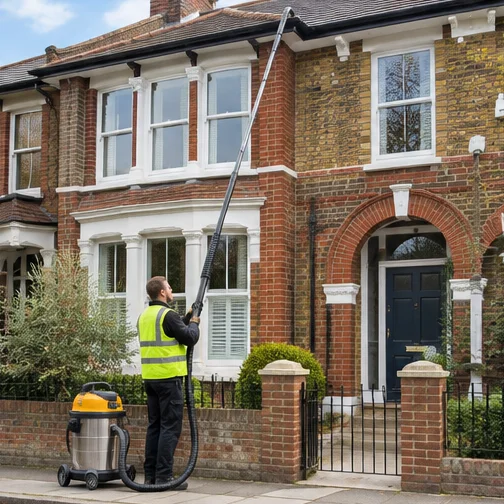
Illustrative photograph.
Use the building’s own roof or elevation reference
Westminster’s conservation area audit for the Abbey and Parliament Square describes large institutional buildings around Storey’s Gate as well as prominent public spaces. An enquiry from that part of Westminster should identify the actual building, entrance and roof involved. A location near a landmark is only a starting point. If a maintenance record identifies the affected run by an elevation or roof number, give us that reference. A wide image can show where the gutter meets an adjoining roof or changes direction above an entrance. That helps us discuss which length belongs in the visit.
Tell us whether water can be seen overflowing from above or whether the report concerns a wet surface lower down. The same roof can discharge to outlets at different ends, so the point where water appears may be a better reference than the part that is easiest to see. If you know the position of the first wet area, mention whether it starts at a seam, pipe opening or roof edge. Where an enquiry relates to a flat or smaller property, give the side of the building and nearest window or door. That will help identify the location again when the wall is dry.
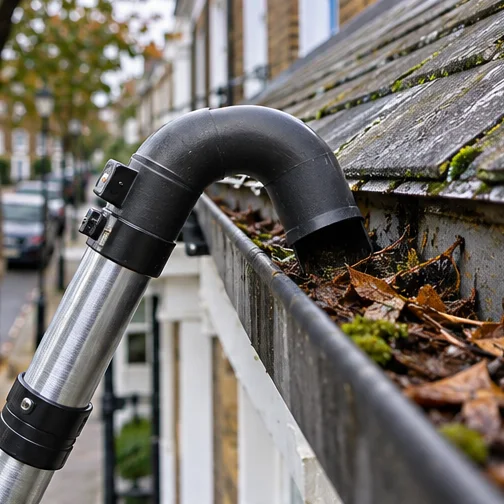
Record the boundary of the work for the next person
When the visit is complete, we describe the lengths cleared, the accessible outlets checked and any visible fault that remains. We use the roof or elevation reference if the site has one. If part of the run could not be reached, we tell you which section and what access may need to be arranged. This helps the person responsible distinguish the clearance from a future inspection or repair. If the site contact and person approving follow-up are different, give us the details of both so the findings can be passed on.
Tell us if the next visit will use a different entrance or working position. A roof that was approached from one area before may need another arrangement if access has changed. If water is now appearing at a different point, include the new location and which outlets were checked previously. A record of the work is most useful when it distinguishes the parts that were reached from those that remain outside the booking. If another contractor has worked on the gutter in the meantime, tell us which part was changed.
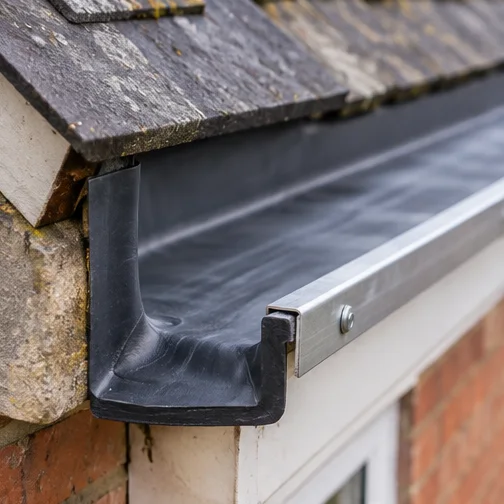
Provide the route that leads to a usable position
The entrance used by visitors may be a sensible place to meet a site contact but not the approach for equipment. Tell us where it should be brought in and whether access has to be arranged through the person responsible for the site. A service courtyard may have room to set up on one side but not under the particular run. Give us a description of the ground beneath it and anything that projects from the building. We consider both the height and the angle at which the roofline can be reached before agreeing a position.
If a door or pathway needs to remain available, identify it in advance. Tell us who can confirm the use of the working area and who can show us where the gutter sits. They may be different from the person who approved the visit. If you want several elevations covered, describe the route to each. The arrangements for an inner courtyard may differ from the arrangements for a frontage. We discuss the work that is possible from the available positions instead of assuming the whole building can be reached in one setup.
- Use the roof or elevation reference from the maintenance record.
- Distinguish the meeting point from the equipment entrance.
- Name the person who controls the working area.
- Identify which lengths and outlets need checking.
Confirm each site arrangement
| Position | What we need | Who can confirm it |
|---|---|---|
| Public frontage | Available working space below the run | Person responsible for access |
| Service courtyard | Equipment entrance and route to the gutter | Site contact or keyholder |
| Separate roof or elevation | Name or number used in maintenance records | Person who can agree the included length |
Work through the accessible channel and check the visible discharge
We confirm the agreed lengths and locate their accessible openings. On a suitable run, reach poles and a gutter vacuum let us remove reachable leaves, moss and compacted material. We follow the channel to the point where it empties and check for debris at the opening into the pipe. On a roof with more than one outlet, we say which one the included length serves where that can be established. If the channel turns behind a roof feature, we explain where the check could be made and which part lies beyond the available view.
A camera view can be discussed if a gutter is hidden or a site team wants to see a particular section. The position and roof shape determine the view. A concealed pipe inside the wall cannot be assessed from a picture of the channel alone. If the accessible opening is clear but there is still a sign of restriction, we describe where the check ended. See our gutter cleaning service for details of how the equipment is used. When an earlier visit included only one part, give us the reference for that run so we can identify what is different about the new request.
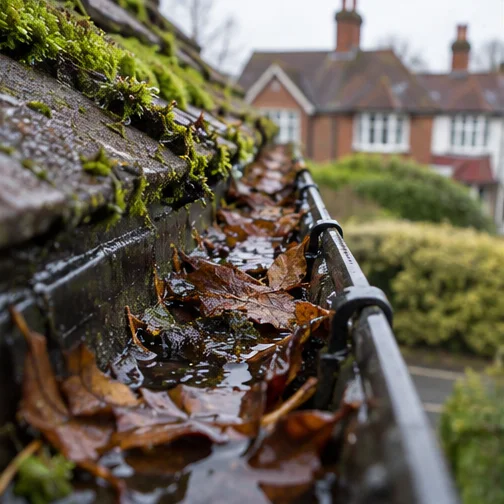
Separate work at the premises
Gutter cleaning
We clear reachable runs agreed using the building’s own roof or elevation references.
Ivy removal
We can discuss opening up the view of a pipe that is obscured by growth.
Guttering repairs
We identify the accessible joint or support that may need repair and record its position.
Water damage repair
For moisture that has reached the building interior, identify the room, surface and timing of the report.
Gutter replacement
We consider the adjoining fittings before discussing renewal of a failed length.
Gutter lining
We assess the support and outlet of a concealed channel before discussing lining.
Report the location in terms of the building
| First visible sign | Reachable check | Information to give us |
|---|---|---|
| Water drops beside a public entrance | Run and outlet above the entrance | Entrance name and nearest visible pipe |
| Water appears at an internal courtyard edge | Accessible gutter and its exit point | Courtyard reference and which side is wet |
| A seam continues to drip after rain | Visible joint and surrounding supports | Whether the run has already been cleared |
Take repairs or further assessment as a separate decision
A gutter can continue to leak if a visible joint has failed or a support has moved. We can discuss guttering repairs after assessing the accessible fitting. If a length is beyond repair, we consider how a replacement could meet the existing gutter and outlet. An older supported channel with a failing surface may be suitable for gutter lining. We discuss the observed condition before proposing what to do. If the relevant part is hidden, we explain what needs looking at separately.
If growth conceals a connection or obstructs the view of the pipe, tell us where it starts and how the area can be reached. We can discuss taking ivy back from the relevant fitting. For moisture that has reached an interior wall, ceiling or finish, describe the room and when the mark appeared. We discuss water damage repair separately from the work outside. An indoor report and a visible roof overflow can both be useful even where the route between them has not been established.
What helps when several people report the leak
Coverage and bookings
See the areas we cover. For nearby enquiries, see Victoria and Pimlico and South Bank.
Questions about gutter visits in Westminster
Can we use our own roof references in the booking?
Yes. Give us the reference and describe the visible symptom. A photo or relevant part of the plan can help relate it to the available access.
Does the public entrance need to be used for equipment?
Tell us if there is a separate approach. We discuss the route and where the equipment can stand before agreeing the work.
Can we book for one elevation at a larger site?
Yes. Identify that run and the visible outlet. Tell us how we can reach the working position for that part.
Can you inspect a hidden channel if the site team needs a record?
Ask about a camera view and specify the location you want to see. We discuss what can be shown from the available position.
Who needs to receive the results?
Give us the contact who can use the findings to organise access or follow-up work. We describe the affected fitting using the building reference where provided.
What if part of the gutter is outside the reachable area?
We tell you which part was reached and where the check ended. We can discuss what access or further inspection would be needed for the rest.