
Ivy Removal in London
We remove or trim ivy where it has reached gutters, downpipes and other parts of the building. Tell us how far the growth extends and what you want cleared. We look at where it is attached, what sits behind it and how we can reach the affected area before discussing the work.
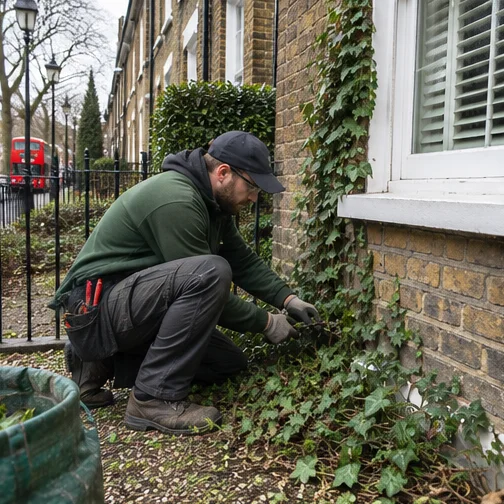
Photographic illustration of ivy removal in london.
Can you clear ivy away from a downpipe?
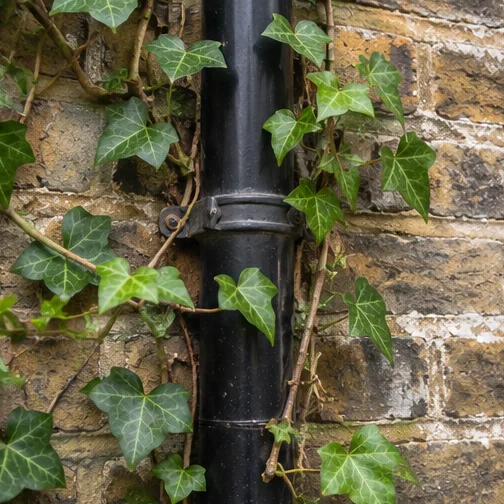
We assess where the stems cross or wrap around the pipe and whether the clips and joints are sound. Tell us if the pipe has moved or started leaking. We discuss which growth can be removed and what may need checking once the pipe is visible.
Can you cut the ivy back without clearing the whole wall?
Tell us which parts you want to retain. We can discuss trimming growth away from a gutter, window or other fitting and agree the area to work on. How far we can go depends on access and what the stems are attached to.
Look at what the growth covers
Leaves can hide the path of the stems and conceal fittings or loose material behind them. We check where the growth comes from, where it reaches and which parts of the building it contacts. A thin layer along a boundary wall calls for a different approach from old stems running behind a downpipe or into the roof edge.
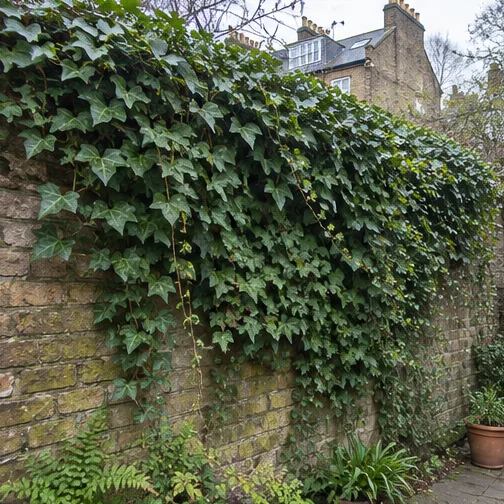
A photograph of a fully covered wall rarely shows the path of the older stems. Look for the base of the plant from a safe position and tell us whether the growth has crossed behind pipes or over a fence. The highest leaves may be clear of the gutter even when stems are already caught around a fitting lower down. That is why we ask for one view of the whole wall and another that shows the roofline or downpipe you want cleared.
Agree where we are cutting back
Tell us if your priority is access for gutter maintenance, clearing a window or removing a larger area of growth. We discuss the boundaries of the work and identify places where attachments or building condition need particular attention. If growth crosses into another property, tell us who can arrange the relevant access.
We discuss the area you want cleared before starting. Some customers want to open up the route to a downpipe so it can be inspected. Others want growth cut away from windows and the roofline while keeping part of the planting. If you want the whole area addressed, tell us whether the base is on your property or in a neighbouring garden. We also need to know if any trellis, gate, cable or garden structure is concealed by the growth.
Tools and working around fittings
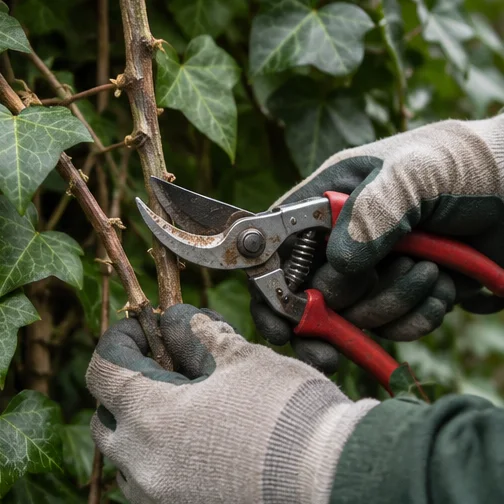
The tools depend on the thickness and position of the stems. We look for safe working space and avoid treating the building or a rainwater fitting as a support for pulling away growth. Around gutters and pipes, we check whether stems can be dealt with without putting additional load on clips and joints. We explain what is practical once we see how the ivy is attached.
On a wall with older pointing or painted render, we assess what the stems are attached to before discussing how far the growth can be taken back. Thick stems can pass behind clips and corners where the visible leaves give little indication of their position. We work around those areas with the condition of the fitting in mind. If clearing the growth could expose an already loose pipe or unstable surface, we explain which area needs further attention.
Where ivy has spread
| Location | What we check | Work to discuss |
|---|---|---|
| Downpipe | Stems around clips and joints | Clear growth around the pipe |
| Gutter edge | Access and stems near the outlet | Cut back growth affecting the channel |
| Masonry | Attachment and visible surface condition | Agree an approach for the wall |
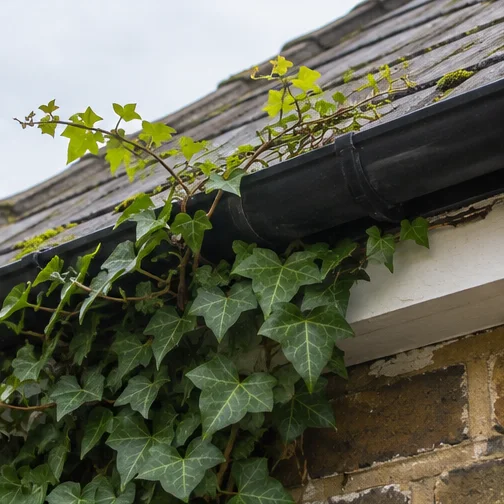
Ivy on walls, extensions and rooflines
At a front terrace, there may be railings, a bay or a paved entrance beneath the growth. At the rear, ivy can spread behind an extension and become difficult to reach from the garden. At a managed building, tell us if the affected wall is beside a shared entrance or parking area and who can arrange access.
The space below the ivy affects how we work. A paved side passage can be useful access, but a locked gate or narrow turn may prevent equipment reaching the wall. At the front of a house, a planted bed, railings or a bay can limit where we can stand. For a block or commercial site, tell us whether the affected area is above a public entrance or a shared route so access can be agreed with the right person.
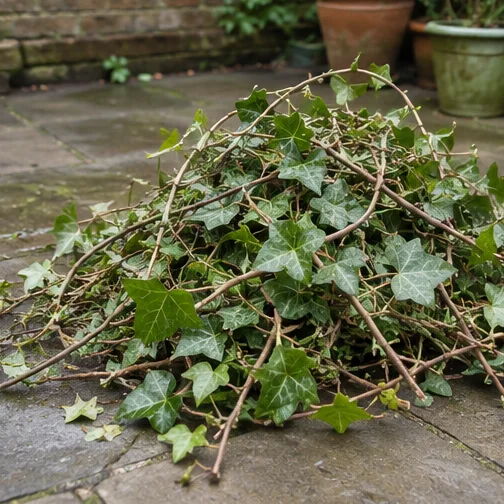
What happens once the growth is back
Removing growth can reveal debris in the channel or a pipe fitting that was hidden. We can discuss clearing the gutters if the run is obstructed. If a pipe has shifted or a gutter is leaking, ask us about repairing gutter and pipe fittings after the area can be inspected.
Once the growth has been cleared back, we can look at the fittings that were hidden. If stems were holding leaves against the outlet, we may need to discuss clearance of the gutter as a separate task. If clips are loose or a joint has opened, we identify the location rather than assuming the pipe needs to be replaced. Tell us if the original reason for booking was a leak so we can relate what we find to the place where you saw the water.
What to show in a photo
| View | Include | Why it helps |
|---|---|---|
| Whole wall | Where the ivy starts and ends | Shows the area affected |
| Gutter or pipe | Visible joints and neighbouring roof | Identifies fittings in the growth |
| Ground below | Passage, fences or extension | Helps plan working access |
Arranging a visit in London
When you ask for a quote, let us know roughly how high the growth reaches, how long the wall is and whether there is a clear route to both ends. If access depends on a neighbour or caretaker, give us that information before the appointment is arranged. Let us know what you want retained and which fittings need to be accessible after the visit. That gives us a clear starting point for discussing the job.
Tell us if ivy has been cut back before and where it grew again. If the growth starts along a boundary, the visible spread may extend across several surfaces even though only one section is affecting the gutter. Describe the sections you want accessible after the work and any nearby planting you want kept. If the main concern is a damp patch inside, tell us where it sits relative to the growth and the rainwater pipe.
Questions about ivy removal
Do you need access to the base of the ivy?
Tell us where the stems start and who can reach them. This affects the work we can agree.
What if the ivy is over a conservatory?
Send a photo from the garden and describe the height. We need to consider where equipment can stand.
Can you clear ivy beside a neighbour’s gutter?
We need to understand whose gutter and wall are affected and who can give access.
Will the wall need work afterwards?
The condition may be hidden by growth. We point out visible issues after we can see the surface.
Can I book gutter clearance at the same time?
Tell us both jobs are needed so we can discuss access and the order of work.
What about growth behind a pipe?
We check whether the pipe can be reached without disturbing its clips and discuss repair if anything is loose.
Request a quote for ivy removal
Send us your postcode and describe the affected part of the building. Call us if you would like to talk through the work before arranging an inspection.