
Gutter Cleaning South Bank
We clear accessible gutters on the South Bank and check reachable openings into downpipes. Give us the building address, the side where water appears and the way to reach the ground beneath it. At a premises with more than one public level, the place where people see the water and the position used for the work can be quite different.
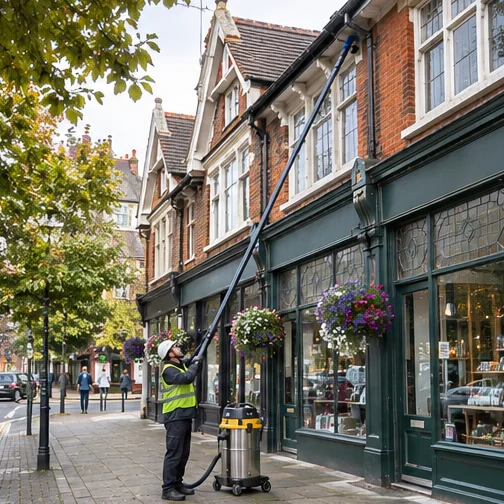
Illustrative photograph.
Distinguish the riverside side of the building from the landward side
Lambeth’s South Bank conservation area profile describes twentieth-century buildings facing the Thames. A property with a riverside face and another approach inland can have several roof edges, projections and entrances. For a clearance enquiry, tell us the address and which side the gutter faces. If the drip appears above a walkway, describe the level of the walkway and what sits above it. The nearest public entrance is a useful point of reference, but we also need to know where the relevant roofline is and whether the working position can be reached from there.
A picture of a wet path or door does not always show whether water is falling from a roof gutter or from a connection lower down. Tell us what you first saw in rain and give us the nearest visible pipe. If the channel is behind the roof edge, include the projection and any separate roof below it in a wide image. The main building may shed water onto a lower run or discharge through another side. We consider the visible parts before deciding where the first check can be made. If your report concerns a smaller home or premises behind the riverside frontage, give us its own entrance and the affected elevation.
Describe the results using the building’s level and entrance references
After clearance we tell you which runs were reached, which accessible openings were checked and whether a visible defect remains. If the site uses names or numbers for different levels or entrances, give us those references. We can use them to describe where the work was carried out and where a further assessment may need access. Tell us who should receive the findings if the person opening the route does not manage the gutter. Where the cause could not be established from the accessible position, we explain what was and was not visible.
If another visit is needed, tell us about changes to the working area or the route that brings us there. A later report about water on a different level may concern an independent channel. Give us the previous location and the one now affected, so we can discuss which outlet needs to be looked at next. If another contractor has repaired a fitting since the clearance, identify its position and say whether the visible symptom changed.
Make the service approach clear before the visit
At a site with public routes at more than one level, tell us where the equipment can be brought in. A path can lead to a door without reaching the area below the gutter. Explain whether the approach involves steps, a gate or a turn, and how much usable ground there is beneath the run. We take account of the angle to the roof as well as its height. If a lower roof, balcony or covered passage projects from the building, show it in the photo. The available position may be to one side of the point where the water is seen.
Give us the person who can confirm access and the contact who can approve the work. A public entrance may be a good meeting point while the equipment needs to use a service door. Tell us which routes or entrances must remain available during the visit. If the work concerns an area controlled by another occupier, check who can agree the position. We can discuss what is reachable once those details are clear. If an adjoining run needs a separate approach, describe that route instead of assuming it is covered by the same access arrangement.
- Give the level as well as the nearest entrance.
- Identify the riverside or landward elevation.
- Distinguish the meeting point from the equipment route.
- Show any lower roof or walkway below the spill.
Arrange access to the working position
| Access route | Detail to give us | Who can confirm it |
|---|---|---|
| Public entrance at another level | Where to meet and where equipment should go | Site or building contact |
| Service door | Steps, turns and space below the run | Person who can open the route |
| Shared space below the gutter | Time and area available | Person responsible for that space |
Clear the accessible run and note how far we can check
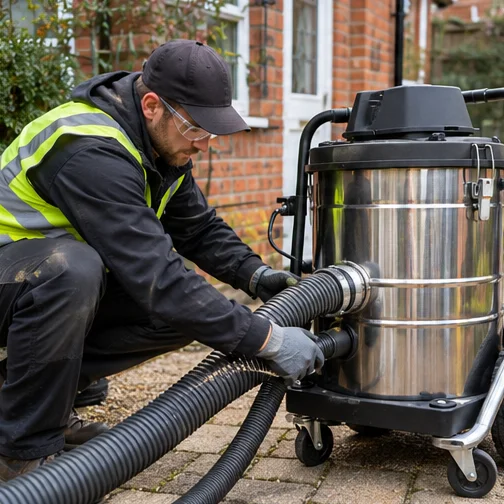
We confirm which lengths are included and look for the accessible outlet each one serves. Where the position allows it, we use reach poles and a gutter vacuum to remove reachable leaves, moss and silt. We work through the accessible channel and check for debris where it meets the pipe opening. A corner or change of direction can collect material that is not visible from the path below. If the gutter above one level feeds another roof, we identify the visible connection and explain which parts were reached. For details of the equipment, see our gutter cleaning service.
Ask about a camera view if the roof edge prevents a direct view of the channel. We discuss what can be seen from the available position. The view may show an obstruction or standing water within the reachable part, but it does not trace a pipe inside the building. If the accessible opening is clear and water still appears to back up, we describe the point where the check ended. A restriction farther down or at another level may need separate assessment. Tell us if part of the roof has already been cleared and which outlet was checked.
Separate work at the premises
Gutter cleaning
We clear the reachable runs agreed by level and check their accessible openings.
Ivy removal
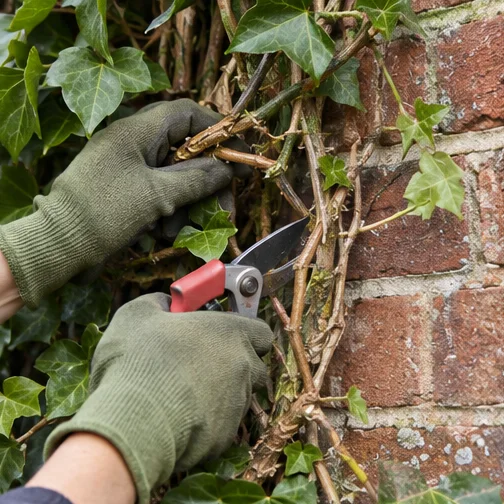
We can discuss exposing a pipe connection obscured by growth beside an access route.
Guttering repairs
We look at the reachable fitting where water still escapes after the channel has been cleared.
Water damage repair
For water inside a building, identify the room and level separately from the visible roofline.
Gutter replacement
We consider the joins and the outlet when discussing renewal of a failed section.
Gutter lining
We assess a supported concealed channel and its exit before discussing lining.
Match the report to the right roof level
| Where water is seen | Reachable check | Helpful information |
|---|---|---|
| Drops beside an upper walkway | Roof edge and outlet above the walkway | Walkway level and nearest entrance |
| Water appears at a lower canopy | Lower gutter and visible discharge from above | Which surface wets first |
| A pipe joint leaks near a service door | Accessible connection and outlet above | Door reference and height of the seam |
Consider the remaining issue after debris is removed
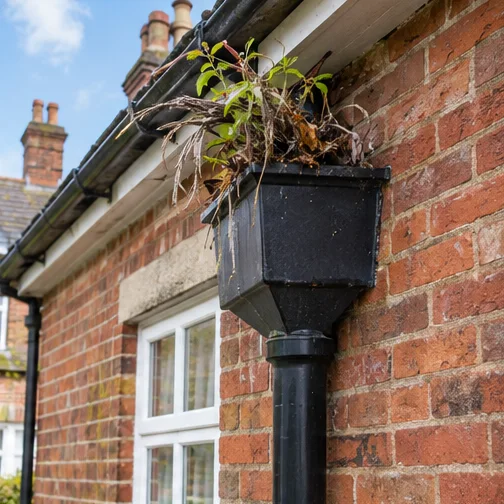
If water still escapes at a reachable fitting, we can discuss guttering repairs. We look at the visible joint, support and adjacent gutter before deciding what kind of work to discuss. A damaged length that cannot be repaired may need replacement, in which case its joins and outlet matter. A sound supported channel with a failing surface can be assessed for lining where we can see its condition. A separate visit may be needed if the relevant section lies outside the working position agreed for clearance.
If ivy hides a fitting at a rear wall or side passage, tell us where it begins and which part you want exposed. We can discuss how far it can be cut back where access is available. For a report about water inside, identify the room or level and the surface affected. We discuss water damage repair separately from clearing a roof channel. Water visible on two levels does not establish that it came from the same gutter. Give us the timing and location of each report so we can distinguish them.
What helps when several people report the leak
Coverage and bookings
See the areas we cover. For nearby enquiries, see Westminster.
Questions about South Bank gutter visits
Can the riverside entrance and service entrance be different?
Yes. Give us both locations and tell us which side the gutter faces. We discuss how to reach the working position from the agreed route.
What if the water appears one level below the outlet?
Tell us where it first becomes visible and what lies above it. We consider the accessible gutter and connections before discussing further checks.
Can we book for a separate canopy or lower roof?
Identify the run, its outlet and the position below it. We can discuss it independently if it can be reached.
Who needs to agree the working area?
Give us the person who controls the area and can confirm its use. The person who authorises the gutter work may be someone else.
Can you provide findings by level?
Yes. Give us the names or numbers used on site. We can describe the reachable lengths and outlets using those references.
What if the pipe disappears into the building?
We check the accessible opening where possible and say where the inspection ends. The concealed route may need separate assessment.