
Gutter Cleaning Tufnell Park
We clear accessible gutters in Tufnell Park and check reachable downpipe openings. For a pair of houses that appear to share a roofline, tell us where your gutter ends and which pipe it serves, if you know. We can discuss the accessible length you want cleared without assuming an adjoining gutter or a separate side run is included.
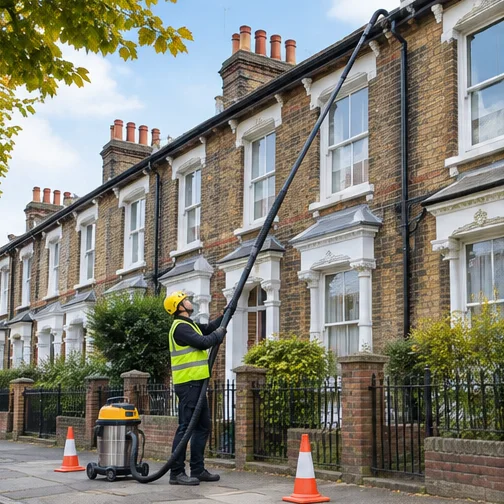
Illustrative photograph.
Find the join between a pair of properties
Islington’s Tufnell Park conservation area guidance describes detached and semi-detached villas alongside terraces. That mix makes it useful to name the roofline rather than assuming each building has the same type of gutter. If you are reporting a spill beside the middle of a pair of houses, say where it falls relative to the boundary and whether a pipe is visible on either side. One gutter can end at the join, or it can continue beyond it. Give us a photo from ground level that includes both the edge and the nearest outlets, where you can take one safely.
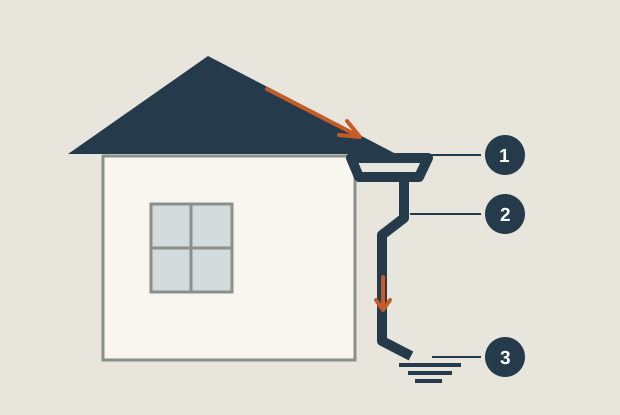
If you are not sure which pipe serves the run, tell us what you can see of the channel and the height where the water appears. A lower roof or bay can sit beneath the same visible edge and have an independent outlet. The easiest pipe to see from the street might serve a different section. If the water is first noticed at the side, describe which house it is beside and whether it falls directly from the gutter or reaches another surface first. That gives us a better location to discuss than a general report of overflow at the property line.
Check who can agree access on either side
Tell us whether the usable ground lies in your front garden, a side passage or the adjoining property. If access depends on the neighbour, explain what has been agreed and who can open the route. A gap between houses can look wide at the frontage while narrowing beside an extension or garden gate. We need space to bring the equipment to a suitable position and to approach the gutter from that position. Give us a view along the path if it shows the narrowest part and any projection above it.
At a terrace or building divided into flats, the person who reports water may not control the ground below. Tell us who can open the route and who can approve the gutter work. If the gutter connects across a boundary, identify the included length and the position from which it can be reached. We can discuss the run on your property without treating the adjoining one as part of the booking. If you want both front and rear cleared, describe the approaches separately. The layout at the rear can require a different position from the one available in front.
- Describe the visible join between the two properties.
- Give the position of each pipe you can see.
- Confirm access if the working area lies next door.
- Identify any lower bay with a separate outlet.
Work along the reachable length and check where it drains
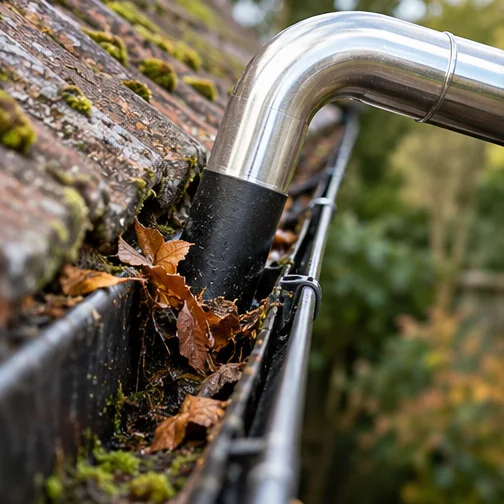
We confirm the included run and locate the accessible opening into the pipe. Where the height and position allow, we use reach poles and a gutter vacuum to collect leaves, moss and compacted material. We work along the reachable channel and check where debris collects at corners and the outlet. If two lengths appear to join, we look at the part visible from the agreed position and clear what we can reach. We explain where the accessible check ended, particularly where a pipe appears to serve an adjoining length. Read about our gutter cleaning service for the typical equipment and checks.
A camera view may help where the roof edge obscures the channel. If you want to see the join or outlet, ask about it when booking and tell us which location matters. We consider what the available position and reach allow. A camera view of the open channel cannot establish what is happening farther down a concealed pipe. If the reachable opening has been cleared but water still seems to back up, we explain which part may need further assessment. A gutter that no longer holds debris can still sit unevenly, so we also describe any visible concern with a seam or support.
Identify what the join is doing in rain
| First visible sign | Reachable check | Information to provide |
|---|---|---|
| Water spills beside the boundary | Visible channel end or junction | Side of the boundary and nearest pipe |
| Drip appears over a lower bay | Upper run and separate bay outlet | Which roof edge wets first |
| Side pipe remains wet after rain | Visible connection and opening above | Height of the seam and previous clearance |
Decide whether the join or another fitting needs separate work
If a visible seam continues to drip, we can discuss repairing the gutter fitting after seeing the accessible condition. A length that has failed beyond repair may call for replacement, and its connection to the remaining gutter matters. If a concealed channel is supported and the problem appears to lie in its surface, we can assess it for lining. We discuss any work beyond clearance separately and identify whose agreement and access would be needed.
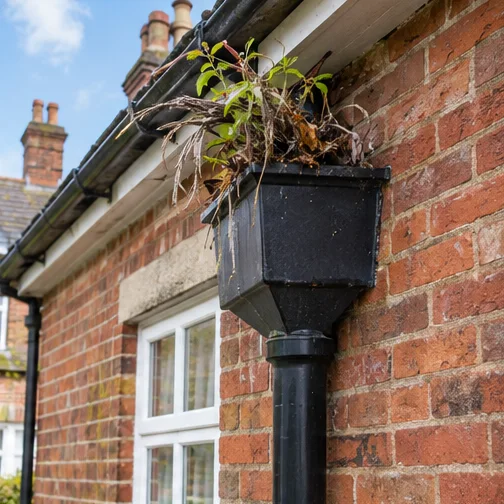
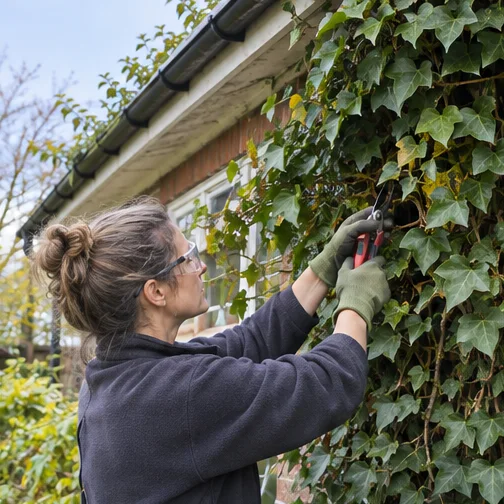
Where growth hides the pipe or a bracket beside a boundary, describe the plant and where it is rooted. We can discuss cutting back ivy where access to that part can be arranged. If water has reached an indoor surface, tell us which room became wet and when. We discuss water damage repair separately from the outside clearance. A mark in a room near the boundary may be useful information, but the route from the roof still needs assessment. We identify what can be seen at the accessible fitting and explain if another check is needed.
Work we can discuss after clearance
Gutter cleaning
We clear the reachable length agreed and check its accessible outlet.
Guttering repairs
We look at the reachable seam, support or connection where water still appears.
Gutter lining
We assess the surface and support of a concealed channel before discussing lining.
Gutter replacement
We consider how renewal would meet the adjoining gutter at the boundary.
Ivy removal
We can discuss exposing a pipe that is hidden by growth beside the boundary.
Water damage repair
For moisture inside the property, identify which room and surface became wet.
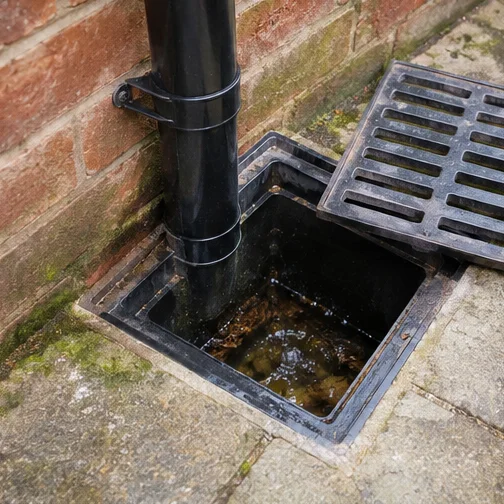
Tell you which side and outlet were reached
After the visit we describe the lengths cleared and the reachable openings checked. If the gutter continues towards another property, we say where the agreed work stopped and identify any visible issue at the connection. If part could not be reached, we explain which position would need to be arranged. Tell us if the findings will go to a neighbour, tenant or manager who was not there. A description that uses the boundary, nearest window or pipe will be easier for them to locate later.
If you arrange a further visit, tell us whether the adjoining length has since been cleared or the connection repaired. Include any changes to the gate or route used before. If water now appears on a different side, give us the position relative to the last reported leak. We can discuss whether the same outlet is involved or whether a separate run needs to be checked. It is useful to keep the previous description of where the accessible work ended.
Give the route below the agreed length
| Position | Detail to confirm | What it helps establish |
|---|---|---|
| Side gap between houses | Width, gate and any rear projection | Working approach to the gutter |
| Adjoining garden | Person who can agree access | Whether that position is available |
| Separate frontage or rear | Ground below each run | Which lengths can be reached independently |
Before we assess the roof edge
Questions about Tufnell Park gutter clearance
Can you clear our half of a shared-looking gutter?
Tell us where the agreed length ends and which pipe it serves. We can discuss the accessible work without including an adjoining length by default.
Does the neighbour need to provide access?
Only if the position or route depends on their property. Tell us what access is available and who can agree it.
Can you tell if both roofs drain into one pipe?
We look at the visible channel and accessible openings. If the route is concealed, we explain which part still needs checking.
What if the side gap becomes narrow behind the gate?
Show the narrowest point and the ground beneath the run. We assess the approach as well as the working position.
Can a lower bay be booked separately?
Yes, where the run is identifiable and reachable. Tell us whether it has its own outlet or receives water from the roof above.
Can you tell us where work stopped near the boundary?
We describe the accessible length and the opening reached, and identify any section that would need separate access or assessment.
Coverage and bookings
See the areas we cover. For nearby enquiries, see Kentish Town and Archway and Holloway.