
Gutter Cleaning Archway
If rain falls onto a shop entrance on Junction Road, a useful first question is which roof edge serves that entrance. A low canopy, an upper main gutter and a downpipe behind the property can all affect what people see at street level. Glen’s handles gutter cleaning in Archway for households and businesses. Tell us where the water lands, when it happens and who can provide access on each side of the building. We can then discuss what an initial clearance visit can cover and whether a different inspection is needed.
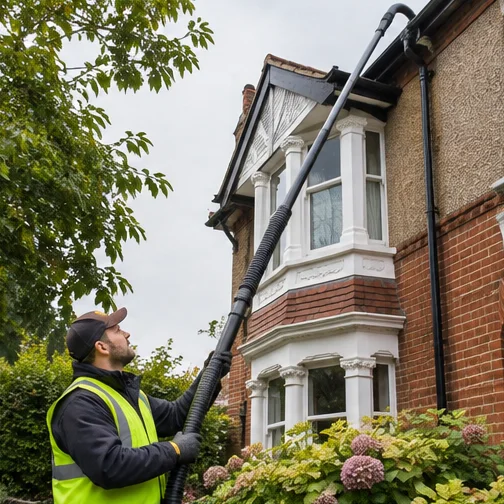
Illustrative photograph.
Compare upper and lower routes for rain
A residential property on the rising ground towards Highgate Hill may have a different number of storeys visible from the street and the garden. Give the height and ground arrangement on the side where the gutter actually needs attention. For example, an address with two floors above the pavement might also have a lower entrance on another level. A staircase at the back, a narrow basement area or a sloping approach can change where equipment can be positioned. A description of the front alone leaves these details unresolved.
A wide view of the roof edges helps us understand how the sections relate. An upper pipe may deliver water to a lower roof, which then relies on its own outlet. In that case the lower edge can overflow even when the upper gutter looks clear. Conversely, a lower trough can receive water from a split fitting above without having a blockage of its own. A resident can describe where they first notice the water and whether it is visible immediately when rain starts or builds over several minutes. Those observations guide where to look. The condition of any concealed connection remains a separate question.
- Commercial frontages and entrances
- Residential access at different ground levels
- Outlet and canopy observations
- Clearance records for occupiers and agents
Start with the frontage that people use
Islington’s Local Plan identifies Junction Road and Holloway Road as Archway’s main shopping streets. The council also describes Navigator Square as a public space used for markets and other events. A shopfront or residential entrance along a busy route may have people directly beneath the section in question. Include the position of the doorway and the usual pattern of use in your enquiry. An alternative entrance, where one exists, may affect how the work can be arranged. Mention any tables, signs, delivery bays or shared steps between the building and the proposed working position.
If you report dripping over a shop entrance, say whether it is near the door hinge, shop sign or edge of a projecting canopy. On a photograph from the pavement, the feature that catches water may look like the one that releases it. A wide image can show that a drip crosses a sign or follows a surface before it falls. You can also tell us whether the problem coincides with water from a neighbouring frontage. There may be two separate systems or a connection that is difficult to see. We establish what we can observe from a permitted position and discuss additional access if needed.
Details for your Archway enquiry
| What you can see | Detail to send | How it helps |
|---|---|---|
| Water over a main entrance | Name the entrance and where drops touch down | Relates the symptom to people and surfaces below |
| High rear roof edge | Give the rear floor count and ground level | Helps assess the reach from the proposed position |
| Canopy below a downpipe | Show the roof and pipe together in a wide view | Gives context for the lower outlet |
| Damp patch inside a flat | Describe where it appears relative to external features | Helps locate an area for separate investigation |
Plan around the people who hold access
For premises with a shop below flats, tell us who can admit us to the rear and whether they are also responsible for the rainwater system. The route to a rear courtyard may pass through a locked side door, a residential hallway or another occupier’s unit. A named contact for each relevant part of the premises helps us plan a visit that covers the agreed sides. State whether passage through a unit can be used for equipment and whether the route is shared with deliveries or residents during the proposed work.
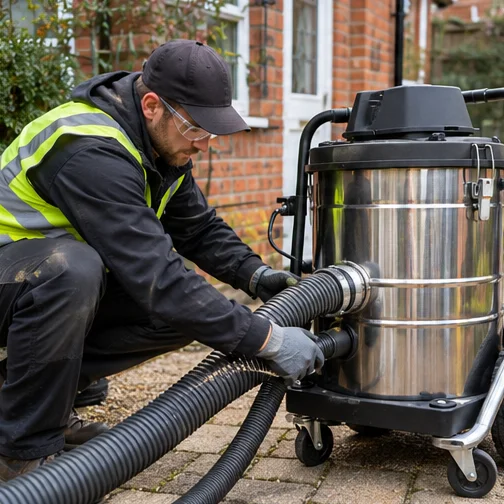
Where a line can be approached safely from ground level, an extendable gutter vacuum may be suitable for clearing loose material. A camera view can sometimes identify the top of an outlet that is hard to see from below. A projection or overhead obstruction can restrict the pole angle even where the ground itself is level. Give details of awnings, lean-tos and wires from the outset. Gutter cleaning covers agreed accessible lengths, with any part requiring a different access method identified for discussion. Street-front work and rear work may call for different arrangements at the same address.
Leave a record the next occupier can use
A report that names the left rear corner or the canopy directly above the entrance is more useful to a caretaker than one that just says the building was attended. We can describe the visible condition, the material cleared and any length we could not reach. An accessible gutter edge can be clear while the outlet disappears into a part of the pipe we cannot inspect during that visit. If the original symptom continues, the record helps the person arranging the next investigation focus on the remaining section.
For a block or shop with more than one point of contact, tell us who needs to receive the account of the work. If a tenant is reporting the symptom and an agent is arranging the visit, give both the affected location and the agreed correspondence details. Describe old staining separately from new marks or active dripping. Historic stains can remain after the source has stopped, while a fresh trail below the same fitting can provide a useful clue. A dated picture taken safely during rain is worth keeping alongside any observations made after clearance.

When upper and lower gutters need separate attention
Look for the point where clearance ends
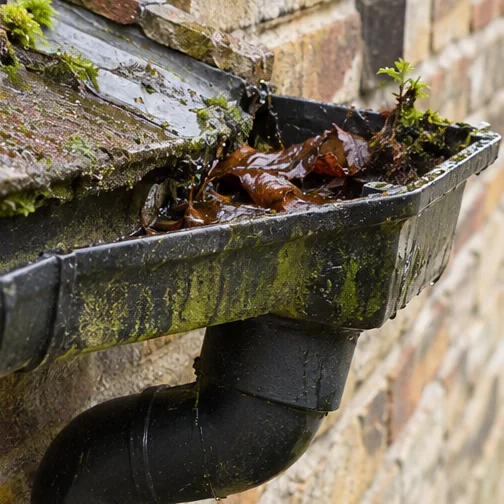
Loose leaves and sediment can settle where a gutter changes direction or where the opening into the downpipe narrows. Removing that material may uncover the lip of the outlet, the edge of a joint or marks left by water that has stood in the channel. A run that holds water in one place can also have uneven support or an alignment issue. If there is still water coming from a particular connection in rain, record the position and whether the adjoining length also overflows. That helps define the question for a guttering repair assessment.
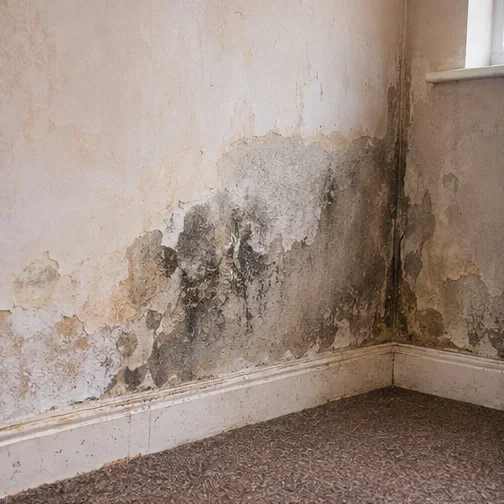
A local defect may be limited to a fitting or bracket. If several lengths have deteriorated, replacement may be a better discussion. Gutter lining depends on the condition, layout and support of the existing channel. A loose edge or badly positioned outlet still needs to be assessed. At a wall with climbing growth, we consider whether stems obscure fixings or pass into the channel before any ivy removal is agreed. If there is damp by a window or stain at an internal ceiling, water damage repair depends on understanding where water is entering and how long the affected material has been wet.

Arranging access by property use
| Property arrangement | Point to confirm before the visit |
|---|---|
| Retail premises with a pavement frontage | Tell us which entrance is in use and when deliveries arrive |
| Flats over a business | Identify the contact who controls the rear or communal entrance |
| House with a lower rear level | Describe steps and space at the foot of the wall |
| Shared canopy or rainwater pipe | Explain who can confirm the agreed work and access |
Other work on the extension and roofline
Gutter cleaning
Clear agreed gutters above entrances and along accessible rear elevations.
Gutter replacement
Discuss replacement when deterioration extends across multiple lengths.
Guttering repairs
Identify a visible failed joint or displaced support for repair assessment.
Ivy removal
Assess climbing growth around canopy outlets and concealed wall fixings.
Gutter lining
Review whether an existing channel has suitable support and access for lining.
Water damage repair
Use reports of recurring staining to guide investigation into moisture entry.
Coverage and bookings
See the areas we cover. For nearby enquiries, see Tufnell Park and Highgate and Holloway.
Questions about gutter work in Archway
What if the drip only affects the shop when its awning is out?
Tell us where water lands with the awning open and where it lands with it closed. The awning may change how water falls once it leaves the roof edge. Its position can also affect the space available for an inspection.
What information helps if there is a basement area in front?
Describe whether there is a railing, a gate and a clear area on either side of it. A photograph showing the house entrance and the basement opening together helps us understand the approach and what sits directly below the gutter.
Can you include the front and back on the same visit?
Ask for both in your enquiry and outline each route. The ability to cover both depends on the height, the working positions and whether access for both sides has been agreed with the people who control them.
Can an outlet be blocked when the rest of the gutter looks empty?
Yes. A compact plug near the outlet can hold water back even if most of the trough contains little debris. Seeing the top of the outlet can help, although some bends and enclosed connections need a separate inspection.
Should I send you a close picture of a damaged joint?
A close view can be helpful if it was taken from a safe position. Include a wider photograph that shows which side of the building it is on and any pipe connected nearby. A street-level image is enough to start a conversation.
What should a property manager tell tenants after clearance?
Share the exact sections that were cleared and flag any area awaiting access or inspection. Ask occupants to identify any recurring drip by location and time rather than simply reporting that the whole frontage is still leaking.