
Gutter Cleaning Stratford
We clear accessible gutters and check reachable outlets in Stratford. If the building has an entrance at one level and a service yard at another, tell us where the gutter is affected and how the working ground is reached. Give us the site name and postcode. We can agree the lengths to include and discuss whether more than one working position is needed.
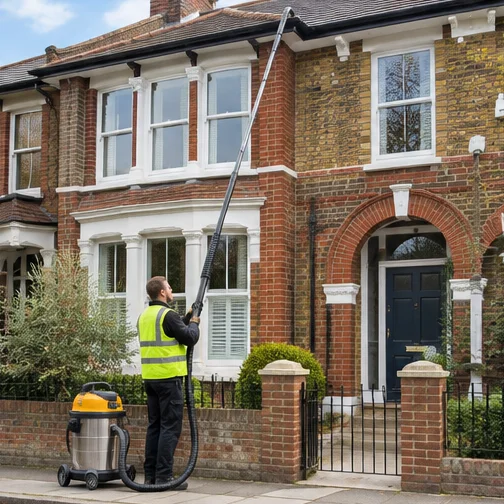
Illustrative photograph.
Identify the section on a building with several levels
A site can have a roof over a lower entrance, a canopy above a loading area and a higher run that drains behind the frontage. A description of the leak as being at the front may not distinguish them. Tell us which level receives the water and which door or sign is nearest. A wider photo of the roof edges and pipes can help us identify the channel from the ground.
If you have a site plan or a description of the units, mark the relevant elevation. It is useful to know whether the water starts above one entrance or appears farther along a wall. Give us the first point where it is visible before it spreads over the ground. We can use that to agree what to inspect rather than treating a whole building as one gutter run.
Report the result by level and by access route
We describe which gutters and openings were reached and which positions were not available. If one roofline could be cleared from the service level but another was outside reach, we identify each one separately. Give us the names used for the levels, doors and units so the report can be understood by someone who was not present. If a visible fitting needs attention, we can refer to the same position when discussing any follow-up.
For a Stratford quote, include the postcode, roof heights and the entrance used to reach the area below the gutter. Tell us whether water first falls onto a canopy, enters a loading yard or runs down the wall. If the site plan names the roof or wing, use that name so the location can be found. Where a lower and upper length drain independently, identify which one needs clearance now.
If a maintenance visit elsewhere on the site changes which access route is open, tell us before the appointment. An agreed working position may be reached from a different entrance on the day. If you have a recent photo of the approach, include it. That allows us to discuss whether the intended gutter can still be reached from the available ground.

Agree the route for the operator and equipment
Tell us where the working area is in relation to the gate or service entrance. A lower yard may be reached by a ramp or another route from the public entrance. We consider both the space below the gutter and how the equipment can get to it. If there is a canopy, loading platform or parked vehicle below the run, include it in a photo of the approach.
Give us the name of the person who can open the area and say when it needs to remain in use. The contact at reception may need to pass the details to a site manager or caretaker. Let us know whether there is another working position for the higher length if the lower yard cannot be used. At a house, the same questions apply if the front and rear sit at different levels or have different gates.
- Name the relevant level, unit or entrance.
- Identify the route to the working area below.
- Give the access contact and person approving follow-up.
- Show where the water first appears above the service level.
Agree which route and position can be used
| Area | Detail to send | What we consider |
|---|---|---|
| Service yard | Gate contact and available time | Route for the equipment |
| Ground below an upper projection | Height and nearest clear working ground | Reach to the booked length |
| Public entrance with another route nearby | Which area needs to remain open | Alternative approach |
Clear the reachable lengths and identify their outlets
Where reach and the working position suit the equipment, we use reach poles and a gutter vacuum to collect leaves, moss and compacted debris. We work along the agreed channel and check corners and outlet openings. If the roof has more than one accessible outlet, we identify which length each one appears to serve. That helps us describe where a restriction was found and which part was included.
At a reachable opening we clear material we can remove and report what can be seen of the connection. If a pipe disappears behind the wall or the discharge is not visible, a remaining restriction may need separate investigation. Ask about a camera check if you need to see a hidden part of the channel. We can discuss whether the available position gives a useful view for the maintenance contact.
Separate work at the premises
Gutter cleaning
Clear the agreed accessible gutter lengths and check the openings at the relevant levels.
Ivy removal
Discuss cutting back growth that prevents access to the side pipe.
Guttering repairs
Look at a visible seam or support above the reported entrance.
Water damage repair
Assess the affected interior separately once the reported roofline is identified.
Gutter replacement
Consider where a renewed run would meet the existing gutter over the service level.
Gutter lining
Assess a supported concealed channel and its visible outlet before discussing lining.
Identify the level below the reported gutter
| What you notice | Information to send | What we check |
|---|---|---|
| Water spills onto a canopy | Upper edge and canopy outlet | Which run first overflows |
| Wet wall near the service level | Position of the pipe and first visible drip | Accessible channel or fitting |
| Overflow reaches a lower entrance | Roofline and any pipe above it | Reachable opening on the affected run |
Discuss follow-up for a fitting above a different entrance
If a seam or support appears damaged after clearance, we can look at repairing the affected gutter fitting and explain where it sits. Where several sections have failed, we can discuss renewing the damaged run and how the replacement would connect to the existing outlet. A supported channel with a failed inner surface may be considered for lining after its condition and opening have been inspected.
If ivy covers the side pipe or a route into the yard, tell us where it starts and what you want cut back. We can discuss removal separately. If water has reached a room or entrance inside, water damage assessment is a separate enquiry. Our gutter clearance service explains which reachable parts we usually clear and how we report visible faults.

What helps when several people report the leak
If the gutter is on a building with an entrance above a service yard, send a picture of the yard and the elevation above it rather than a photograph of the public door alone. The view should show where the lower route reaches the wall. Tell us whether the nearest outlet can be seen from that position and what needs to remain available during the visit.
Where a maintenance record uses a floor number that differs from the one at the public entrance, give us the description used by the site contact. The relevant gutter may be above a service level that is not shown on signs at the front. We can use the agreed label when reporting which lengths and openings were reached.
Coverage and bookings
See the areas we cover. For nearby enquiries, see Bow and Old Ford and Leyton.
Stratford booking questions
Can we book a single roofline on a large site?
Yes, where we agree the length and can reach it. Identify the relevant entrance and outlet before the visit.
Who should we give as the access contact?
Give us the person who can open the working area and confirm which route is available. Provide a separate contact for approval of any extra work if needed.
What if the service yard is on a different level?
Show the route and where there is clear ground beneath the gutter. We discuss access to each length separately.
Can you report which outlet serves the included run?
We describe what we can see of the accessible route. If a pipe becomes concealed, we identify the last visible connection.
Can a camera show part of the gutter from a lower position?
Ask about the view you need. We consider the reach and angle of the available position before agreeing what can be inspected.
Can you describe an issue by unit number?
Yes. Tell us which numbers or names the site uses for the entrances and elevations so we can refer to the same place in the findings.