
Gutter Cleaning Hammersmith
We clear reachable gutter runs in Hammersmith. If water has started falling onto a newly painted wall or repaired fascia, tell us where it first leaves the roofline. We look at the reachable channel and outlet and describe any visible defect after clearance. A wet mark can tell us where the water landed, but we also need to know how it got there.
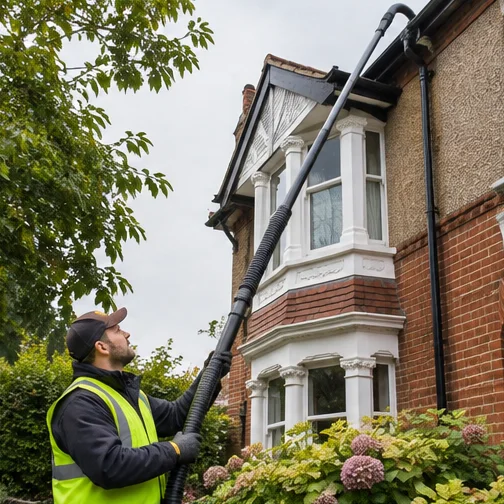
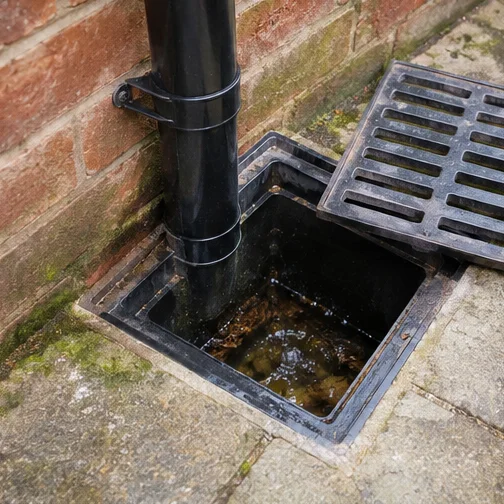
Illustrative photograph.
Choose a position beneath the part we need to reach
Tell us how the building can be approached. A pavement-facing frontage may offer a view of the gutter without being a suitable place to position equipment. There may be better ground at the side or behind the building. Include gates, steps, lower roofs and the space available beyond them. The approach to the working position can be as important as the position itself.
If we need to work beside an entrance used by residents, staff or customers, tell us which route must remain clear. For a shop or office, give us the site contact and explain which door they can open. When the rear access is shared, give us the name of whoever can confirm it is available. A person who can approve work on the building may not hold the gate key.
For a home with different routes to the front and rear, describe both if you want both included. If the garden is reached through the house, mention the turns or steps along the route. If work was recently finished outside, tell us which ground or doorway is usable now rather than describing how it was accessed while the building work was in progress.
- Photograph the mark and roof edge together.
- Identify any recent work on the wall, fascia or gutter.
- Show the available approach beside the affected entrance.
- Tell us who can open access and receive the findings.
Use the roofline to locate a fresh mark
The Hammersmith town centre planning material covers redevelopment and refurbishment in the town centre. At an individual address, tell us if a new finish or fitting has made a problem more visible. Fresh paint may show a streak that was difficult to spot before, even if nothing was changed on the gutter. Let us know whether work was carried out on the channel, fascia or wall and which section it affected.
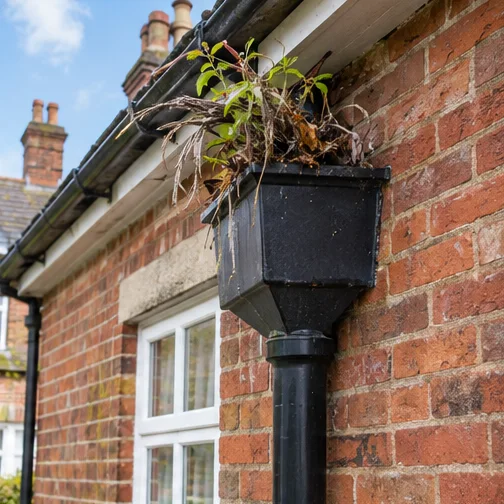
Look from the ground during rain if you can do so safely. Is water coming across the lip of the gutter, or does it run along the underside before falling near the mark? Tell us whether it starts at one join or at the end of a longer length. If the drip is near a downpipe, show where the upper connection sits. A close photograph of the stain alone does not tell us whether the water reached that point from the gutter, another roof edge or a different fitting.
A lower roof or canopy can hide where the water first came off the higher one. Give us a wider view that includes both edges and the surrounding wall. If you manage premises with more than one entrance, give the number or a reference for the wall concerned. We can then agree the section to clear rather than relying on terms like “the front” when several units use the same elevation.
Describe the position of a fresh rain mark
| Observation | Reachable item to check | Helpful detail |
|---|---|---|
| New streak below a join | Visible fitting and nearby channel | Where water first appears during rain |
| Water falls above a canopy | Higher run and reachable opening | Photograph including both roof edges |
| Staining near a new fascia section | Gutter edge and nearby support | What the earlier work covered |
Remove what we can reach and check the inlet
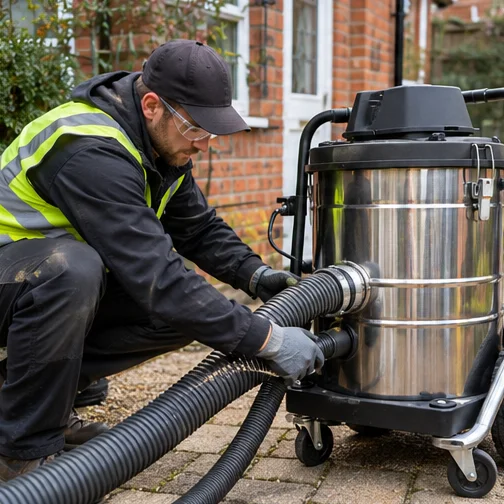
Where the working position and roofline suit the equipment, we use a gutter vacuum with reach poles. We collect accessible leaves, moss and compacted material along the lengths agreed in the booking. We check the reachable opening into the downpipe and clear material we can access there. A run can look clear from below while debris remains beside the inlet or behind a change in profile.
Ask about a camera view if you want us to look at an obscured part of the channel. The view depends on the roofline and approach. It may help show the condition of a reachable fitting, but it does not give us a full view of a pipe that disappears behind the wall. If the restriction appears beyond the opening we reached, we explain where the check stopped and discuss what may need separate assessment.
After clearance, we identify which lengths and outlets were reached and say if a visible defect remains. See our gutter cleaning service for how we agree the accessible work. If an earlier repair or newly painted surface makes a leak easier to locate, tell us which fitting you want identified in the findings. That helps you discuss any next work with the person responsible for the building.
Give us a reference for the visible change
Send the address, the affected elevation and a photograph showing the mark in relation to the roof edge. If you have a photo from before the wall or fascia was repaired, include it where it helps identify the location. Let us know which lengths were cleared before and whether the drip changed afterwards. We can use the same reference points when telling you what was reached and what remains to be checked.
If you arrange work on behalf of someone else, give us the person who can open the access route and whoever should receive the findings. We describe the particular run rather than treating every gutter on the property as included. If a further visit needs a different approach, we tell you which section remains and where the access would need to be arranged.

When upper and lower gutters need separate attention
Separate a continued leak from the clearance work
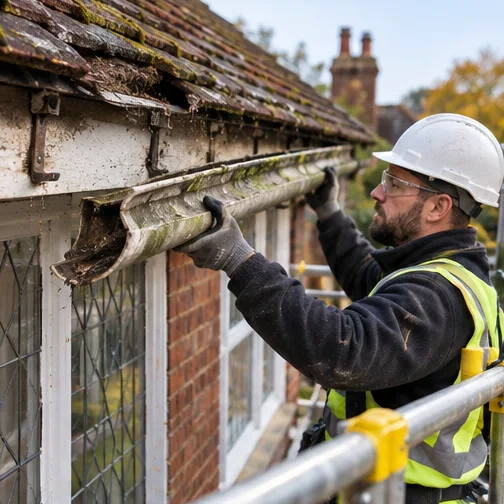
If water still comes from a visible seam once debris has been removed, we can discuss repairing the affected gutter fitting. Where damage affects a longer section, we can assess renewing the affected length and how it would meet the retained gutter and outlet. Tell us whether a fitting was installed or adjusted during the recent work. A change to the finish does not itself tell us what was changed on the rainwater system.
If a supported concealed channel has a failing surface, we can discuss lining after inspecting the reachable parts and outlet. If ivy obscures a pipe or narrows the approach, we can consider cutting it back separately. If water has already marked a ceiling or room inside, tell us whether the source has been identified and what surface is affected. Water damage assessment is separate from removing debris outside.
Match the entrance to the affected wall
| Position below the run | Information to provide | What it helps establish |
|---|---|---|
| Door facing the street | Space available and who uses the entrance | Whether there is a suitable working position |
| Rear courtyard | Route from the gate and keyholder | How the equipment reaches the wall |
| Ground beside an addition | Lower roof projection and open space | Whether the upper gutter can be reached |
Other work on the extension and roofline
Gutter cleaning
We agree which runs above the wall or entrance can be reached.
Gutter replacement
We check how renewed lengths would connect to fittings left in place.
Guttering repairs
A seam that still drips after clearance may need separate repair.
Ivy removal
We consider cutting back ivy that hides a connection or access route.
Gutter lining
We assess a supported concealed channel and outlet before discussing lining.
Water damage repair
Tell us which interior surface is marked and whether water still enters.
Coverage and bookings
See the areas we cover. For nearby enquiries, see Fulham and Shepherd’s Bush.
Hammersmith booking questions
Can you tell whether a new mark is from a gutter?
Tell us where fresh water appears and what was done to the wall or fascia. We check reachable gutters and describe visible findings.
What if the wall was painted after the leak began?
Send a current view of the roofline and tell us where the water used to appear. The timing helps us identify what to look at.
Can you include a canopy and the gutter above it?
Tell us about both before booking. We discuss their outlets and access separately.
Does the building contractor need to be present?
We need whoever can confirm access and point out the area. If another person can provide those details, give us their contact.
Will the camera show a pipe behind the finish?
A camera may show a reachable channel or inlet. An enclosed section can need a separate assessment.
Does clearance include repairing the gutter join?
We discuss any repair separately if a visible fault remains after the reachable debris is removed.