
Gutter Cleaning Enfield
When rain drips onto a shop threshold, the first question is where it leaves the roof or pipe. The answer may be hard to see from the door, especially if a sign or canopy catches the water. Glen’s provides gutter cleaning in Enfield for accessible rainwater systems. Send a view of the affected wall and explain how it is approached. If a garden, yard or passage provides access to the roof edge, give the contact who can confirm that route.
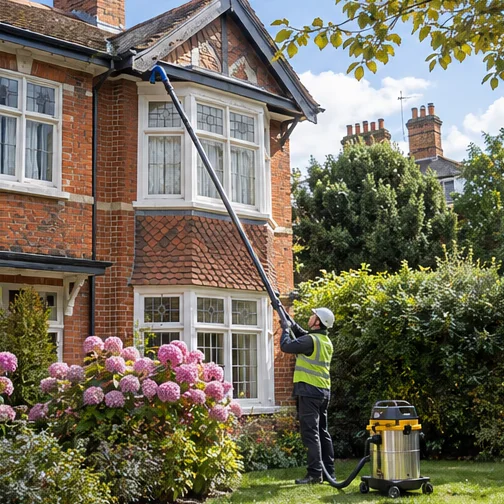
Illustrative photograph.
Describe the working route on the affected side
At a business, the rear yard may be approached from a delivery gate, a separate door or through the unit. Tell us which route is available and who can admit us. If vehicles, staff or other occupiers use the same route, give the times and parts of the yard they need. A view looking from the yard to the affected wall can show whether a cover or extension blocks the line to the gutter. A rear service entrance may provide access to one section while leaving the front to be arranged separately.
For a house, give the width at the narrowest part of the path and mention changes in ground level. A gate may lead directly to a garden or turn sharply beside a garage. A conservatory or roof over a side passage can affect whether the gutter above it is reachable. At a house arranged as flats, tell us who controls the route and who authorises the work. One resident may have a view of the roof while the garden beneath belongs to another. The booking should identify the roles of both.
- Town-centre doors and canopy runoff
- Rear yards and separate delivery routes
- Upper pipes and extension outlets
- Clearance records with fixed building details
Observe the route between an upper and lower roof
If a pipe ends on an extension roof, the extension gutter may carry water from its own surface and from above. Show both levels if you are reporting an overflow. Tell us whether water starts at the lower edge or reaches it from a fitting higher up. In prolonged rain, note the order in which the visible areas become wet. That can help determine which channel or outlet should be considered first. A dry photo showing the full layout can also help if rain photographs are unavailable.
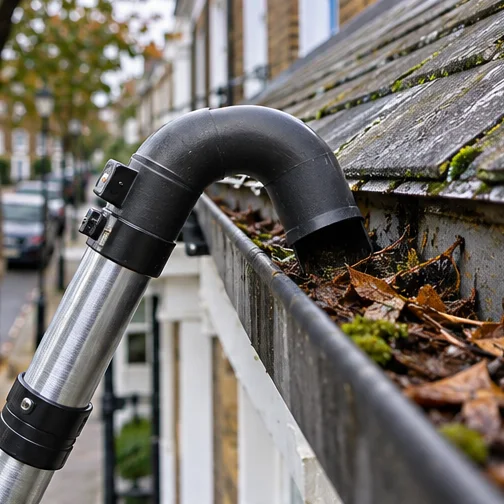
Gutter cleaning covers agreed accessible runs and visible openings. A ground-based vacuum may be practical if the position below gives a clear line to the gutter. A camera may show material near an outlet where access and angle allow. At the base of a pipe, tell us if it enters an open gully or disappears through paving. A puddle can receive runoff from the path as well as the pipe. An enclosed connection may need a separate inspection even where the upper trough has been cleared.
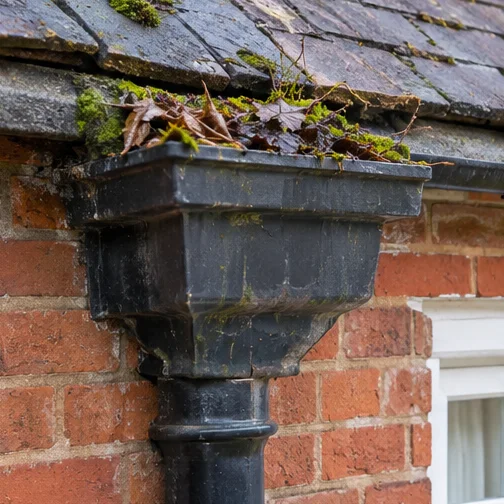
Use a fixed landmark in the town centre
Enfield Council’s draft local plan describes the market square, parish church and nearby Gentlemen’s Row in the town centre. At a property in or around the centre, identify the entrance nearest the wetting rather than naming only a shop or building. An outlet might sit above a separate door to the upper floors. A corner gutter can run towards a side wall even when the rain is visible at the front. A photo showing the roofline and a fixed feature, such as the entrance arch or a group of windows, helps identify the section.
Where water appears on a canopy, note where it first strikes the canopy and where it falls off. A person inside the business may see drops at the threshold while a resident above sees water around a hopper. Record each report with the viewpoint and time. It may be possible to relate the two observations using a wide view of the frontage. If you see water on only one wall, mention whether a return or lower roof partly hides the point at which it starts.
Work for other parts of the rainwater system
Gutter cleaning
Clear agreed accessible lengths and visible openings above shops, houses and extensions.
Gutter replacement
Discuss renewal where several sections or supports have deteriorated.
Gutter lining
Assess channel support and outlet geometry before specifying lining.
Guttering repairs
Review a visible defect against the adjoining run and fixing surface.
Water damage repair
Use the timing of indoor moisture and exterior wetting to guide further investigation.
Ivy removal
Assess stems that reach behind pipe fixings or across an outlet.
Enfield gutter observations to share
| What you noticed | Detail to send | How it helps |
|---|---|---|
| Water above a town-centre doorway | First wet point and nearest window or outlet | Identifies the affected part of the frontage |
| Overflow from an extension | Whether a higher pipe discharges onto it | Shows the relationship between roof levels |
| Puddling next to a pipe | Whether the pipe ends above a gully | Describes the visible end of the route |
| Drip from a previously repaired seam | Where the seam sits and when it drips | Connects the new report to the earlier work |
Use the fittings and supports to assess a persistent drip
Leaves and sediment at an outlet can hold water in the channel. Once the reachable debris has been removed, a visible drip may continue at a seam or pipe joint. For guttering repairs, the position of the adjoining supports and the condition of the connected lengths affect whether the repair can be local. Tell us if previous work changed a fitting or moved the outlet. A photograph showing both the altered piece and the original run can help identify the relevant profile.
Gutter lining can be considered where the channel has suitable support and the outlet and corners allow an appropriate installation. Replacement may need to be discussed if deterioration extends along several sections. Where ivy grows around pipe fixings, describe where the stems run and the surfaces they cover. An ivy removal assessment can then consider the wall and the parts beneath the growth. Water damage repair begins with understanding which materials are affected and where water enters. The visible outside route and the history of an indoor mark can both guide that investigation.
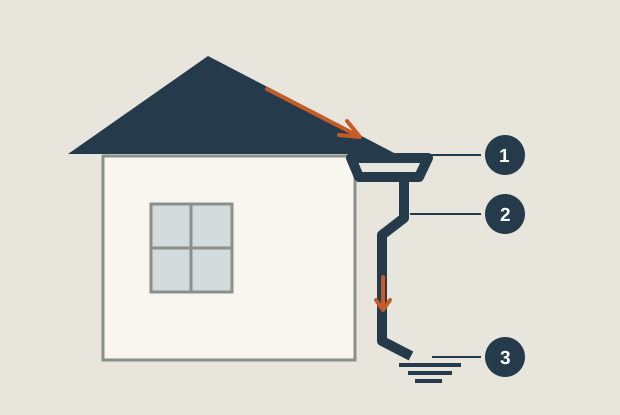
Keeping track of several independent runs
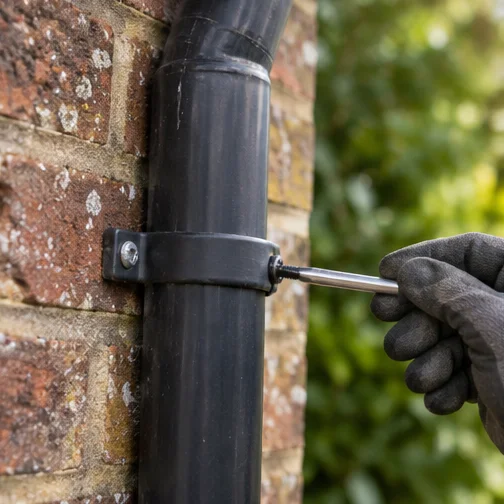
Leave an account that refers to the actual gutter
A clearance record can name the lengths reached, where material collected and whether any visible fitting requires attention. Use a reference such as the outlet above the market-facing door or the corner next to the garden steps. A general account of front and rear work can be difficult to interpret on a building with several entrances or additions. Confirm who needs the report and who can provide access if an outstanding section requires another approach.
At the next rainfall, look for the original symptom from a safe position. Note when it starts, where it first appears and whether the nearest pipe discharges. If a large spill stops but a smaller drip remains below it, record the two locations separately. If an interior mark spreads, give the room and the closest visible feature outside. The person organising follow-up can compare the record and new observations before deciding whether to inspect a gutter fitting, a concealed drain or another part of the building.
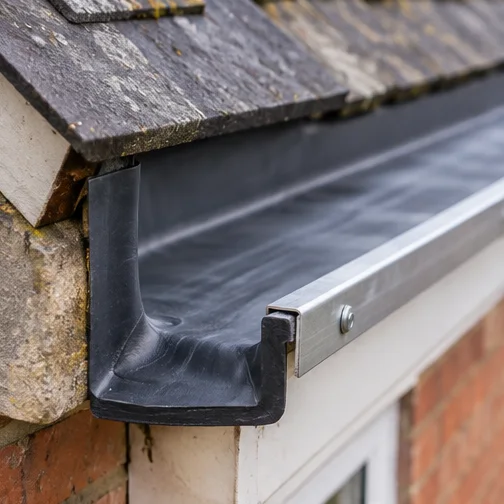
Questions about gutter cleaning in Enfield
Can you clear a frontage gutter if its outlet turns onto a side wall?
It depends on the working positions for both lengths. Send a view of the corner and tell us who can provide access. We can discuss what can be reached from the frontage and what needs a separate approach.
What if the rear gate opens into a delivery area?
Explain who uses the delivery area, when they need it and which wall is affected. Give the name of the person who can open the agreed route. A photograph showing the door and yard can help establish where work might take place.
Why does an extension gutter spill only when rain is heavy?
It may receive extra runoff from an upper pipe or have a partly restricted outlet. Its support and alignment can also affect where water collects. Show the two roof levels and note where the overflow first appears.
Should I mention a stain if it has been there for years?
Yes, if it helps locate the area, but explain which marks are old and which change after rain. A dated photograph can help distinguish active wetting. Include any new mark inside the property separately.
Can a visit include a gutter hidden by a parapet?
Tell us what is visible, including any hopper or pipe, and describe the approach. A camera may give a view in some cases. The position behind the parapet can also mean another access arrangement is needed.
What if someone else owns the wall beside the gutter?
Confirm which sections and positions are covered by the instruction and who has agreed access. Provide a drawing or maintenance record if it shows a shared fitting. The visit can then be planned around the agreed extent.
Booking access for the relevant elevation
| Working area | Detail to confirm |
|---|---|
| Frontage near the market square | Door use and any canopy or sign below the gutter |
| Shared delivery yard | Key holder and times when the route is in use |
| Side path beside a garage | Narrowest point and position of the lower roof |
| Garden used by one occupier | Agreed entry route and contact for work authorisation |
Coverage and bookings
See the areas we cover. For nearby enquiries, see Winchmore Hill and Edmonton and Hadley Wood.