
Gutter Cleaning Earl’s Court
A report from a top-floor flat can describe an overflowing gutter very clearly while leaving a question about where to stand below it. We clear accessible guttering in Earl’s Court and ask who controls the area beneath the affected run. If you can see the overflow from your window, describe the nearest corner or pipe and tell us which door or gate leads to the ground below.
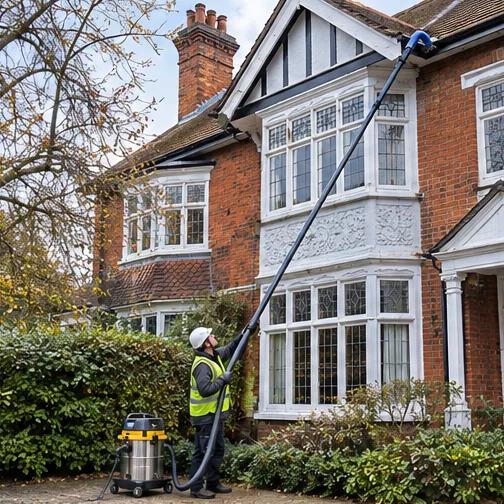
Illustrative photograph.
Read the first signs of overflow
| Visible symptom | Where we begin | Information that helps |
|---|---|---|
| Water spills from a hopper below the roof | Reachable opening and visible connections | Height of the hopper and route of the pipe |
| Damp appears by an upper window | Roofline and fittings visible above the window | Whether water also falls from the gutter edge |
| Water drips from a fitting near the party wall | The end of the run and visible adjoining lengths | Which property controls access below |
Look at the roofline separately from the flat that reported the leak
The council’s appraisal of Nevern Square describes a mix of terraces and mansion flats. The arrangement of rainwater pipes can differ even between addresses that face the same square. Tell us the building number, which elevation you are looking at and whether the gutter above you continues into the next property. At some addresses the roof edge is much higher than the door you use. An entrance on one street can lead to a property whose affected gutter faces another. Give both points of reference when they help explain the position.
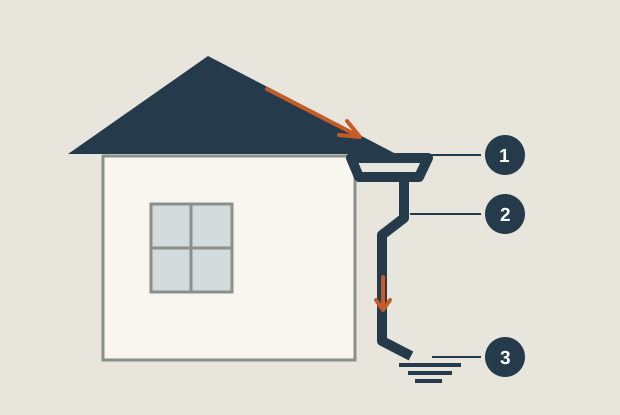
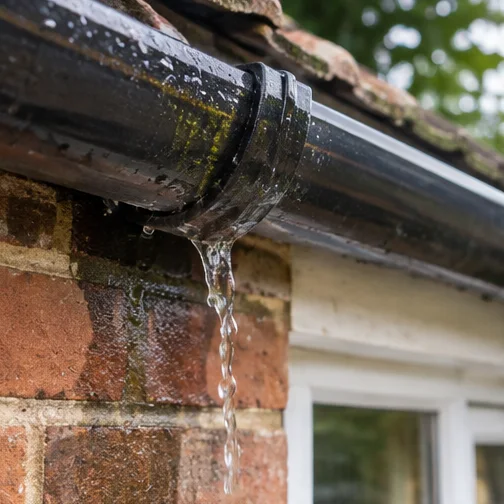
If you see water falling beside a window, look for the highest point you can identify from a safe position. A gutter can discharge into a hopper partway down the wall, and a full hopper can overflow even when the roof gutter is carrying water along its length. Let us know if the water appears at the top, at a box lower down or beside a pipe joint. A picture of the complete elevation can show these as separate positions. If you have a view only from inside the flat, a second photo of the ground beneath the roofline can help us discuss access.
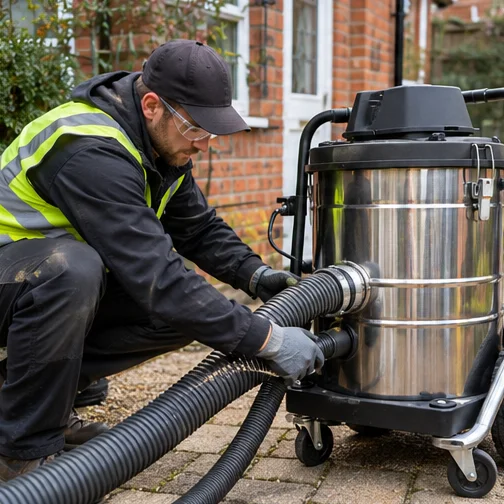
Clear the gutter and inspect the accessible transition into the hopper
We confirm which length is in the visit, look at the route to its outlet and then clear reachable debris with gutter vacuum equipment where suitable. If several people have reported overflow at different points, show us where those reports relate to the same run. Debris may be visible near the roof edge, but the obstruction that holds the water can be closer to the outlet. We work towards the opening and explain what we can reach at the transition from the channel to the pipe or hopper. For more about the setup, see our gutter clearance service.
A camera view may help where the front of the channel is hidden from below. It can also give a managing agent an image of the particular section a resident is reporting. Ask about this when arranging the visit if the view matters to someone who will not be on site. We still have to assess whether the position allows us to see and reach the area. If the hopper empties into a section hidden behind another fitting, we distinguish the material removed from the accessible opening from any restriction farther down. If water still collects in the channel after debris has been cleared, we note that for further assessment.
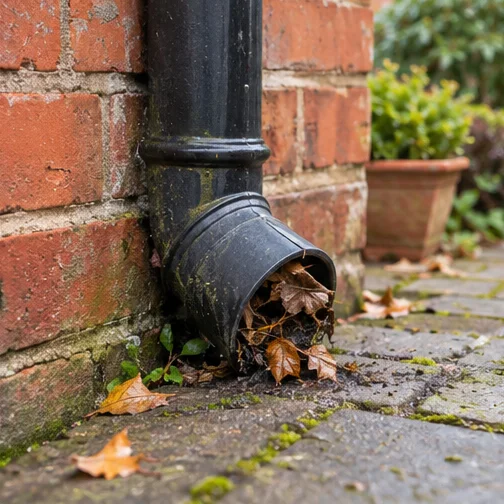
Confirm permission for the space beneath the gutter
The leaseholder asking about a visit may not control the garden, entrance or yard where we need to stand. We ask who can open the route and who can authorise the gutter work. If permission is needed from a building manager, give us their details before booking. The resident who first saw the water may still be the best person to explain its route. We can work from their description without asking them to arrange access they do not control.
For a rear elevation, tell us if the gate opens straight onto a yard or if the route crosses another property. If the accessible area is a basement patio, say how it is reached and what sits above it. Equipment needs a position from which it can be used safely. Knowing the number of floors helps but is only part of that assessment. We also consider how far the gutter sits back and whether balconies, trees or another roof are in the way. We discuss what can be included once the route and working position are understood.
- Give the elevation as well as the flat number.
- Distinguish a roof gutter from a hopper lower down.
- Confirm who controls the space beneath the run.
- Share the building manager’s reference for the affected roofline.
Decide what to discuss when the overflow leaves a separate defect
If the gutter is no longer holding debris but a seam still drips, the next discussion may be about guttering repairs. We look for a visible failed joint, damage to a bracket or a section that appears to have shifted. If a replacement length would have to meet an existing gutter of a different shape, we consider that connection when discussing renewal. A sound channel with a failing surface can be assessed for lining once we can see its support and how water leaves it.
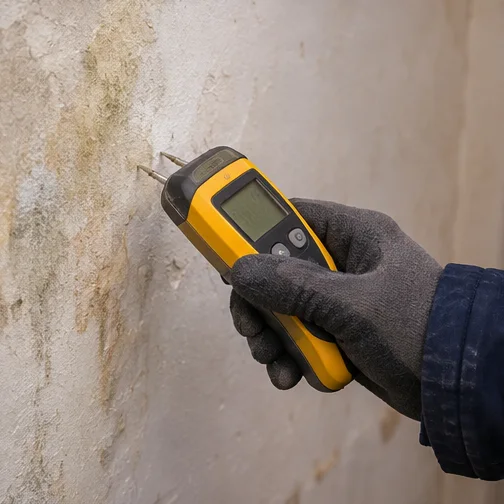
A pipe that has growth around it can be difficult to check without first knowing where the stems are rooted and who controls access. Describe which fitting the ivy covers if you want to discuss cutting the growth back. If water has already reached an interior surface, tell us which room and the height of the mark. An outside overflow and an inside mark can be related, but the route needs assessment. We discuss water damage separately from clearing the roof drainage. Tell us if the mark appeared before the latest overflow, since that can change which problem needs to be looked at first.
Services for the building manager
Guttering repairs
We look for a visible fault at a hopper, seam or support and identify the relevant elevation.
Gutter cleaning
We agree the lengths on the affected elevation and clear reachable debris at each accessible outlet.
Water damage repair
For water entering a flat, identify the affected room and when the indoor mark first appeared.
Gutter replacement
We consider what connects to a damaged length when discussing replacement on a shared roofline.
Gutter lining
We can assess the visible support and surface of a concealed channel before discussing lining.
Ivy removal
We can discuss growth obscuring a fitting where the person responsible can arrange access.
Information to keep with the maintenance record
Contacts for a divided building
| Person or route | Detail to confirm | Reason for confirming it |
|---|---|---|
| Flat occupier | Where and when the overflow is visible | Helps identify the right elevation |
| Manager or owner | Who can agree the included lengths | Separates clearance from additional work |
| Garden or yard keyholder | Entrance, gate and space below the run | Lets us discuss access before booking |
Give the property manager enough detail to arrange the next visit
We tell you which run we cleared, which accessible opening we checked and where a separate issue remains. A building manager may have to pass that information to several residents. It is easier to identify the right gutter later if the location is given in terms of the elevation, corner and nearest pipe rather than a flat number alone. If any section could not be reached, we explain what was in the way and which access details would need to be agreed. An image may help where there was an available camera view, particularly when more than one outlet looks similar from the pavement.
For future clearance, it is useful to keep a note of the route used and which person opened it. If the building is undergoing work or an occupier changes, tell us before another appointment. An access arrangement that worked previously may no longer be available. If the earlier visit only included part of the gutter, ask about the remaining length when sending the enquiry. We can discuss whether the same position can be used or whether further access would be needed for the work.

Questions about Earl’s Court appointments
Can I report the issue if I do not manage the roof?
Yes. Describe what you can see and where. Give us the details of the person who can arrange the work and access if those responsibilities sit elsewhere.
Does the person with the key have to identify the gutter?
It is helpful if they know where it is, but a photo or a note with the elevation and nearest window can help if they do not. Arrange a way for us to contact the person who reported it if necessary.
Do you need both street names for a corner block?
Give the address and describe which side has the problem. The other street name is useful if it identifies a different entrance or a better view of the pipe.
Can you include an outlet several storeys below the gutter?
Tell us its height and position when booking. We can assess whether it is reachable and whether it forms part of the same drainage route.
What if only one flat has seen the water?
The description is still useful. Ask where the first flow appeared and whether it reached a window, hopper or joint. We can then discuss where the initial check should be made.
Can you explain a fault to a manager who is off site?
Give us the manager’s contact and the reference they use for the affected elevation. We explain what was visible and where any further inspection or repair may be needed.
Coverage and bookings
See the areas we cover. For nearby enquiries, see South Kensington and Kensington and Fulham.