
Gutter Cleaning Crouch End
Rain that drips beside a shop sign on Crouch End Broadway may have crossed a canopy before anyone sees it. At a house a few streets away, the first report might be a stain below the roof of a rear addition. Glen’s provides gutter cleaning in Crouch End for accessible rainwater systems. Tell us where the water first becomes visible, what roof edges sit above it and which approach leads to that wall. A wide photograph can be useful even if the weather has since turned dry.
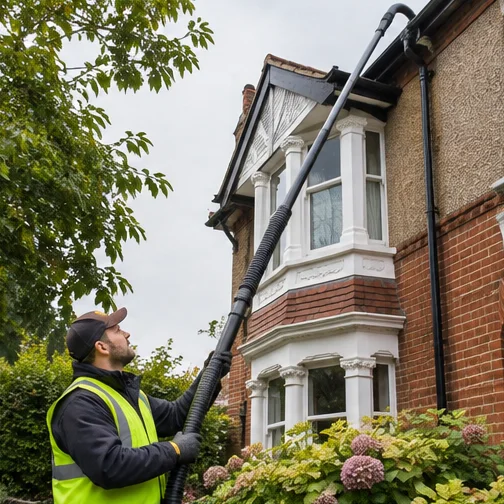
Illustrative photograph.
Follow the eaves around the roof
The residential streets around the centre include buildings from the late nineteenth and early twentieth centuries, as described in Haringey’s appraisal. A frontage with a projecting bay or gable can have several short gutter lengths with different outlets. From one window, you may see the middle of a trough but miss the return at the far side. At the rear, the layout may include the original roof, a rear projection and a newer extension. Tell us which part appears to spill and whether there is a pipe between two roof levels.
A downpipe can continue straight down, turn behind another feature or feed a hopper further below. If there is water near a joint, show any bend immediately above it. A dry mark below a connection may help locate the symptom, while a new photograph during rain can establish whether it still occurs at that point. You can also note whether the pipe discharges into a visible gully or enters paving. When the visible route ends at a concealed section, the inspection of that section may need to be arranged separately.
- Broadway and Tottenham Lane frontages
- Gables, bays and rear returns
- Access around customers and deliveries
- Reports linked to fixed building details
Locate the water in relation to the people below
Haringey’s conservation area appraisal describes the Broadway and Tottenham Lane as part of the commercial centre, with shops and restaurants surrounded by residential streets. For a business, use the sign, a particular entrance or the end of an awning to identify where the water lands. Say whether it falls onto the approach used by customers or close to a door for the premises above. A narrow forecourt or area used for outdoor seating can change how the space beneath the roof is used. Include that information when discussing access.
If the report comes from two people, record each viewpoint. A member of staff may see water at the shop threshold while someone above sees the first spill near a gutter outlet. A drop that looks as though it comes from the sign may be hitting it from much higher up. A rear extension can produce a similar effect at a house where water strikes the lower roof and runs to a different corner. Photos of the whole arrangement give us something to compare with the descriptions of the first wet point.
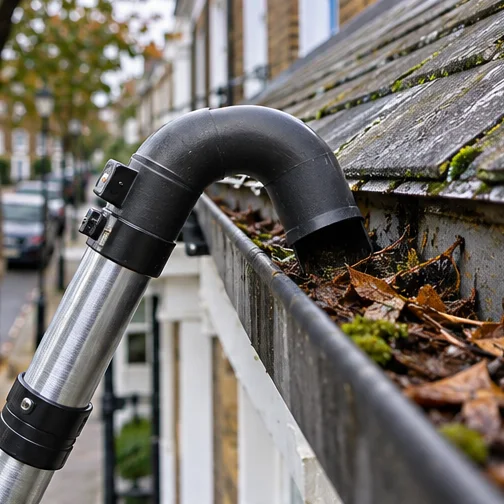
Details for a Crouch End enquiry
| Visible issue | Information to add | Why it helps |
|---|---|---|
| Water over an awning | Where water first reaches the fabric or cover | Helps locate the upper point to check |
| Spill at a rear return | Whether a higher pipe ends on the lower roof | Shows how two roof levels may connect |
| Drip below an elbow | Position of the outlet and nearest window | Identifies the affected fitting in context |
| Wet patch inside a room | When it changes and which surface shows it first | Gives a reference for further investigation |
Describe the approach from the usable entrance
At a house on rising ground, steps at the front can lead to the main door while the rear garden sits at another level. The usable route could be through a gate, through the property or down a shared passage. Explain how to reach the affected wall from the entrance you expect us to use. Tell us where the route narrows and whether it passes below a fixed cover. Photos showing the entire approach are more useful than a close view of the channel when we are assessing where we can work.
A business with a rear delivery entrance should identify who holds the key and when deliveries use the same route. A conversion with a private ground-floor garden may need the occupier to agree access while an agent authorises the work. If an extendable vacuum can reach the channel from a suitable position, gutter cleaning can clear agreed accessible lengths and visible outlets. A projection, lightwell or overhead obstruction can interrupt that line. We assess the available position and identify any section that needs a different approach.
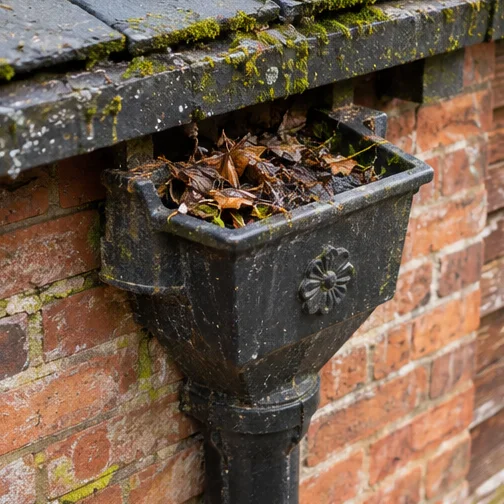
Leave enough detail for the next visit
If the instruction covers several roof sections, name them in a way the owner, occupier and maintenance team can each recognise. The area above the back window facing the side passage is more precise than the back gutter. A clearance record can give the sections reached, the material seen and any further access required. A business or converted property may need a specific recipient to share the report with residents or staff. Confirm that contact when making the booking.
At the next rain, look for the original symptom from a safe position. Note whether the drops begin in the same place and how long it takes for the surface to get wet. If a report comes from inside, identify the affected room, the nearest external feature and whether the mark is expanding. Keep the new observation alongside the maintenance record so the person arranging follow-up can distinguish a continuing problem from a different one. Where a pipe disappears into the building or a wall has several possible entry points, the record can help narrow the area for a separate assessment.
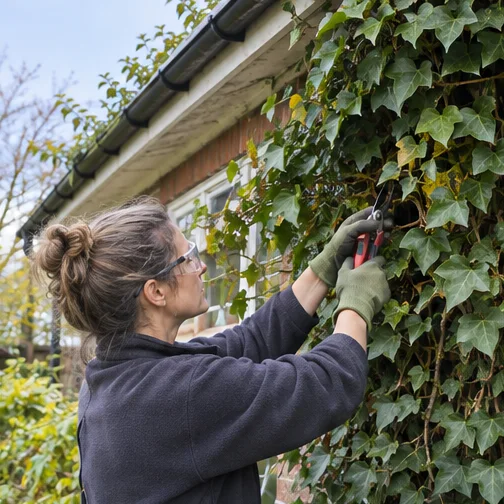
When upper and lower gutters need separate attention
Discuss what remains after material has been cleared
Sediment near an outlet can reduce the space for water to leave a channel. At another point, a joint may drip even where the water moves freely into the pipe. Once we can see the relevant area, we can describe visible issues that might need guttering repairs. The assessment may need to consider the connector, the position of the gutter and the condition of the surface supporting the brackets. Provide any record of earlier work if a leak returns at a changed fitting or near a junction between two materials.
Gutter lining may be considered if the existing channel has adequate support and a workable outlet arrangement. A run with several damaged sections may be a candidate for replacement. For climbing growth behind a bracket or passing under the roof edge, an ivy removal assessment should include where the stem starts and which finishes or neighbouring walls it crosses. Water damage repair calls for an account of how the affected surface became wet and how the mark developed. An inside stain below a visible gutter problem may still need another investigation to establish the connection.

Access by property type
| Setting | Detail to confirm |
|---|---|
| Restaurant or shop frontage | Timing of entrance use and any seating or deliveries below |
| House with a side path | Width at gates and position of overhead obstructions |
| Flat with a private garden below | Who grants entry and who authorises building work |
| Rear projection above a yard | Height and usable space between the roof edge and boundary |
Other work on the extension and roofline
Gutter cleaning
Clear agreed accessible gutters and outlets above frontages, bays and extensions.
Gutter replacement
Review replacement options when damage affects several lengths or connections.
Guttering repairs
Assess whether a leak relates to a local connector, bracket or adjoining section.
Ivy removal
Review stems near brackets and under roof edges before agreeing removal.
Gutter lining
Consider a liner where channel support and outlet geometry are suitable.
Water damage repair
Use exterior observations and the history of interior marks to investigate moisture entry.
Coverage and bookings
See the areas we cover. For nearby enquiries, see Muswell Hill and Hornsey and Stroud Green.
Questions about gutter work in Crouch End
How should I describe a leak above the shopfront?
Give the exact door or window and say whether water first hits the sign, awning or paving. Mention the location of any flats entrance nearby and when the area is in use. A view showing the frontage and the roof above is helpful.
Can a short side gutter feed into a longer front one?
Yes, depending on the roof and outlet arrangement. Tell us what you can see where the two edges meet. A corner can conceal the connection from the pavement, so a photograph taken safely from an angle may be useful.
Does a rear delivery route help if the front is busy?
It can, if it leads to a suitable working position for the affected length. Explain the route and who can open the relevant doors or gates. The front and rear may still need separate arrangements.
Could water from a roof higher up cause the extension gutter to spill?
Yes. An upper pipe or roof edge may discharge onto the extension, adding to the water its gutter needs to carry. Show both levels and describe where the overflow begins. This helps us understand what to inspect.
What if the gutter looks clean but a bracket appears loose?
Send a picture that includes the bracket and the adjoining length. An accessible fitting can be assessed with its fixing surface and neighbouring supports. A clean channel can still have a joint or alignment problem.
How can a tenant help with a follow-up?
Ask them to record the time of any further wetting, its position relative to a fixed window or door and how long the rain had been falling. Share those details with the building contact, together with any safely taken photographs.