
Gutter Cleaning Colliers Wood
When water spills into a passage between buildings in Colliers Wood, the first task is to identify which roof feeds the affected gutter. The passage may sit beneath edges on both sides, with a pipe near the far end or an outlet hidden by a lower roof. Glen’s clears accessible gutters and checks reachable downpipe openings. Send the postcode and show us the full passage, both roof edges and the point where water first appears.
Tell us who uses the passage and whether it leads to a shared yard or separate entrances. If you can see the roof only from a window, send an outside photograph of the route as well. A view along the passage lets us assess how much room is available and whether another approach might be needed.
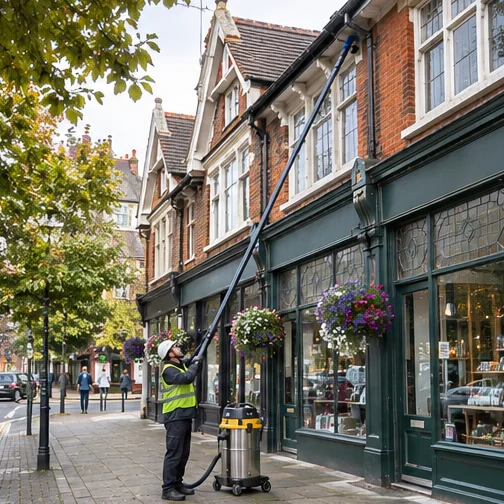
Illustrative photograph.
Identify the wall the water comes from
Stand at either end of the passage where you can take a wide photograph safely. Include both walls, the roof edges and any canopy or extension that projects across the space. Mark the spot where the first drops land. A splash below one wall can come from an edge on the other side if water strikes a projection first. Show any pipe crossing the space or bending around a corner.
If you saw the spill during rain, say whether it dropped straight down, ran along the wall or came through a joint. Include the nearest door, window or gate as a fixed reference. A close photograph of a wet patch can be difficult to place if both walls look similar. We can use the wide view to discuss which reachable lengths to include in gutter cleaning.
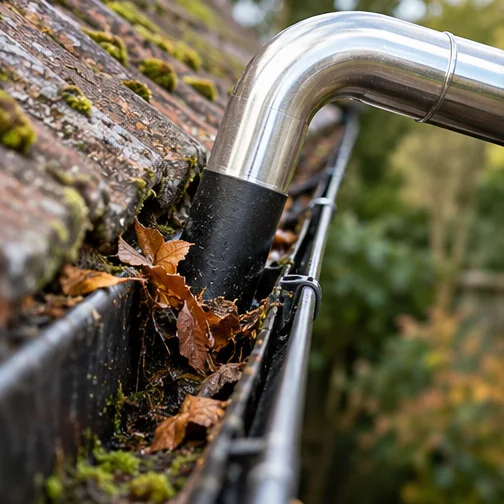
Match an indoor mark to the passage outside
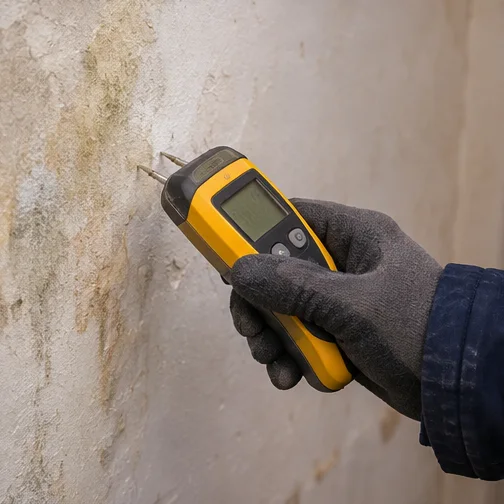
If water appears indoors, locate the first wet point using the nearest opening and the floor or ceiling. Give its position on an exterior view. A damp patch beside a lower doorway can coincide with water flowing along the passage, while a mark higher up may be near a roof junction or visible pipe. Note whether the mark first appears during rain or later. If it spreads only after a long shower, say how much of the wall is affected.
For a water damage repair enquiry, include the dates of fresh wetting and any work already done on the gutter, wall or roof. Keep the clearance record with the photographs and label each roof edge. If a new spill appears on the opposite wall, the earlier record helps establish whether that length was included. For a shared passage, pass the same references to anyone who may need to report further symptoms or arrange access.
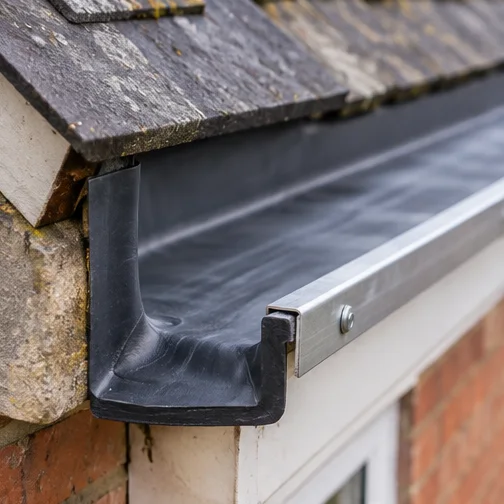
Check where the passage narrows
Take a picture of the entrance with the gate open and another view from the far end. A passage can be wider near the street and taper around a rear projection. Show anything that reduces the clear width, including pipes, meter boxes, steps and fixed storage. Tell us whether there is a usable area beyond the passage where the upper gutter can be approached from a different angle.
If another occupier uses the route, confirm who can make it available and when. There may be a second gate that opens only from one side or a door that regularly swings into the passage. If the passage is the only route to a dwelling or working area, let us know when people need to use it. We can discuss the access needed for each roof edge once we know which positions are available.
- Show the roof edges on both sides of the passage
- Locate the point where the access route narrows
- Photograph where two pipes share a discharge
- Identify the matching inside and outside wet marks
Observations between buildings
| What you see | What to record |
|---|---|
| Water lands close to one wall | Which edge it comes from and whether it strikes a projection first |
| A fitting drips above a gate | The nearest support and the route to the outlet |
| Water gathers along the paving | Where it first appears and whether it comes from a gully |
| Damp appears inside near an opening | The height of the mark and the corresponding exterior position |
Work out whether the two roofs share a discharge
Follow the visible downpipes from their outlets to the points where they end or disappear. Two pipes may run close to one another while draining separately. If a branch joins them, photograph the joint and the roof edge each length serves. Where a pipe continues behind a lower roof, show the visible sections above and below it. Tell us what you know about any change to the drainage.
If more than one pipe empties into a gully, send a wider image showing the gully, the pipe ends and any ground that slopes towards it. During rain, note whether water first comes over the gutter or appears near the base. We can check reachable roof-level openings within the agreed clearance. An enclosed connection or a drain under the passage may need separate investigation.
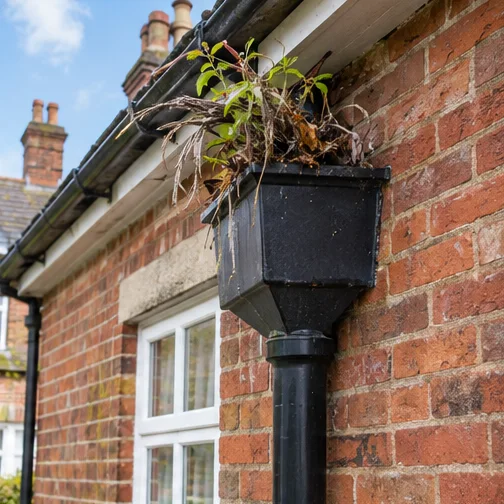
Separate work at the premises
Gutter cleaning
Clear the agreed reachable gutter lengths on either side of the passage.
Ivy removal
Check where ivy from an adjoining wall reaches a pipe or gutter edge.
Guttering repairs
Assess visible damaged fittings identified by their position above the passage.
Water damage repair
Compare fresh indoor damp with the position of the outside passage and fittings.
Gutter replacement
Specify new lengths around the connections that serve each building.
Gutter lining
Assess the underlying channel and outlet before considering lining over a narrow route.
Information for a Colliers Wood enquiry
| Detail | What to send |
|---|---|
| Passage | Views from both ends, showing both walls and the roof edges |
| Narrow point | Gate, steps and fixed objects that reduce the working width |
| Pipe route | Visible branches, lower connections and any common gully |
| First wet point | Its position in relation to the wall, roof edge or doorway |
Put visible damage in context before requesting repair
If a clip is loose or a union appears open, show where the fitting sits in relation to the next support and the nearest outlet. The view from below may show only the front edge of the channel. A second view from the far end can show whether the length bends or joins a different profile. After clearing reachable debris, we can describe visible defects and discuss guttering repairs separately.
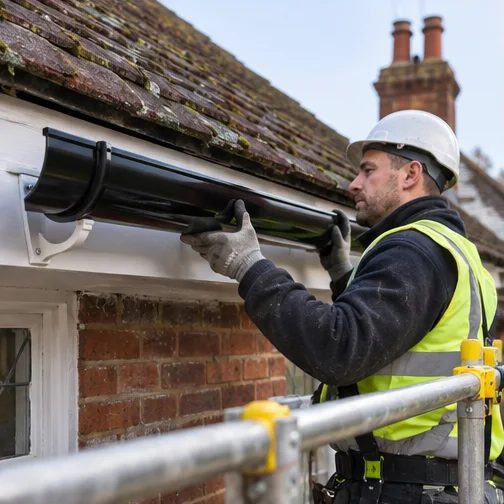
For gutter replacement, identify which length belongs to which building and where it is supposed to discharge. If the pipe or adjoining section serves someone else, agree who can provide access before asking for a scope. Tell us if the existing gutter runs behind cladding or a lower roof. A quote for one length needs to account for where it meets the next fitting and what will remain in service.
What helps when several people report the leak
Where the two walls stand at different heights, photograph from the middle of the route only if the surface is dry and unobstructed. Otherwise take an angled view from the gate. A simple sketch can show which roof edge projects further over the passage and whether a lower gutter sits under the upper one. Include any joint that cannot be seen from either entrance and identify it by a window or doorway.
Coverage and bookings
See the areas we cover. For nearby enquiries, see South Wimbledon.
Colliers Wood gutter cleaning FAQs
Can you reach a gutter above a narrow passage?
We can assess the available approaches. Send pictures from both ends showing the roof height, usable width and any projection. Tell us whether there is another route to the rear.
Can you clear gutters on both sides of the passage?
Yes, where the relevant lengths can be reached and access is agreed. Identify the building each length serves and give the contact who can make the working area available.
What if the same pipe serves two roofs?
Show each visible connection and where the pipe discharges. We can agree which roof edges and reachable openings are included in the work and discuss anything that needs separate access.
Can you check a drain in the passage?
Tell us what is visible at the pipe base and when water appears. We check reachable downpipe openings within the agreed gutter work. A drain below the surface may need a separate assessment.
What if the passage is the only way into another home?
Tell us who uses it and when it needs to be open. We can assess the available area and discuss how access can be arranged for the relevant gutter lengths.
How should I send photographs of a dry stain?
Take one close image and one showing its position on the wall. Include the nearest gutter or pipe and give the last date you saw it become wet. This helps locate the part of the building that needs attention.