
Gutter Cleaning Chelsea
We clear accessible gutters and downpipes in Chelsea. On a house with a front bay and a rear addition, the two elevations may call for different equipment positions. When you enquire, tell us which gutter is overflowing and where we can reach the ground beneath it. A photograph from the street or garden can show the roof edge, the outlet and any lower roof in the way.
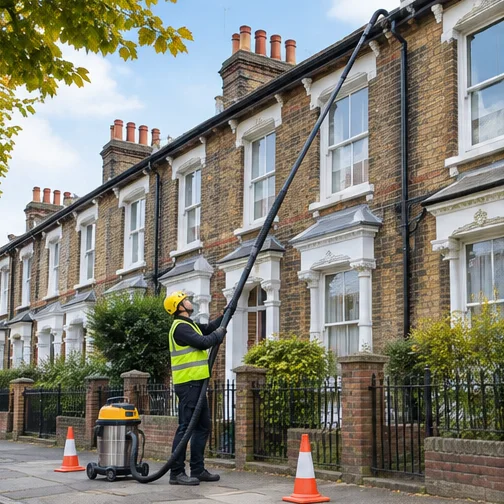
Illustrative photograph.
Establish which part of the roof is draining badly
At the front of a house, water may fall by a bay window even though the restriction is farther along the main gutter. At the rear, an extension can have its own small channel and outlet, or it can receive water from the larger roof above. We ask you to identify the first point where you see the water. If the leak follows a seam across the underside of the gutter, tell us where it starts rather than only where it lands.
The Royal Borough describes the Chelsea Conservation Area as predominantly residential, with buildings from different periods. That mix is a reason to ask about the individual building. A modern extension and an older frontage can have quite different gutter profiles and fixings at the same address. We check the layout before deciding where to position the equipment.
Prepare access to both elevations
If the rear can only be reached through the house, tell us about steps, narrow doors and the route through to the garden. We can discuss how the vacuum and pole sections would be brought in. If a caretaker or tenant has the key, give us the name of the person who will be there. If a front bay sits behind railings, a photograph showing the space between them and the wall helps us discuss where the equipment can stand.
In a converted building, the occupier reporting the leak may not have access to the garden below. Tell us which floor or room is affected and who can provide access. For a shop below a home, we also need to know which entrance is used by customers and whether a different side of the building provides a clearer working position.
- Identify the upper gutter and any separate bay outlet.
- Show the position of basement railings relative to the front wall.
- Name the keyholder for a garden or roof terrace.
- Ask about a camera view of the concealed length.
Clear the channel and follow the water to the pipe
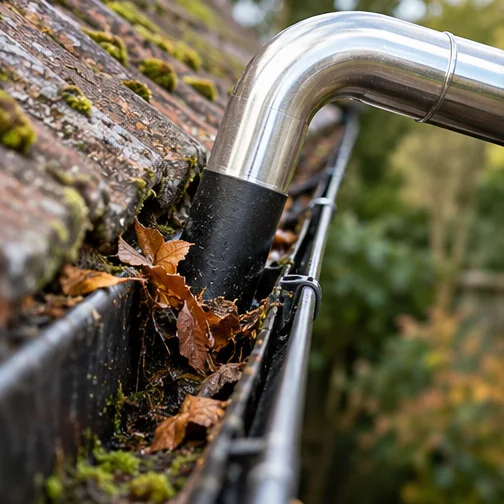
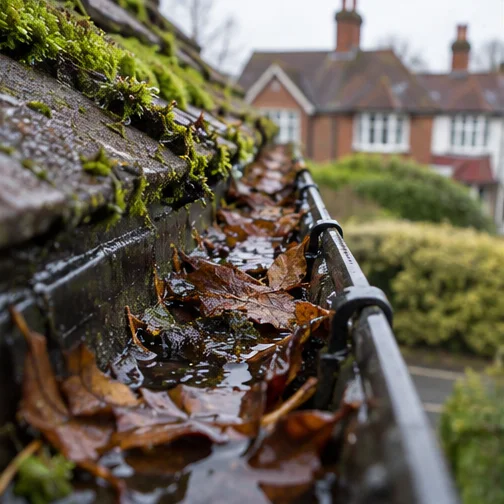
We begin with the agreed runs. Using a gutter vacuum and reach poles where the space and height allow, we draw leaves, moss and silt into the collection drum. We work towards the outlets and check the points where debris is likely to gather against a corner or bend. A channel may look empty from the pavement even when wet debris is pressed flat against the bottom.
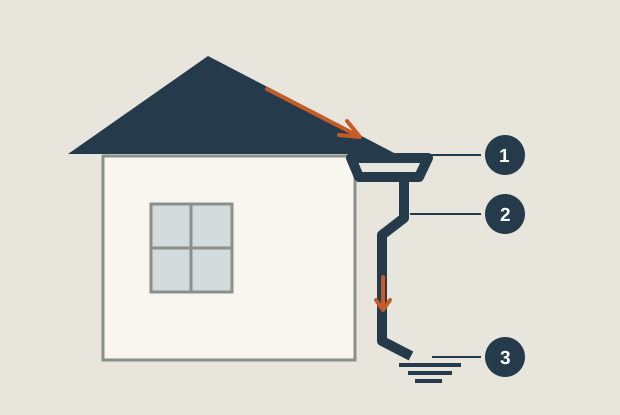
At the outlet we check for reachable obstructions. If water still backs up after those are removed, we look at what can be seen of the connection and discuss whether the pipe or discharge point needs separate investigation. A camera can help with an obscured channel, where access allows. Tell us in advance if there is a particular length you want us to inspect.
Where the reported symptom points
| What you see | What we check | What may need separate work |
|---|---|---|
| Water above a front bay | The main run and the bay outlet | A joint on the upper gutter |
| Staining by the rear addition | Whether the addition has its own outlet | A pipe feeding into the lower run |
| Water escaping at a concealed edge | Visible channel and reachable outlet | Assessment of the roof junction |
When clearance reveals a fitting that needs work
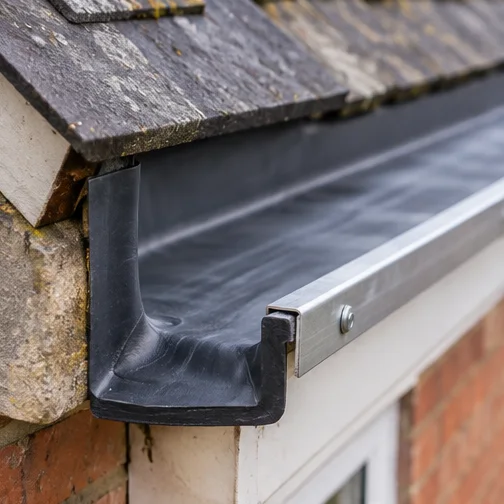
A leaking seam can remain visible after the debris has gone. We explain which fitting appears to be affected and discuss a repair to the guttering if it is a local defect. If several sections have failed or the shape cannot be matched, replacement guttering may be the next step. A sound concealed channel may suit lining, while loose supports need separate consideration.
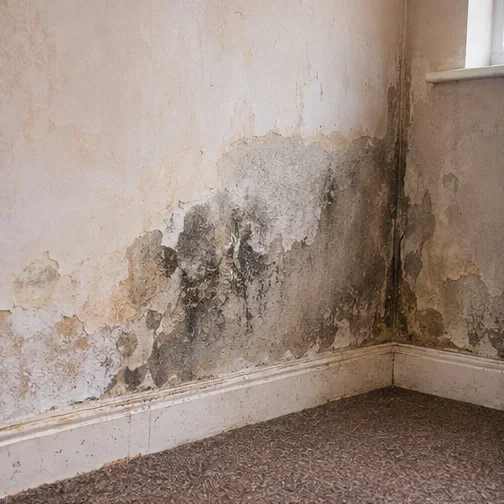
If ivy has wrapped around a pipe or reached a gutter opening, tell us what growth you want cut back and where it starts. We can discuss clearing the growth around the fitting. Where there is staining indoors, we can assess water damage separately once the likely path of the leak is understood. Our London gutter clearance service explains the difference between clearance and follow-up work.
Work we can discuss after clearance
Gutter cleaning
We clear the agreed bay or main roof gutter and check its accessible outlet.
Guttering repairs
We assess the seam or bracket above the bay once we can see where water leaves the gutter.
Gutter lining
For a concealed channel beside a terrace, we consider the existing support and outlet before discussing a liner.
Gutter replacement
We can look at renewing a worn frontage run while retaining any compatible adjoining section.
Ivy removal
Tell us if ivy conceals the clip above a basement stair or the pipe by a garden wall.
Water damage repair
We can discuss a separate assessment of a ceiling or wall affected by rainwater.
Property and booking details we use in Chelsea
Give us the address and describe the part of the roofline you want us to look at. For a house with a basement entrance, point out the steps and railings, because the space immediately below the gutter may differ from what is visible in a cropped roof photo. For a shop or small office, tell us if the run is over a service entrance or public doorway. Include an alternative point of contact if the person arranging the quote will not be there.
After the visit, we explain which agreed lengths were cleared and whether any were inaccessible. We distinguish a visible defect from a restriction that needs further investigation. If you are passing the information to a building manager, ask about an available camera check when you book so that we can discuss the most useful view of the affected section.
Access to include in your enquiry
| Property arrangement | Details to send | How we use them |
|---|---|---|
| Railings by the frontage | Width and position of the available area | Discuss where to stand the equipment |
| Rear access through the building | Doors, stairs and who will unlock them | Work out a route to the garden |
| Flat above commercial premises | Keyholder and public entrance | Identify a suitable access time |
Before we assess the roof edge
A front gutter can be interrupted by a projecting bay, and the downpipe you see beside the door may belong to a different length. If you are arranging work for the first time, send a picture wide enough to show the outlet at each end of the frontage. For a building with a roof terrace, tell us whether there is a channel beside the terrace or a pipe that passes through the wall. That information helps us agree which parts are included in the visit.
At a house with several floors, an indoor mark may be the first sign of a leak even when the gutter looks dry from below. Tell us which window or ceiling it is near and whether it follows rain from a particular direction. If you saw water behind the gutter, include that detail. The distinction matters because clearing the channel can help an obstructed outlet while leaving a separate roof-edge defect for further inspection.
A photograph of a single fitting can help after we know where it is. For the initial enquiry, a wider view of the building is usually more useful. Include the lower roof if there is one and point out the nearest accessible ground. If someone else will meet us, send their contact details and agree who should receive the findings. Where repair is discussed, we can describe the visible part that is affected and agree whether a separate visit is appropriate.
Questions about booking in Chelsea
Can you clear a bay gutter and the main gutter in one visit?
Tell us about both when you enquire. We check where each run drains and whether they can be reached from the same position. A small gutter over a bay may have its own outlet, so it helps to identify it separately.
What if I can only send photos of the front?
Send those first and describe how the rear is reached. A picture of the front cannot show the space below the rear gutter, so mention any extension, steps or narrow passage that would affect the setup.
Can you inspect a gutter hidden by a parapet?
We can discuss a camera check or other access after seeing where the channel sits. Let us know if there is a roof hatch or terrace nearby and who controls access to it. We confirm what can be reached before agreeing the work.
Why is water still dripping after the rain has stopped?
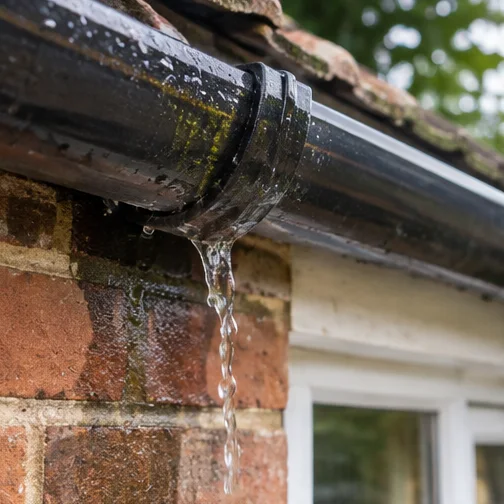
Tell us whether it drips from one seam, along the whole edge or near the downpipe. Water can remain in a restricted section or escape slowly at a fitting. We use the position of the drip to decide where to start looking.
Can you deal with a pipe that ends above a basement stair?
Tell us where the pipe discharges and what access there is at the foot of the steps. We can check a reachable opening or connection and discuss what needs looking at if water appears below it.
Can a caretaker show you the problem if I am away?
Yes, if we have agreed access and you have identified who can answer questions on the day. It helps if the caretaker knows which runs are included and who can approve anything beyond the original clearance.
Coverage and bookings
See the areas we cover. For nearby enquiries, see Fulham.