
Gutter Cleaning Holborn
We clear accessible gutters and check reachable downpipe openings on Holborn properties. Tell us whether the gutter is above a public entrance, at the rear of a commercial building or on a smaller residential roof. If you are arranging work for a managed site, identify the roofline using the reference your team uses and give us the access details for the area below it.
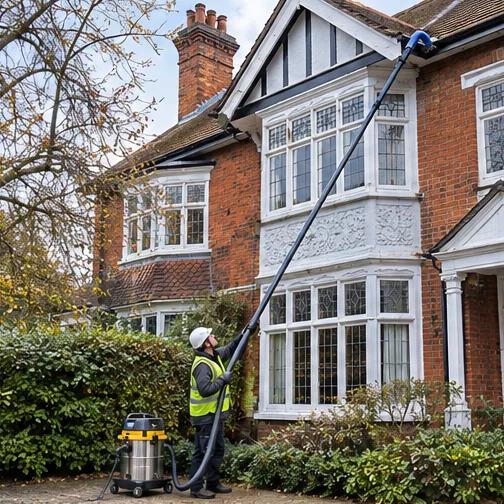
Illustrative photograph.
Locate the relevant outlet on a managed site
| First observation | Reachable check | Information to provide |
|---|---|---|
| Water falls by a public entrance | Run and accessible outlet above that part | Entrance and nearest visible pipe |
| Standing water at a hidden roof edge | Accessible channel and exit point | Where the water remains after rain |
| Damp shows beside a rear service door | Visible fitting or discharge above | Whether water can be seen leaving the gutter |
Match the enquiry to the part of the site that can be checked
Camden’s Local Plan identifies High Holborn and much of Kingsway as commercial frontages serving workers and residents. For gutter clearance at an address with several uses, the name of the building alone may not identify the relevant roof. Tell us if the overflow is above an entrance, beside a service door or in a courtyard beyond the public frontage. For a residential enquiry, say which side of the building you see from the affected room. We can use a view of the whole roof edge and its nearest outlet to discuss where the first check should be made.
If the roof has a formal maintenance reference, send it with a photo or a section of the plan. A marked area is more useful when it shows where the water appears and the route to the ground below. If the site team is reporting standing water rather than visible overflow, say whether they can see the channel, the pipe or only the surface below it. A report that a gutter has overflowed can cover several observations. We start by separating water leaving a roof edge from water appearing at a connection lower down.
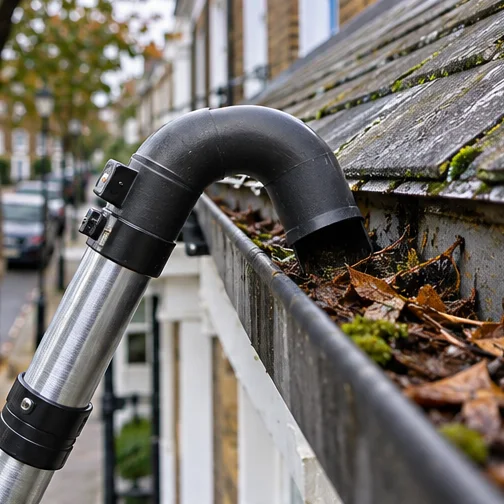
Use the accessible run to narrow down the likely restriction
On suitable gutters we use a vacuum and reach poles to collect leaves, moss and compacted material. We confirm the length included and the outlet serving it. We pay particular attention to reachable corners and the opening into the downpipe, where debris can hold water even when another part of the channel looks clear. If there are several outlets, we identify the ones connected to the agreed run. We can clear obstructions that are reachable at the opening and explain if the remainder of the pipe is beyond the visible route.
A concealed channel can be discussed for a camera view where the working position allows it. If the site team needs a view of a particular outlet, give us that reference before the visit. We describe what can be seen and what is hidden behind the roof edge. The view does not establish whether a restriction is farther along a pipe or below ground. If the reachable part is clear but the symptoms continue, we explain which location may need a separate assessment. See our gutter cleaning service for more about the equipment and the scope of the accessible checks.
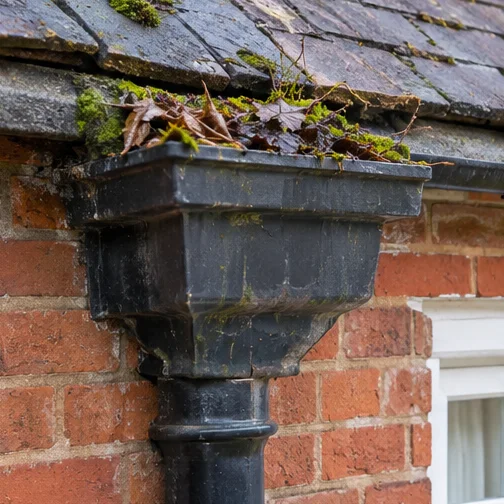
Confirm the working area and on-site arrangements
A building reception can be the right place to meet someone without being the route to the gutter. Give us the entrance for the equipment and tell us whether access requires an escort or advance notice at the site. If the area is shared with deliveries or another contractor, describe when it can be made available. We consider the ground below the run, the distance to the wall and any roof or canopy in the way. A short service passage can be workable from one end and too restricted from the other. Describe how it is approached so we can discuss what is suitable.
If the premises has separate contacts for facilities and occupiers, tell us who can confirm the work and who can show us the affected part. A meeting in the reception area is helpful if someone can then take us to the actual working position. For a home, tell us if the route is through a garden or shared rear entrance. If you want a front and rear length included, describe the available approach to each. We can discuss what is practical from those positions before accepting a booking that covers both sides.
- Give the site’s roof or elevation reference.
- Confirm the equipment route if it differs from reception.
- Tell us how a shared yard or entrance is used.
- Name the contact who can approve follow-up work.
Decide what to take forward after clearance
If we can see a local fault at a seam or support, we can discuss a guttering repair. If an entire section is damaged, we can look at how replacement guttering would connect to sound fittings. A supported channel with a leaking surface may be suitable for lining after checking the channel and outlet. We discuss the work separately, especially where the initial clearance was instructed by a different person from the one who can approve repair.
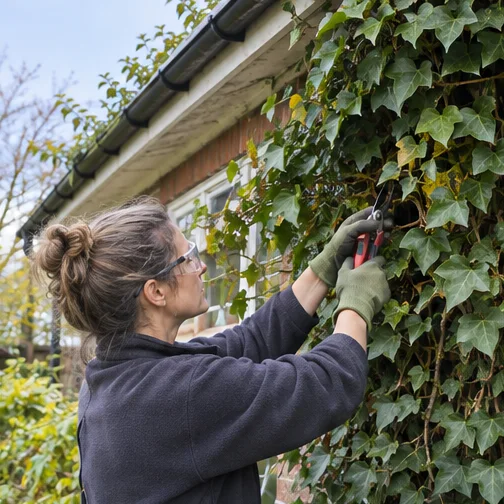
If growth hides a pipe near the rear or prevents access to the fitting, describe which part needs to be visible. We can discuss ivy removal where appropriate and where access allows. If moisture has reached a room or finish inside, identify the location and when it first became wet. We can consider water damage repair separately from clearance or work on the rainwater fittings. A mark inside the building is worth reporting alongside, rather than in place of, the location of any visible overflow.
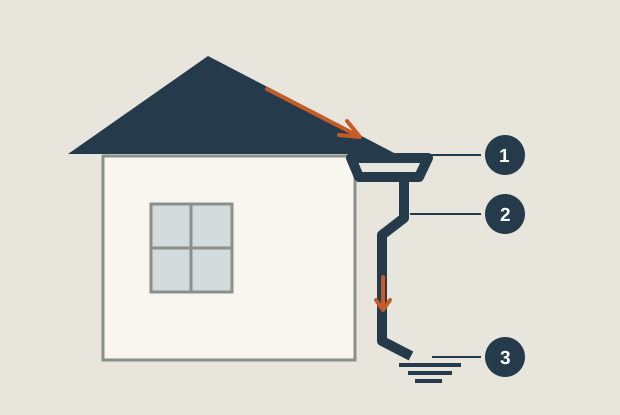
Services for the building manager
Guttering repairs
We look at a reachable joint or support and identify it by the site reference.
Gutter cleaning
We clear the reachable run identified by the site team and check its accessible outlet.
Water damage repair
Tell us which indoor surface became wet and when before discussing water damage separately.
Gutter replacement
We consider the join to sound fittings before discussing replacement of a failed length.
Gutter lining
We assess a concealed channel and the way it empties before discussing a liner.
Ivy removal
We can discuss exposing a pipe or outlet that is obstructed by growth.
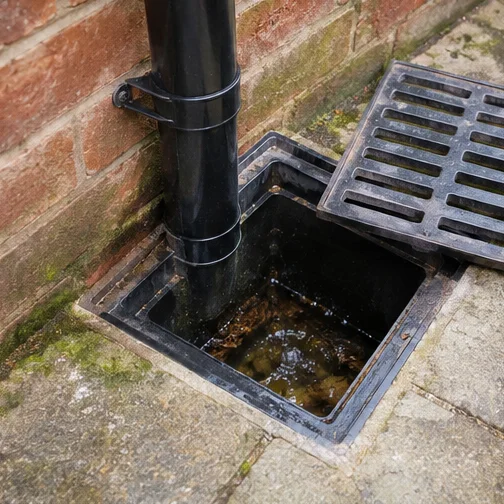
Information to keep with the maintenance record
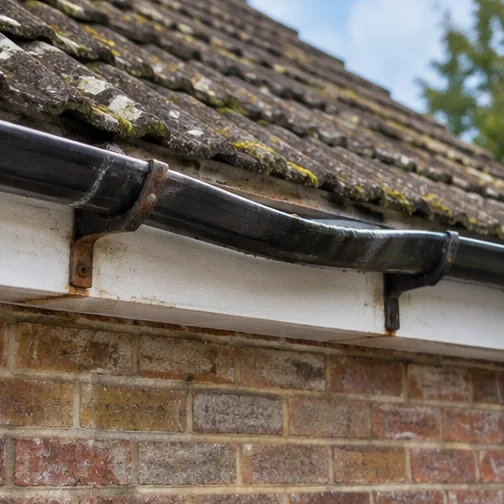
Confirm arrangements for the visit
| Site arrangement | What to confirm | Reason for confirming it |
|---|---|---|
| Reception and service entrance are separate | Meeting point and equipment route | Ensures access to the working position |
| Yard shared with deliveries | Space and when it can be used | Lets us discuss what can be reached |
| Several roofs under one address | Roof reference and nearest outlet | Defines the length included |
Close the visit with a clear reference for follow-up
We tell you which lengths were reached and which pipe openings were checked. For a managed site, we can describe the findings by the relevant entrance, roof reference or nearest visible fitting. If another person will organise any follow-up, give us the terms they use for the site. We distinguish an observed defect from a part that still needs inspection. A description of where a check ended can be as useful as a description of the debris removed when the route continues into an inaccessible space.
For a later visit, tell us about changes to the approach, the person who provides access or work carried out on the roof since the last booking. A repeated overflow at a different outlet needs to be identified as a new location. If access to part of the run was unavailable before, give us the updated arrangement and the site reference. We can discuss how to assess that part without assuming the earlier working position will cover it. If the enquiry has moved from clearance to repair, tell us which visible finding prompted it.
Questions about gutter visits in Holborn
Can we send a roof schedule instead of photographs?
A schedule is useful if it identifies the roof and outlet. Tell us what is happening and how to reach the area below. A wide photo can help where access is difficult to describe.
Can you work above the main entrance?
We assess the available working position and whether the entrance can remain in use. Give us the contact who can agree the arrangements.
Do you need the facilities manager at the building?
The person on site needs to provide access and identify the relevant area. Give us the manager’s details for findings or approval of any further work if they will be elsewhere.
Can you inspect a concealed outlet?
Ask about a camera view and describe the roof edge. What we can see depends on the position and reach available. We explain if a hidden part remains outside the inspection.
Can we book work for one part of a larger site?
Yes. Identify the included run and the outlet it serves. We discuss the working position for that part without assuming the rest of the site is included.
What if the outlet still seems restricted after clearance?
We say what was reached at the opening and describe where water still appears to back up. Any restriction beyond the accessible part may need further assessment.
Coverage and bookings
See the areas we cover. For nearby enquiries, see Bloomsbury and Clerkenwell and Covent Garden.