
Gutter Cleaning Pimlico
We clear accessible gutters in Pimlico and check the reachable openings into downpipes. If a terrace looks continuous from the square, that does not tell us where the channel ends or which pipe it uses. Tell us the property number, the elevation and the first point at which water appears. A wide photograph can help us discuss the roofline and where we might reach it.
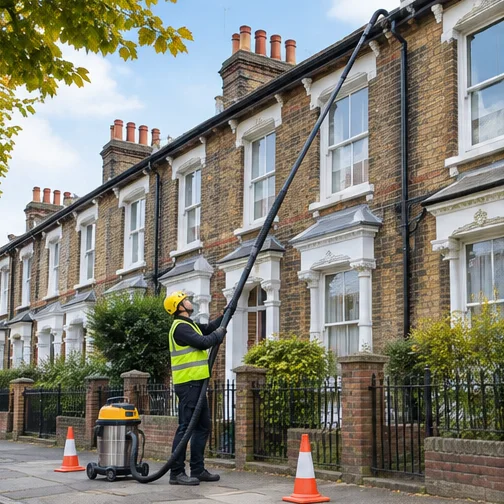
Illustrative photograph.
Identify the roof hidden behind the parapet
Westminster’s Pimlico audit describes terraces with a parapet concealing the roof structure, including examples around Eccleston Square and Warwick Square. If the gutter sits behind the top of the façade, you may only see water when it has already crossed a cornice or reached a balcony below. Tell us which level gets wet first and where the nearest pipe is visible. The pipe may sit beside a boundary rather than directly above the entrance. A picture taken from across the street can show where the parapet, lower features and downpipe sit in relation to one another.
The roof can also have a smaller length at the rear that is unrelated to the front run. Say if the problem appears by a lower extension, at an upper opening or at a seam in a pipe. If a previous roof visit gave you a view of the channel, tell us what part that view showed. We can use the information to distinguish the roof above a balcony from the balcony’s own outlet. The practical question is which run needs clearing and where we can see and reach its opening. Knowing the architectural style alone does not answer it.
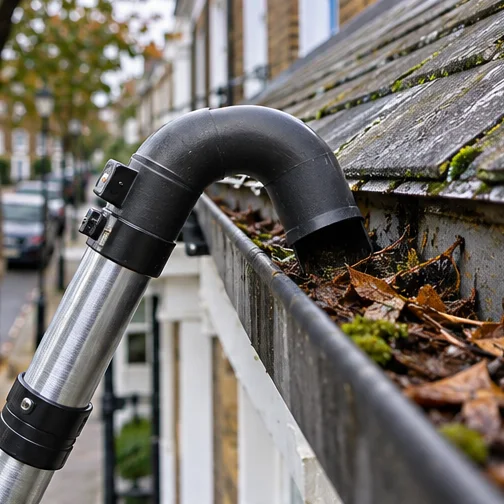
Work out which approach is available below each run
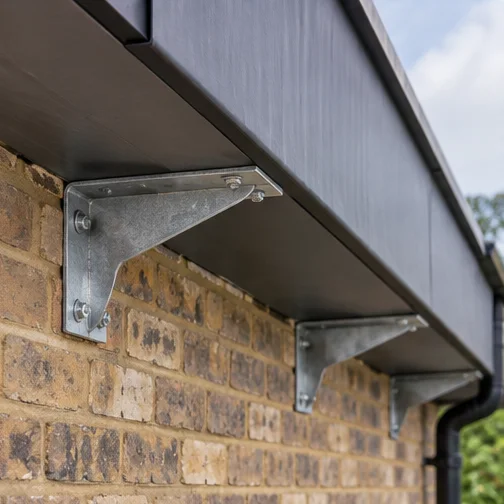
There may be a lightwell or stepped entrance between the frontage and the street. Tell us where there is usable ground and whether access to the lower area is through a separate gate. A long reach pole needs a suitable position as well as enough height. A balcony or portico can restrict the angle from which the gutter can be approached. If you can send a view along the frontage, include the projection and the nearest open space. We can discuss whether the setup might work from the front or whether another approach would need to be arranged.
For the rear, tell us who can open the route and where it leads relative to the gutter. If a garden or lower courtyard belongs to a separate flat, give us the person who can provide access and the contact who can approve the work. If you are booking the front and rear together, describe the arrangements for both. One approach may be usable on the day while the other needs a separate visit. We agree the lengths and working positions so the account of the visit can say which gutters were included.
- Distinguish the upper channel from a balcony outlet.
- Show any portico, steps or railings below the roof.
- Identify the nearest visible downpipe.
- Name the person who can open a separate rear or lower area.
Clear the agreed run and check the reachable outlet
Where the gutter can be approached from a suitable position, we use reach poles and a gutter vacuum to remove accessible leaves, moss and compacted debris. We work along the channel and check where water enters the pipe. Material can build up at the outlet even when the part of the gutter that is visible looks relatively clear. We remove what can be reached at the opening. If the outlet is hidden behind a parapet or turns into an enclosed pipe, we explain which section was accessible and whether another part still needs investigation.
If you need a camera view of the channel, ask about it in the enquiry. A view from a suitable position may show an obstruction or standing water behind the roof edge. It does not establish the condition of fittings that are enclosed or cannot be seen. If the gutter is clear but the water does not leave the visible section, we describe where it remains. The cause could be a restriction outside reach or a fault with the fitting or support. Read about our gutter cleaning service for more on the equipment and the checks that may be possible.
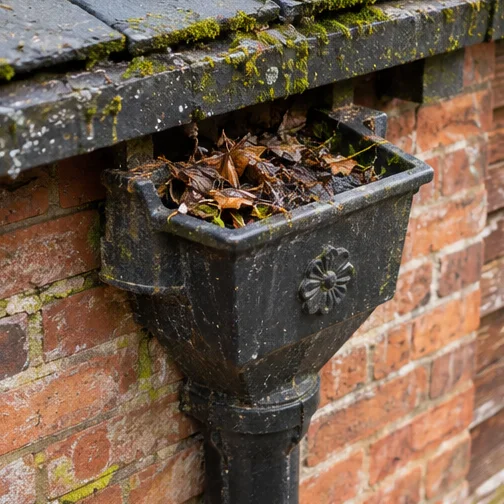
Follow the drip down a Pimlico frontage
| Where you first see water | Reachable check | Useful detail |
|---|---|---|
| Along a cornice below the parapet | Visible edge and accessible outlet above | Nearest corner or downpipe |
| At the edge of a balcony | Lower gutter or outlet and discharge from above | Whether the upper wall wets first |
| Beside a basement entrance | Visible pipe and any reachable opening | Where water first appears in rain |
Consider the fitting if water still escapes
If there is a visible leak at a seam or a section that has moved, we can discuss repairing the gutter after considering its condition. A sound supported channel may be considered for lining where its surface is failing. If a length has deteriorated beyond a suitable repair, we can discuss how replacement might join the existing profile and the outlet. The point where water appears on a cornice may be below more than one fitting, so we explain what was seen before deciding which work is appropriate.
If growth obscures the pipe or keeps a fitting from view, tell us where it is rooted and which section you want exposed. We can discuss cutting back ivy where there is access. If moisture has reached a room, give us the location of the mark and when it first appeared. We consider water damage repair separately from the accessible clearance. A mark near a window may need its own assessment if the roofline check does not establish the route. We explain what was visible and which part remains uncertain.
Work we can discuss after clearance
Gutter cleaning
We clear accessible runs agreed by level and check the reachable opening each serves.
Guttering repairs
We assess the visible seam or support where water still appears after clearance.
Gutter lining
We assess a supported concealed channel and its outlet before discussing lining.
Gutter replacement
We look at the existing profile and outlet when discussing renewal of a failed length.
Ivy removal
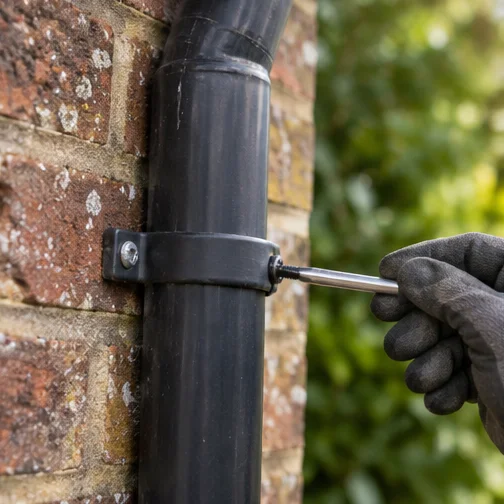
Tell us if growth hides the pipe or prevents a useful view of the fitting.
Water damage repair
We can discuss damage to a room or finish separately after locating the reported water outside.
Describe the work by length rather than by frontage alone
We tell you which runs were cleared and which openings were checked. If the booking included a lower balcony gutter as well as the upper roof, we describe them separately. If we saw a local fault, we give the position by reference to a window, corner or pipe. Where we could not reach a part, we identify the limit and explain what access might be needed. That helps the owner or manager decide whether a further assessment should concern the upper channel, a lower outlet or another visible fitting.
For the next visit, tell us if the access arrangements have changed or if a different occupier now controls the ground below the roof. If the issue has moved from the front to the rear or appeared at another level, give us the new location. A continuous-looking parapet can cover separate runs and outlets. An account of the previous visit helps when it names the part that was actually cleared, rather than simply recording the address. If there has been a repair since, tell us which seam or length was changed.
Give us the available position before arranging the visit
| Approach | Detail to send | What it helps assess |
|---|---|---|
| Street frontage with steps | Ground beside the steps and height of the roof | Position below the upper run |
| Lower front area behind railings | Gate, access and any balcony above | Whether the position is usable |
| Rear garden or courtyard | Person who can open it and space below the run | Route to an independent rear gutter |
Before we assess the roof edge
Questions about gutter visits in Pimlico
Can you check a gutter that is hidden behind a parapet?
Tell us the height and where the nearest pipe can be seen. We assess what can be reached and whether a camera view would help.
Can the balcony outlet be included with the main gutter?
Describe each outlet and the access to it. We can discuss both as separate lengths if they can be reached.
Why is the stain lower down than the gutter?
Water can follow a fitting or a wall before it becomes visible. Tell us which level becomes wet first so we can discuss where to start.
Do you need access to the basement area?
It depends on the position below the roof and where the equipment can stand. Show us the railings, steps and any nearby ground before booking.
Can you check only the rear?
Yes, if the run is identifiable and the route can be agreed. Tell us who can open the rear and where the pipe serves that length.
What if the manager needs to organise a separate repair?
We explain what is visible and identify the fitting by its position. Give us the manager’s contact and the reference they use for the affected elevation.
Coverage and bookings
See the areas we cover. For nearby enquiries, see Belgravia and Victoria and Westminster.