
Gutter Cleaning Mayfair
We clear accessible gutters in Mayfair and check the reachable openings into downpipes. If leaves collect on a roof facing a square but the gutter is out of sight, tell us where the water first appears and where the nearest pipe runs. We can use those details, together with the available access, to discuss which lengths should be included.
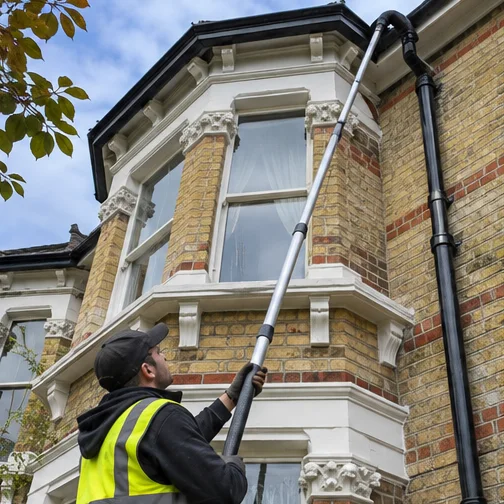
Illustrative photograph.
Confirm how to approach the gutter beneath or behind the frontage
A raised entrance or lightwell may occupy the space directly below the roof. Tell us where there is usable ground and what lies between it and the gutter. If the route is from the rear, describe the gate, steps and any lower roof that limits the approach. We consider the reach and angle of the pole as well as the space for the collection drum. A front gutter may need a different position from a rear one. If you want both included, send details for each rather than assuming the same approach works for the whole property.
At a managed property or business premises, give us the contact who can confirm the working area. The person receiving visitors may not control a yard or the area beneath the gutter. If the approach passes through another part of the building, tell us who can give access and which route needs to remain available. We discuss the work that can be approached from the agreed positions. If one length requires an arrangement you cannot provide for the visit, we explain that before including it in the booking.
- Show which side of the building faces the reported overflow.
- Distinguish visible leaves from a drip at one fitting.
- Identify the approach beneath any lightwell or raised entrance.
- Tell us where the nearest pipe starts.
Clear the debris and check the point where the run empties
We confirm the agreed channel and locate its accessible outlet. On suitable runs we use reach poles and a gutter vacuum to collect loose material and the heavier debris that settles inside the gutter. The section near a corner or pipe opening can hold more material than the part that is visible from below. We work along the accessible length and clear obstructions that can be reached at the opening. We distinguish the gutter from the pipe beyond the point we can inspect. A restriction inside a concealed pipe or below the ground may need separate investigation.
Ask about a camera view if the gutter is behind a roof edge or you want to see a section for a maintenance record. What can be shown depends on the working position. A view of the channel can help identify an accessible blockage or show water that remains, but it cannot establish the condition of enclosed fittings. If a previous appointment dealt with leaves on one side but not the other, give us the location of the new report. Read about our gutter cleaning service for more on the typical equipment and access considerations.
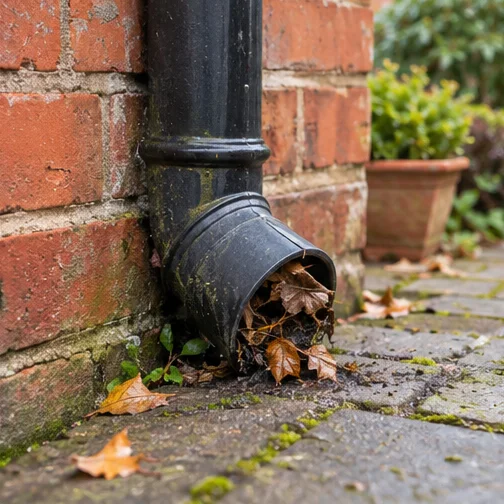
Identify the gutter before deciding that fallen leaves are the cause
Westminster describes mature plane trees around Berkeley Square Gardens. For an individual property near a square or on an adjoining street, the presence of trees does not show what is inside the gutter. Tell us if you can see leaves at the roof edge, water held in the channel, or a drip at a particular fitting. These observations help us decide where to start looking. A gutter can be blocked by a compacted layer that is hard to see from the ground. Conversely, a leaking joint can remain a problem even when leaves are present nearby. We assess the accessible run before discussing what is causing the spill.
Give us the property address and the side of the building. If you only see water lower down, tell us where it falls relative to a balcony, canopy, window or pipe. A wide view can help show which gutter serves that part of the frontage. Where the report is from the rear of the building, mention whether the nearest roof is the main building, a lower addition or a separate property. The position of a tree or a wet patch can be a useful reference when you can also identify the roofline. We do not assume which gutter you mean from the street name alone.
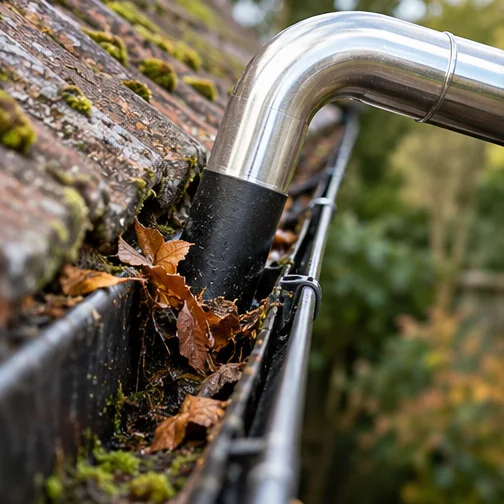
Work for other parts of the rainwater system
Gutter cleaning
We clear the agreed accessible run and remove reachable material from its outlet.
Gutter replacement
We consider how a failed length can be renewed alongside sound fittings.
Gutter lining
We assess the condition and outlet of a supported concealed channel before discussing lining.
Guttering repairs
We look at the visible seam or support where water continues to appear after clearance.
Water damage repair
Tell us which indoor finish became wet and when so we can discuss that separately.
Ivy removal
We can discuss opening up access to an obscured pipe or wall fitting.
Distinguish debris from a continuing leak
| Observation | Reachable check | Useful detail |
|---|---|---|
| Leaves visible near the outlet | Accessible channel and pipe opening | Position of the debris relative to the nearest corner |
| Drip stays at one seam | Visible joint or support | Whether the gutter has already been cleared |
| Water falls onto a lower roof | Upper run and independent lower channel | Which edge becomes wet first |
Consider the visible fitting after debris has been removed
If the gutter still drips from a seam, we consider the condition of the accessible joint or support and can discuss guttering repairs where appropriate. A failed length that cannot be repaired may need replacement. We consider how a new length would meet the adjacent gutter and outlet. A sound supported channel with a failing surface can be assessed for gutter lining once its condition is visible. We discuss what can be established from the accessible position and what would need a separate inspection before any additional work is agreed.
If growth conceals a fitting beside a rear wall, tell us where the ivy begins and what part you want to see. We can discuss cutting the growth back where access is available. Where rainwater has reached the inside of a room, identify the surface and say when it first became wet. We can discuss water damage repair separately from clearing the roof drainage. We use the visible locations to distinguish a continuing fault at the gutter from damage that has already occurred indoors. A stain near the frontage does not by itself establish the route from the roof.
Keeping track of several independent runs
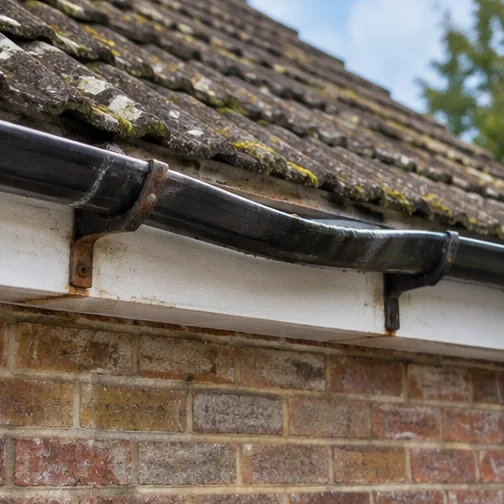
Explain what was cleared and what might need another visit
We describe the runs we reached and the accessible openings we checked. If debris was cleared but water still appears to back up beyond the reachable opening, we explain where the inspection ended. A visible damaged fitting is recorded by reference to the nearby roof edge, pipe or window. Tell us who should receive the findings if a different person will organise the next step. Where a length could not be reached from the working position, we distinguish it from the part that was cleared.
If you arrange clearance again, tell us where leaves or overflow have reappeared and whether access has changed. A record of the previous visit is useful when it gives the actual location of the cleared run. If the enquiry is about a different part, give us a new reference instead of assuming it belongs to the same gutter. Mention any repairs or other changes to the roof since the previous visit. That helps us understand what was already dealt with and what may need a different assessment.
Questions about Mayfair gutter clearance
Does a tree near the building mean the gutter is blocked?
It does not establish the cause. Tell us what you can see of the channel and where water appears so we can discuss the accessible checks.
Can you clear one side of a building at a time?
Yes, where the length can be identified and reached. Tell us the outlet it serves and how the working position can be approached.
What if water keeps dripping once the leaves are removed?
We look at the visible fitting and describe what still needs assessment. A local joint may need separate repair.
Can you inspect a gutter behind a roof edge?
Ask about a camera view. We discuss what the position and available reach allow before agreeing the work.
Who can arrange access if I will not be there?
Give us the person who can open the route and identify the gutter. Tell us who can agree any work beyond clearance.
Should I keep the findings for another visit?
Yes. Keep the location of the cleared length and any remaining issue. Tell us if the next enquiry concerns a different outlet or if access has changed.
Give us the approach beneath the roof
| Position | What to confirm | What we can assess |
|---|---|---|
| Frontage facing a square | Ground below the run and any lightwell | Working position near the façade |
| Rear access | Gate, steps and contact who can open it | Route to the gutter |
| Courtyard below a separate roof | Space to set up and identify the included length | Reach to the relevant outlet |
Coverage and bookings
See the areas we cover. For nearby enquiries, see Marylebone and Soho.