
Gutter Cleaning Harold Wood
Tell us if the gutter behind your Harold Wood home sits over a kitchen extension, a utility room or a glazed roof. A back gate can give easy access to the garden while the extension still prevents a direct approach to the main roof edge. Glen’s cleans accessible gutters and checks reachable downpipe openings. We use photographs to assess where we could work and which roof edges we can include.
Start with a picture from the far end of the garden. Show the upper gutter and the entire extension in the same frame, including the route between them and the nearest solid surface. If water runs into an open doorway or leaves a wet patch by a window, mark that point separately. The position of the water helps us understand which roof edges to examine first.
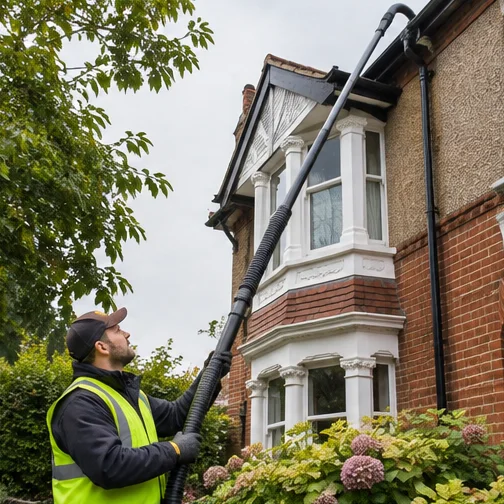
Illustrative photograph.
Show the route from the gate to the working area
Give us the name or position of the gate you intend us to use. At the start of the path it may be possible to carry equipment through, but a wall projection, drainpipe or step can reduce the available width further along. Photograph the tightest point with the gate open. Say whether the path leads to the full width of the garden or ends in an enclosed strip where the roof edge is hard to approach.
A patio can provide a clear view while the nearest usable position is occupied by a raised planter. A gravel area, slope or small retaining wall can also affect where equipment can be set down. Show both the surface and the roof edge if you can fit them into one picture. If reaching the rear involves access through a garage, tell us whether it has doors at both ends and what can be moved. Give us the route as it will be on the day, including any outdoor furniture that usually stays in place.
- Photograph the extension from the garden and from one side
- Show the narrowest point between the rear gate and patio
- Identify any pipe that empties over the lower roof
- Describe when damp first appears beside a rear window
See where the extension changes the route
The most useful rear elevation photograph is often taken at an angle. From straight on, the main gutter can appear to sit directly over the edge of the patio. From the side, you can see whether it is actually behind the extension roof and how far it is set back. Photograph the other corner too if the roof changes height or the boundary cuts close to the house. Mention any feature hidden by the camera angle, such as a low fence across a passage.
A side view also shows whether a shorter lower gutter stops at the corner of the extension or continues along a return. If the lower gutter is the one you can see spilling, include a view of the roof above it. Water may leave the upper gutter, strike the lower roof and travel into the lower gutter some distance from the first spill. We can use the photographs to set out which runs are included in gutter cleaning and decide if either needs further access to assess.
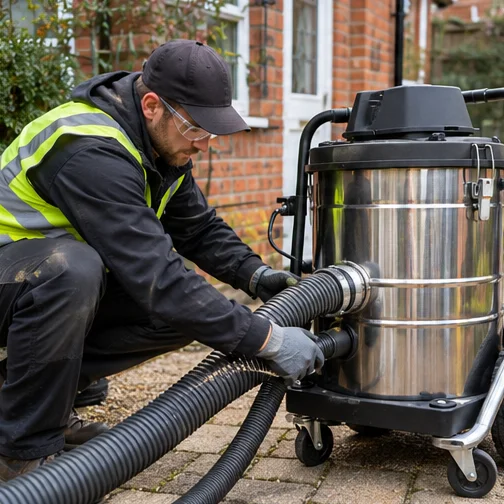
What to send for a Harold Wood booking
| Detail | Useful photograph or information |
|---|---|
| Extension depth | Side view showing how far it projects from the main wall |
| Upper gutter | Wide rear image including both ends of the roof edge |
| Working surface | Clear view of patio, steps, edging and objects that stay in place |
| Downpipe connection | Where the upper pipe goes and which outlet serves the lower roof |
Check whether the lower roof receives discharge
An extension gutter can fill with debris from its own roof or receive material washed off a higher one. Look for a short pipe that ends above the extension or a shoe that points towards it. Photograph that end if it is visible and include the channel the water eventually reaches. Where the upper pipe continues down beside the extension wall, show the lower end as well. It may use a different drain from the one serving the extension.
We remove reachable material from the agreed gutter lengths and check the openings we can access. The first pipe opening and the final discharge point may be separated by several bends or an enclosed length. If water regularly rises out of a ground-level drain when the roof is shedding rain, note whether it happens immediately or after a period of rainfall. Tell us which other pipes meet the same point. This can help decide whether there is a roof-level issue to assess or whether the drain itself needs investigation.
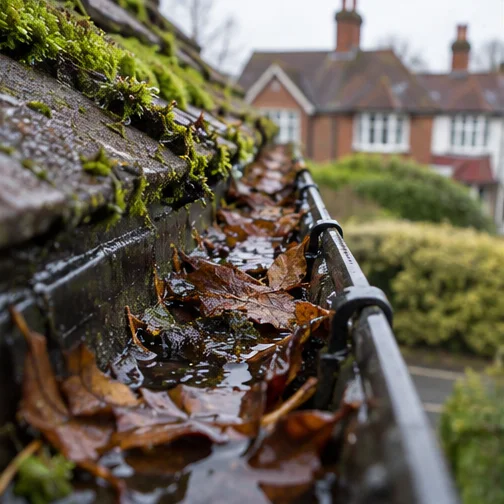
Make the next visit easier to specify
Keep a record of which edges were covered and which were hard to reach. For the upper rear gutter, write down which corner or wall the previous visit used as its reference point. If part of a channel carries around the side of the property, note whether the return was included. This is useful if the same wet patch returns, if you need to arrange additional access or if another member of the household books the next clear.
If you plan to extend, replace an external door or change the paving, take a photograph of the pipe base before work begins. A new surface can change how a gully is approached and how much of the pipe you can see. If you later ask about replacing a gutter, tell us what you intend to keep, including any outlet that must continue to serve the existing roof. For a rental, give the occupier the agreed roof edges and timings, and make sure they can reach whoever is arranging access if there is a change.
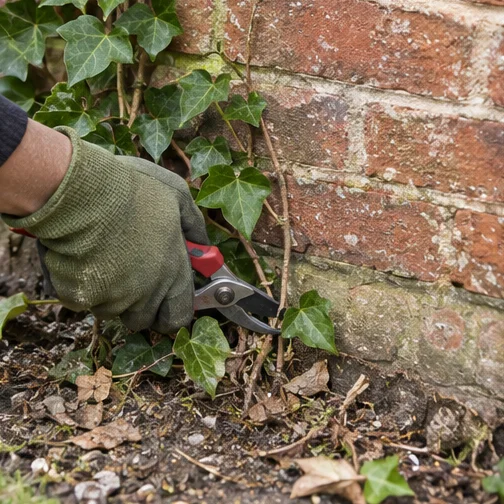
When upper and lower gutters need separate attention
Use the window position to describe the symptom
For a wet patch beside a rear window, photograph the wall from outside and show where the patch is on the inside. Say whether it is above the head of the window, below the sill or off to the side. The equivalent point outside may be alongside a pipe or under a joint between the extension roof and the original wall. Note whether the patch starts while the rain is falling or becomes visible the next morning.
A clean gutter can allow a clearer view of an outlet, support or union. If an accessible joint is visibly damaged, we can describe it and discuss gutter repairs separately. If the gutter and outlet are clear but moisture still appears around the window, water ingress assessment can consider other visible routes. Send any photographs taken before a previous repair and include the date if you know it. Changes in the shape and position of the damp patch matter more than a single photograph of discolouration after everything has dried.

What to note during rain
| Observation | What the timing or position can show |
|---|---|
| Water crosses the extension roof before dripping | Whether it may be coming from the roof above |
| Lower gutter overflows close to the door | Which outlet and adjacent gutter length to check |
| Water appears first around a gully | Whether discharge at ground level needs assessment |
| Damp forms above the rear window later | Which junctions to consider alongside the gutter |
Other work on the extension and roofline
Gutter cleaning
Clear accessible upper and lower runs listed for the property.
Gutter replacement
Consider how a replacement run will connect to the outlet beside the extension.
Guttering repairs
Check visible damage at a support or union near the upper rear wall.
Ivy removal
Assess stems growing from the fence into the gap beside a lower gutter.
Gutter lining
Assess the condition of an existing channel where the extension roof obscures it.
Water damage repair
Compare damp around the extension window with visible water routes above.
Coverage and bookings
See the areas we cover. For nearby enquiries, see Gidea Park.
Harold Wood gutter cleaning FAQs
Can you get to the upper gutter from beyond the extension?
We can assess this from the side and rear photographs. Show the extension depth, upper roof height and the surface we would approach from. Tell us if any roof panels are glazed or if there is an enclosed gap down one side.
Can the lower and upper gutters be booked together?
Yes, where both are reachable. Include a wide view showing the two heights and a close view of their outlets. We can describe the agreed roof edges when booking.
Do you need to use the inside of the house?
That depends on the route to the rear and where the work can be carried out. Tell us if there is a clear route via the side, a rear gate or a garage. If access relies on somebody being home, give us their contact arrangements.
What if the extension gutter is blocked beside a fence?
Send a photograph looking down the gap from each end you can reach. Let us know how wide the gap is and whether a gate or fixed panel closes it off. We can then consider access for that section.
Can you clear a pipe that goes into the patio?
We can check a reachable opening as part of the agreed clear. If the restriction appears under paving or in an enclosed pipe, it may need separate assessment. Describe what happens at the base during a shower.
How should I report an old drip?
Give the location, the last time it happened and whether anything has changed since. A picture showing the drip in relation to a door, pipe or wall corner is useful even when the surface is dry. If another contractor previously worked nearby, identify the part they dealt with.