
Gutter Cleaning East Acton
We clear accessible gutter channels in East Acton and check the openings that feed the downpipes. If water appears between two parts of the building, show us where the rooflines meet. A corner that receives rain from several directions can be difficult to diagnose from the floor below. A view of both elevations gives us a starting point for discussing what to clear and how to reach it.
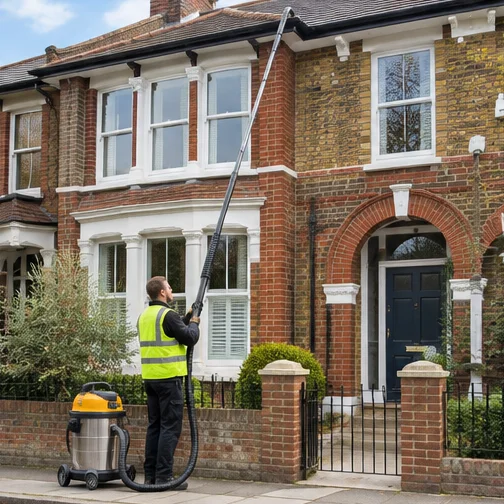
Illustrative photograph.
Look at the turn between the elevations
A gutter can turn around a corner without having a downpipe at the turn. Water arriving from one side may continue along the other side before it reaches an outlet. If the channel spills at the corner, we ask what the next section does and where the nearest pipe sits. We want to know whether the water escapes at a join, crosses the outside edge or comes from a roof above.
A corner at the point where an addition meets the original building can be harder to interpret. There might be a separate channel just below the higher roof. A rainwater pipe from the higher section could discharge into that channel, or it could run all the way down the wall independently. A photograph taken from a diagonal position can show how the surfaces and pipes sit in relation to each other. Tell us if a roof has been added or altered since you first noticed the problem.
If rainwater overshoots the front edge of a gutter, the wall beneath may look as wet as it would after a blockage. The distinction matters because removing debris addresses an obstruction in the channel. It does not alter how the roof delivers water to it. Tell us what you see in a short shower as well as in heavy rain. We can check the reachable channel and discuss whether a visible issue at the edge needs looking at separately.
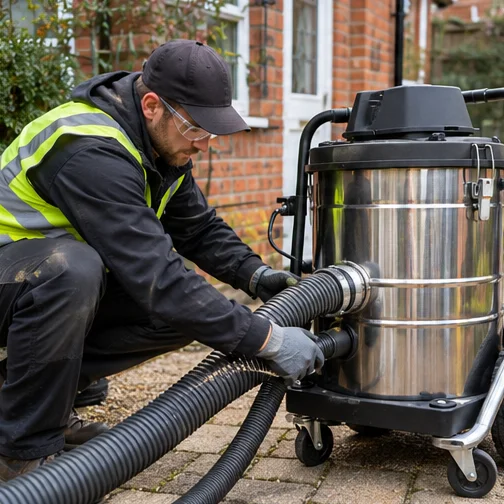
Include the details that change the visit
Tell us if rain falls down the face of the wall only at the corner or along a stretch of the adjoining elevation. That helps identify which parts of the channel we need to discuss with you. If there are two downpipes near the join, include both and show how they connect to the gutter as far as you can see. A photograph from the ground can give useful context even if the inside of the channel is hidden.
If the property has different keyholders for the front and rear, put us in touch with the appropriate person for each working position. The corner may need to be approached from both sides, and one gate may only be available at certain times. If the adjoining channel belongs to a different property, establish which work you are arranging. We explain any further access we would need if a visible defect is outside the lengths already agreed.
Find a position that reaches either side
The ground below the corner might be divided by a fence or boundary wall. Let us know which side can be approached from your property. If there is a gate, describe whether it opens to a path or onto a different level. We discuss where a vacuum can stand and where the pole can be raised. A corner may be reachable from one direction without being approachable from directly beneath it.
If there is a car parking area next to the gutter, tell us where vehicles will be during the visit. A space on a plan may be unavailable when we arrive, or the path to it may pass a door that needs to remain open. For a flat or rented home, give us the name of the person who knows the route and who can let us into shared areas. Let us know if the person approving the work will be somewhere else.
Do you need us to approach the back as well as the side? Explain whether we can move between them without taking equipment back through the house. If a porch, lean-to or conservatory sits below the channel, show how far it projects from the wall. That gives us a better idea of what we can reach than the height of the eaves alone.
- Photograph both sides of the turn from ground level.
- Point out the downpipe that serves the affected channel.
- Tell us which side has space for a vacuum and pole.
- Mention changes to the roof or a recent repair to the corner.
Compare available working positions
| Ground below the return | What to describe | Decision it helps with |
|---|---|---|
| Narrow path inside a boundary | Width and available entrance | Whether equipment can be brought to that side |
| Area shared with parked vehicles | Positions that will stay available | Where the vacuum and pole can be placed |
| Garden with a roof projection | Distance from wall and depth of projection | Which part of the gutter can be approached |
Check the channel on both sides of the corner
We agree the lengths at the start. Where there is a suitable ground position, we use a gutter vacuum and reach poles to lift debris from the accessible channel. Material can accumulate at a turn where the profile changes or the surface meets a join. We clear the agreed length towards the outlet and pay attention to compacted silt that might stay behind after loose leaves have been collected.
We then look at the reachable downpipe opening. If there is debris across the entrance, we clear what we can reach. If the next section is out of sight, a camera can help us inspect part of the channel when the position allows it. Let us know if you want a view of a particular return or joint. The view can be useful if you are arranging work on behalf of the owner and cannot see the roofline from where you live.
After the visit we identify the section reached from each position and tell you if anything remained inaccessible. If the corner is clear but the water still escapes in the same place, we discuss what else might be causing it and whether a separate inspection is appropriate. Our gutter cleaning page explains how we agree the work and check reachable outlets.
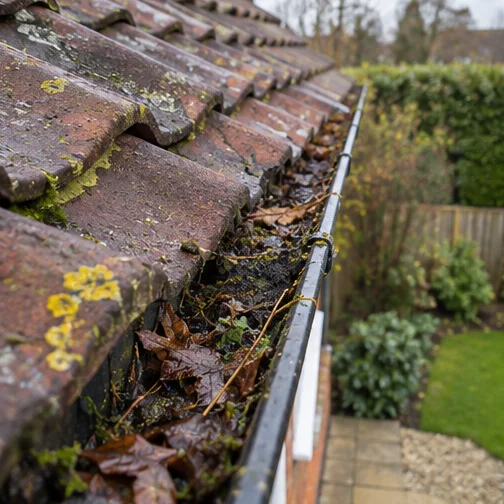
Separate work at the premises
Gutter cleaning
We agree the accessible lengths leading to and from the corner.
Ivy removal
We can discuss cutting back growth that hides a fitting on either side of the turn.
Guttering repairs
A leaking corner union can be discussed after reachable debris is removed.
Water damage repair
We ask where water has marked the inside and whether the source has been resolved.
Gutter replacement
We assess how a new return would connect to the rest of the run.
Gutter lining
For a concealed channel, we look at the surface and how the lining would meet the turn.
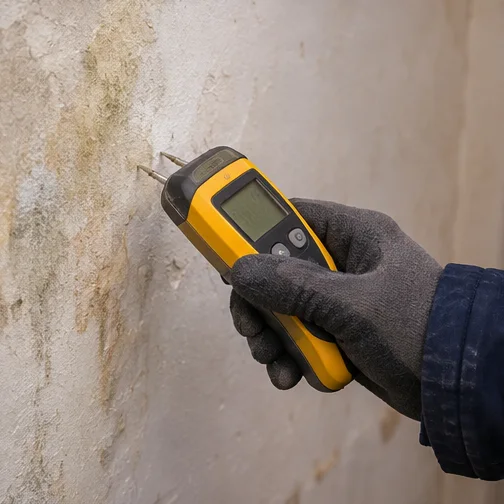
Identify the symptom at a corner
| What happens in rain | What we look at | Useful detail |
|---|---|---|
| Water leaks at a single join | Fitting and nearby debris | Whether it leaks in a light shower |
| Flow comes over the face at the turn | Accessible lengths leading into and out of the corner | Which side begins overflowing |
| Rainwater arrives from a higher roof | Upper pipe or gutter and the lower channel | View showing the connection between levels |
Decide whether the corner needs a fitting or a new length
A visible leak at a union can remain even after we clear the channel. In that case, we can discuss repairing the gutter join and look at whether the adjoining lengths are sound. If an angle or end fitting has separated, tell us when you first noticed it and whether the channel has moved since then. If the condition affects a longer length, we can consider replacing the section around the return. We assess how it would connect to the rest of the run.
A supported concealed channel with a failing surface may be a candidate for lining, subject to its construction and the condition of its outlet. If ivy obscures the join or pipe beside a boundary, we can discuss cutting back the growth to improve access. If rain has already affected an indoor finish, tell us where the mark is and whether the source of the water has been resolved. We consider assessment of the damage separately from clearance at the eaves.
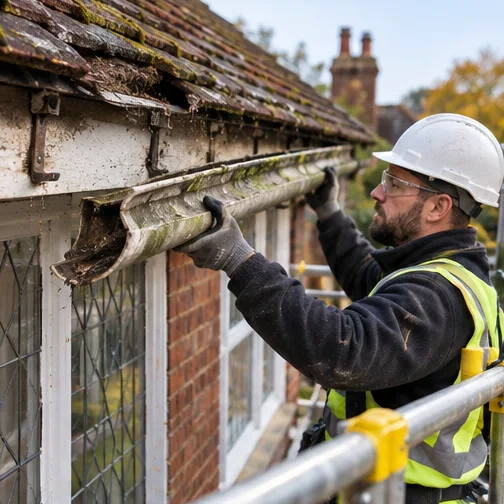
What helps when several people report the leak
Coverage and bookings
See the areas we cover. For nearby enquiries, see Acton and Park Royal.
East Acton booking questions
Can you clear one side of a continuous gutter?
Tell us where the length turns and which outlet it serves. We can discuss which section can be reached from your side.
What if my neighbour has the only clear view of the corner?
Send what you can see from your property. We can discuss whether their permission or a different working position would be needed.
Can you tell if water is missing the gutter entirely?
Tell us where the water lands and in what conditions. We can check accessible debris and look at visible roof-edge details before discussing further work.
Do I need to move a parked car?
Explain where it normally stands and which part of the roof it is below. We can tell you what space we expect to need.
Is a corner joint repair part of a clearance?
Clearance and repair are separate. If a visible defect remains, we explain the finding and can discuss an additional repair.
Will a camera show both sides of the turn?
That depends on the position and the shape of the gutter. Ask about the view available from each side when agreeing the visit.