
Gutter Cleaning Croydon
Book gutter clearance in Croydon for a house, managed building or commercial premises. Tell us if the address has more than one entrance or a separate loading area. The place where someone notices rainwater can be some distance from where the gutter can be reached. A note giving the nearest door and the roofline above it helps us work out which part of the system needs a visit.
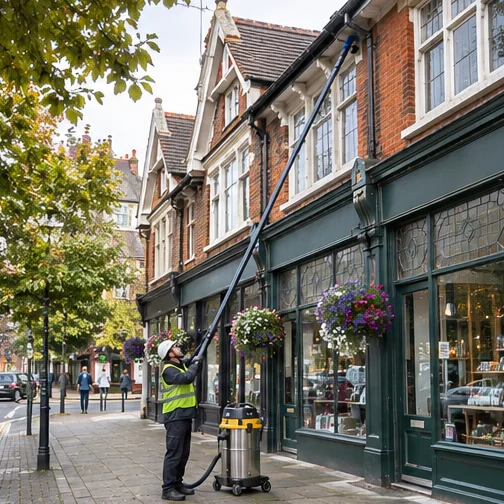
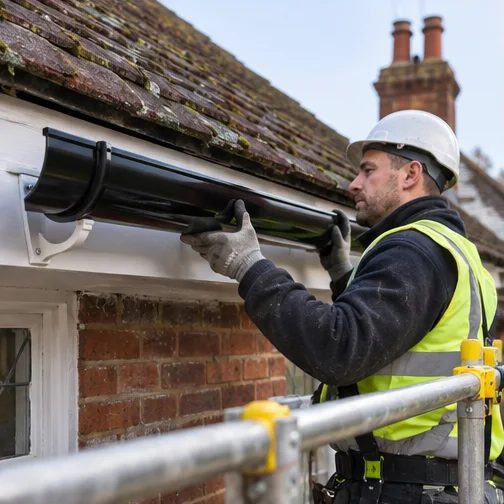
Illustrative photograph.
Agree how people will use the ground below
On a commercial site, tell us when staff need to get through the doors beneath the gutter and who can agree a suitable working position. A service road may look empty in a photograph but be needed for collections at certain times. If there is room beside the route, show us where the space starts and how the equipment would get to it. Where access depends on a site manager or security staff, let us know how they expect visitors to arrive.
If the affected run is on a house, the equivalent detail might be who can move a vehicle from the drive or give access to the side passage. We ask about overhead obstructions, uneven ground and any lower roof between the ground and the gutter. Tell us if the working area is used by another occupier. We can discuss the visit when we know which parts of the site can be reached.
- Identify the door, unit or gate below the overflow.
- Say when a loading route needs to remain open.
- Give contacts for access and approval separately.
- Name the gutter runs in the maintenance record.
Find the roofline above the right entrance
If you manage a site with several entrances, start with the door or gate closest to the overflow and say what is above it. A report that water falls at the front of the building may refer to the entrance customers use rather than the elevation facing the road. When the building wraps around a corner, the channel can feed a pipe on the other side. A wide photograph of the corner is useful if you can take it safely from ground level.
A downpipe behind a loading bay may carry water from a roof over an entirely different entrance. If you have a drawing or can describe where the pipe emerges, include that with your enquiry. We use the details to agree the lengths that are part of the booking. We do not assume that clearance of a visible channel includes a concealed system elsewhere at the same address.
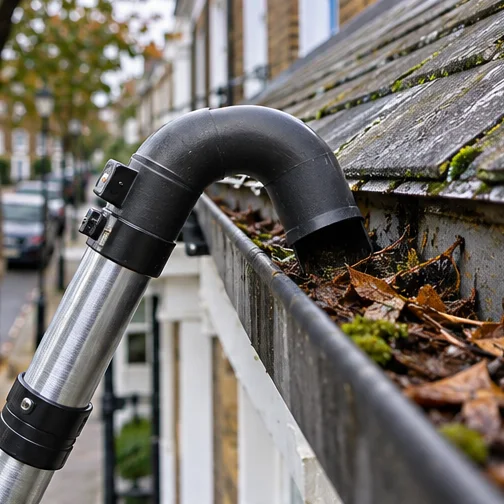
Identify the run at a site with several entrances
| What you notice | Detail to send | What we check |
|---|---|---|
| Water above a loading door | The roof edge and the nearest downpipe in one view | Outlet serving the relevant run |
| Drip beside a corner entrance | Which elevation is wet first | Joint where the runs meet |
| Water by a staff gate | Where the visible pipe ends | Accessible opening and discharge |
Clear the agreed runs and note what is still hidden
We check the accessible gutters before setting up the vacuum and reach poles, where they are suitable for the height and position. We collect leaves, moss and packed debris into the drum and work along the length, paying particular attention to corners and outlet openings. At a long run there may be more than one outlet. If some lengths were cleared previously, identify them so we can discuss where to begin.
When we check an opening, we remove material we can reach without treating the full concealed length of pipe as part of a standard clearance. If the top was blocked and the water still appears to back up, we explain which point we can see and what needs investigating separately. A camera can be discussed if you want a view of an unseen section or need to pass the findings to a colleague. We agree what the working position is likely to allow.
For a rear yard with fixed equipment beneath the gutter, the safe position may be farther from the wall than it first appears. We tell you if that restricts what can be reached and discuss other access before including the affected length. The fact that one elevation can be cleared with a vacuum does not establish that the same setup will suit a taller or obstructed part of the building.
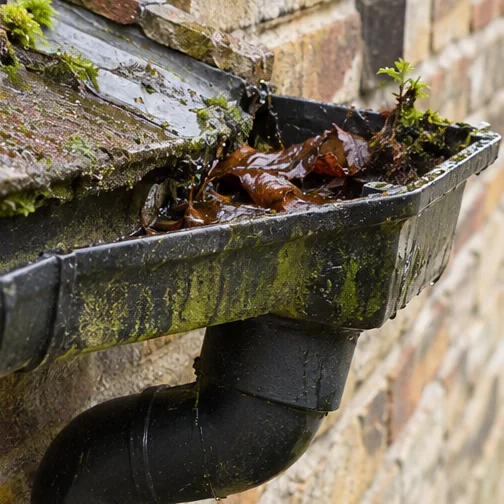
Pass the result to the person who can act on it
We explain which sections were cleared, which openings were reached and whether any visible defect remains. If several teams use the premises, let us know who should receive the findings. A site contact who opened the gate may not be the person who handles a repair quote. Giving us both names lets us describe the part of the building in terms everyone recognises.
A maintenance record is more useful when it says which side of the building was worked on. If you have names for the elevations or different units, use them at booking. If a run was left out because it could not be reached, note what was in the way so access can be considered before another visit. Ask about a camera check if a manager working elsewhere needs a view of a particular fitting.
To arrange clearance, send the Croydon postcode, the building height and the name of the nearest door or yard. If water runs down a wall before reaching the ground, say where it first appears. Let us know which parts have been inspected already and whether the problem began after alterations. If the site has a gate that is only opened at certain times, include the contact who can meet us there.
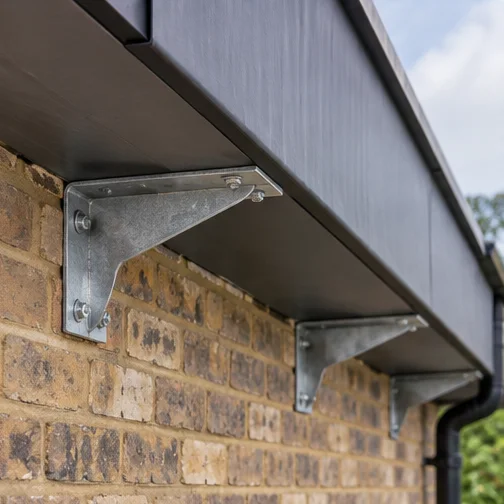
When upper and lower gutters need separate attention
Identify follow-up by fitting and location
If a union drips or a support has moved, we can discuss gutter repairs once we have identified the affected position. If an older run has damage at several points, we can consider renewing the gutter. We discuss how new sections can meet an existing outlet or return. Where a supported channel has a failed inner surface, we can assess whether a liner is suitable after checking the channel and the opening it feeds.
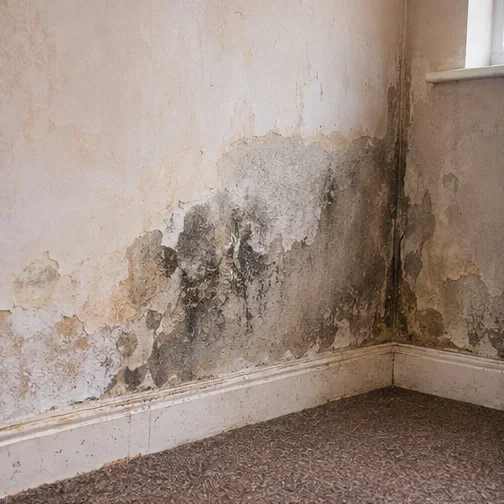
Ivy around a rear pipe may obscure its clips. Tell us how far you want it cut back so we can discuss access to the fitting. If water has reached internal finishes, ask about assessing the water damage separately and say whether the entry point has been addressed. See our main gutter clearance service for the usual work covered by a clearance visit.
Record access and results
| Information | Before clearance | After clearance |
|---|---|---|
| Working position | Who can agree where the equipment can stand | Any position we could not use |
| Included gutter runs | Which elevation or unit needs work | Which lengths we reached |
| Outlet or fitting | Where the reported leak first appeared | Visible issue and any separate work |
Other work on the extension and roofline
Gutter cleaning
We vacuum debris from accessible channels and check the reachable opening into the pipe.
Gutter replacement
We discuss which lengths and fittings need replacing and which adjoining parts can remain.
Guttering repairs
We look at local faults such as a leaking joint or loose support before agreeing any separate repair.
Ivy removal
We assess growth around rainwater fittings and discuss how far it can be cut back.
Gutter lining
We inspect the support and outlet before discussing a renewed waterproof surface for a sound channel.
Water damage repair
We discuss assessment and drying for affected surfaces once the route of water entry is understood.
Coverage and bookings
See the areas we cover.
Croydon booking questions
Can we book the back of the building separately?
Yes, if we agree the rear runs and can reach them. Tell us if the outlet also serves a gutter on the side so we can check what is connected.
Can the equipment stand in a loading area?
Tell us when the area is in use, who controls it and whether there is space beside the route. We discuss the working position before agreeing the visit.
What if the roof is higher on the road side?
Give us a view from both sides and say where the ground changes level. The height and working distance may differ even along the same roofline.
Who needs to be available if a fitting is damaged?
Give us a contact who can approve further work and the person who can identify or open the affected area. They can be different people.
What if a pipe disappears behind the cladding?
Tell us where it enters and where it can next be seen. We check reachable openings and explain if the concealed part needs a separate inspection.
Can you report which entrance was affected?
Yes. Tell us the names or numbers you use for the entrances so we can describe the relevant run and any fault in the same terms.