
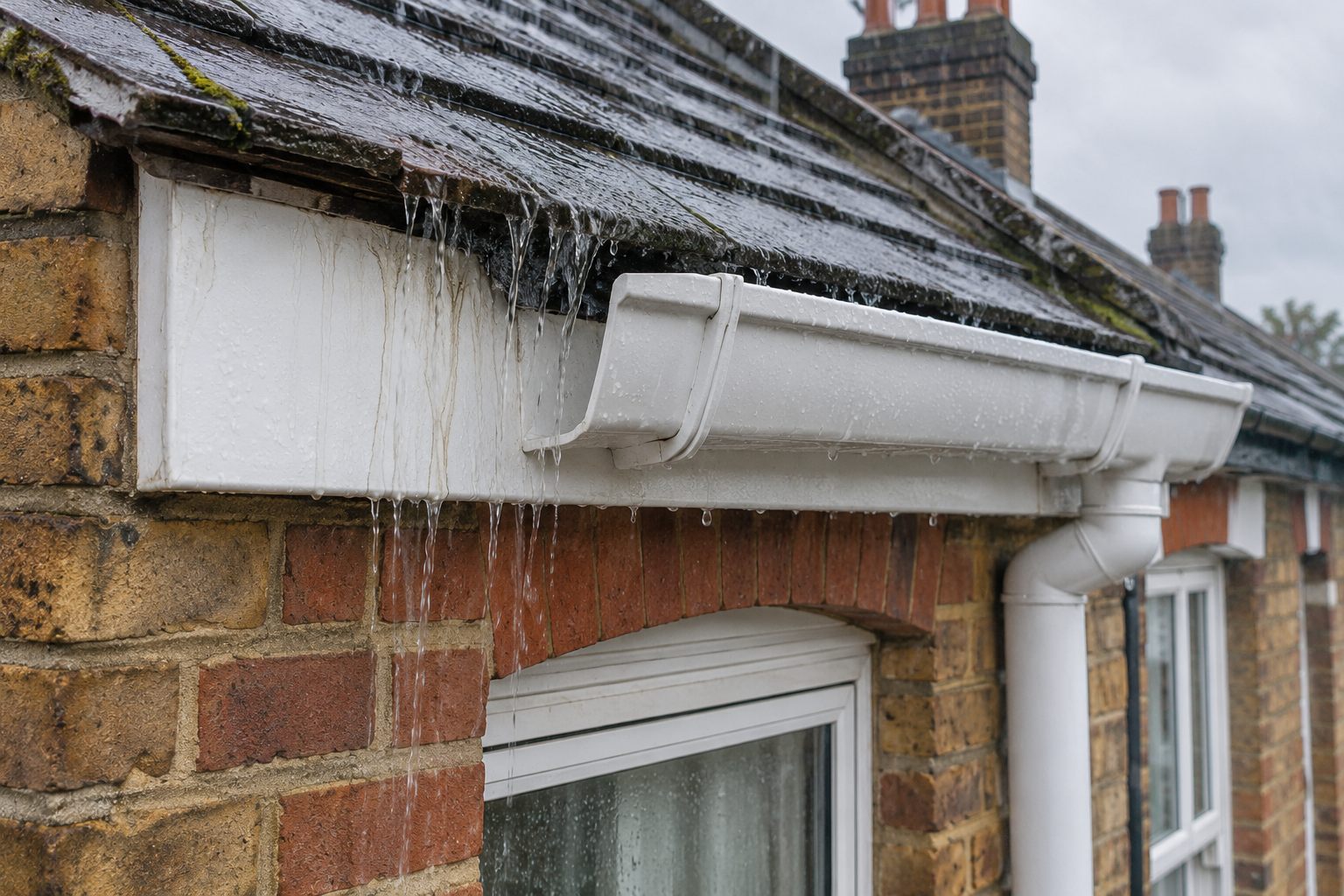
A gutter can look clear from the pavement and still leave a wet stripe down the wall. If the water appears between the back of the gutter and the fascia, the fault may sit at the roof edge rather than inside the gutter. That difference matters: clearing leaves will not correct a gap that lets rainwater miss the channel altogether.
The useful first question is where does the water enter the wrong path? A brief observation during rain, made safely from ground level, can tell a contractor far more than a photograph taken on a dry day. It can also help separate a gutter fault from a roof-covering or flashing problem.
What “behind the gutter” actually means
In a typical eaves arrangement, rain travels down the roof covering and drops into the gutter. The gutter carries it towards an outlet and downpipe. Water behind the gutter takes a different route: it passes the back edge of the channel, reaches the fascia or wall, and may continue downward out of sight.
There are several ways this can happen. Runoff may leave the roof short of the gutter; the gutter may sit too far out or too low; a roof-edge detail may be missing or damaged; or the channel may fill and spill over its inner edge. These faults can look similar from below, especially in wind. A sound diagnosis considers the roof edge, gutter position, fall, outlet and downpipe together.
The distinction also explains why a leak can appear only in particular weather. Gentle rain may drip neatly into the gutter, while a heavier flow or a gust drives water across a gap. Conversely, a partly blocked outlet may cope with light rain but raise the water level enough to spill towards the building during a downpour.
Start with observations you can make from the ground
Do not lean out of an upstairs window, stand on a ladder or reach over a roof edge to investigate. Watch from a safe position during rain, or ask a contractor to assess an inaccessible area. If you can see the affected run clearly, note the following:
- Does water appear along the whole run, or only below one joint, corner or outlet?
- Does it begin immediately when rain reaches the roof, or after several minutes?
- Is the front edge of the gutter also overflowing?
- Does the downpipe carry water away, or is there little visible discharge?
- Are there persistent stains, peeling paint, damp fascia boards or washed-out mortar below the same point?
- Was roof, fascia or gutter work carried out before the problem began?
A short video from ground level can show the direction of the flow and the rainfall conditions. Include enough of the roofline to identify the affected section. Do not assume that the wettest patch marks the source: water can travel along a fascia or behind a fitting before it emerges.
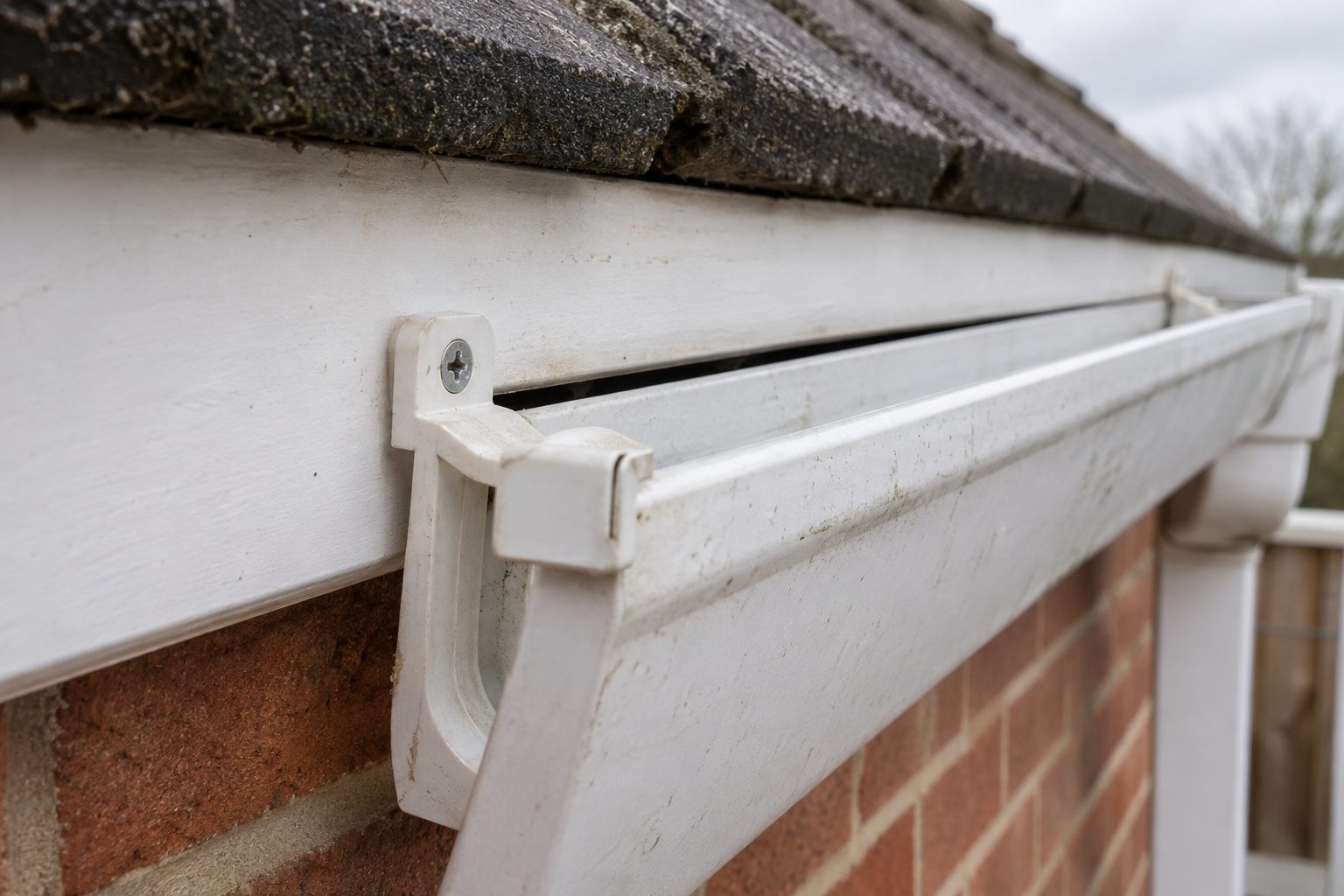
A gap between the roof edge and gutter
Roof coverings should deliver runoff into the gutter. If the gutter has been fitted too low or too far from the roof edge, some water may pass behind it. This can happen after a replacement if the new profile sits differently from the old one, or after fixings have loosened and allowed a section to move.
The relationship is three-dimensional. A gutter can appear level when seen from the street yet have too much horizontal separation from the roof edge. It can also be correctly placed at one end but drift away from the roof along the run. A professional can inspect the brackets and measure the position before deciding whether refixing, resetting or replacement is appropriate.
An apparent gap should not automatically be filled with sealant. Sealant does not correct a displaced gutter or a defective roof-edge detail, and it can hide the actual route of water. The repair should address the reason the runoff is missing the channel.
A damaged or unsuitable roof-edge detail
Many roofs have an edge detail that helps water leave the covering and enter the gutter without wetting the fascia. Its exact form depends on the roof construction. If that detail is missing, damaged or poorly positioned, water can cling to the underside of the roof edge and run backwards towards the building.
This is a roofline question as much as a gutter question. A contractor should check how the roof covering terminates and whether any underlay, support tray or flashing has deteriorated. The right remedy depends on what is actually present. Adding a generic strip without considering the roof covering and ventilation may create a new problem.
Older and altered properties deserve particular care. An original eaves detail may be different from a modern uPVC fascia arrangement. A change made merely to support a new gutter can affect appearance and water movement. Where a building is listed or the roofline is unusual, seek advice appropriate to that construction before changing it.
Overflow over the inner edge
Sometimes water is entering the gutter correctly but cannot leave quickly enough. Debris at the outlet, a blocked downpipe, an inadequate fall or a damaged channel can raise the water level. If the inner edge is lower, or the gutter is tilted towards the wall, overflow may run behind it rather than visibly over the front.
This is why the timing of the leak helps. Water that appears only after the rain has continued for a while may point towards a capacity or drainage issue. A clear section of gutter can still overflow if the outlet beneath it is obstructed. Equally, a gutter that holds standing water after the rain may have a fall or support problem.
The assessment should follow the complete water path: roof area, gutter, outlet, downpipe and discharge point. Cleaning can resolve a blockage, but it will not repair a run that has sagged or an outlet that was incorrectly arranged. Approved Document H for England notes that gutters should be laid towards an outlet and arranged so excess water is discharged clear of the building. That is a useful principle when investigating any overflow near the wall.
Loose brackets, joints and fascia boards
A failed bracket can let a short section of gutter rotate or pull away from the eaves. The change may be small enough to miss from the pavement, but sufficient to alter where the water lands. A joint can also separate when a run moves, creating a concentrated leak that resembles water passing behind the entire gutter.
The fixing surface matters. Replacing a bracket is unlikely to last if the fascia beneath it is soft, split or unable to hold the fixing. A repair visit should therefore include a check of the substrate as well as the gutter. Wet timber may indicate a long-standing problem; it should not be painted over before the source of water has been addressed and the condition assessed.
If several fittings have moved, ask whether a local repair will restore a consistent fall. A patchwork of adjustments can leave low spots that hold water and debris. For a single sound run with one loose fitting, a targeted repair may be sufficient. The visible defect and the condition of neighbouring sections should determine the scope.
Could it be a roof leak instead?
Water seen below a gutter is not proof that the gutter caused it. Damaged roof coverings, faulty flashing and defects around a parapet can introduce water higher up. It may then emerge at the fascia, making the gutter appear responsible. Interior damp can likewise have several possible sources.
Ask the person inspecting the roofline to show where water is believed to enter and what evidence supports that conclusion. If the gutter is flowing freely and correctly positioned but staining continues, a roof assessment may be needed. Treating the first visible symptom without tracing the source can lead to repeated work and continued dampness.
What to ask for in a repair quotation
A useful quotation names the affected run and the suspected cause. It should describe whether the work includes cleaning, refixing brackets, resetting the fall, replacing a fitting, addressing the roof edge or checking the downpipe. Ask how the finished installation will be checked, and whether any fascia or roof work falls outside the quoted scope.
Access can influence the method and price, particularly where a rear extension, conservatory or narrow side passage limits safe working space. Provide photographs and access details when requesting an assessment. Avoid choosing a treatment solely from a photograph of a damp wall; the roofline may need direct inspection before the work can be specified.
If water is running behind your gutter, the most useful next step is a diagnosis of the entire eaves and drainage route. A professional assessment of guttering repairs can identify whether the gutter needs cleaning, repositioning or a targeted repair, and whether the roof edge needs separate attention.