
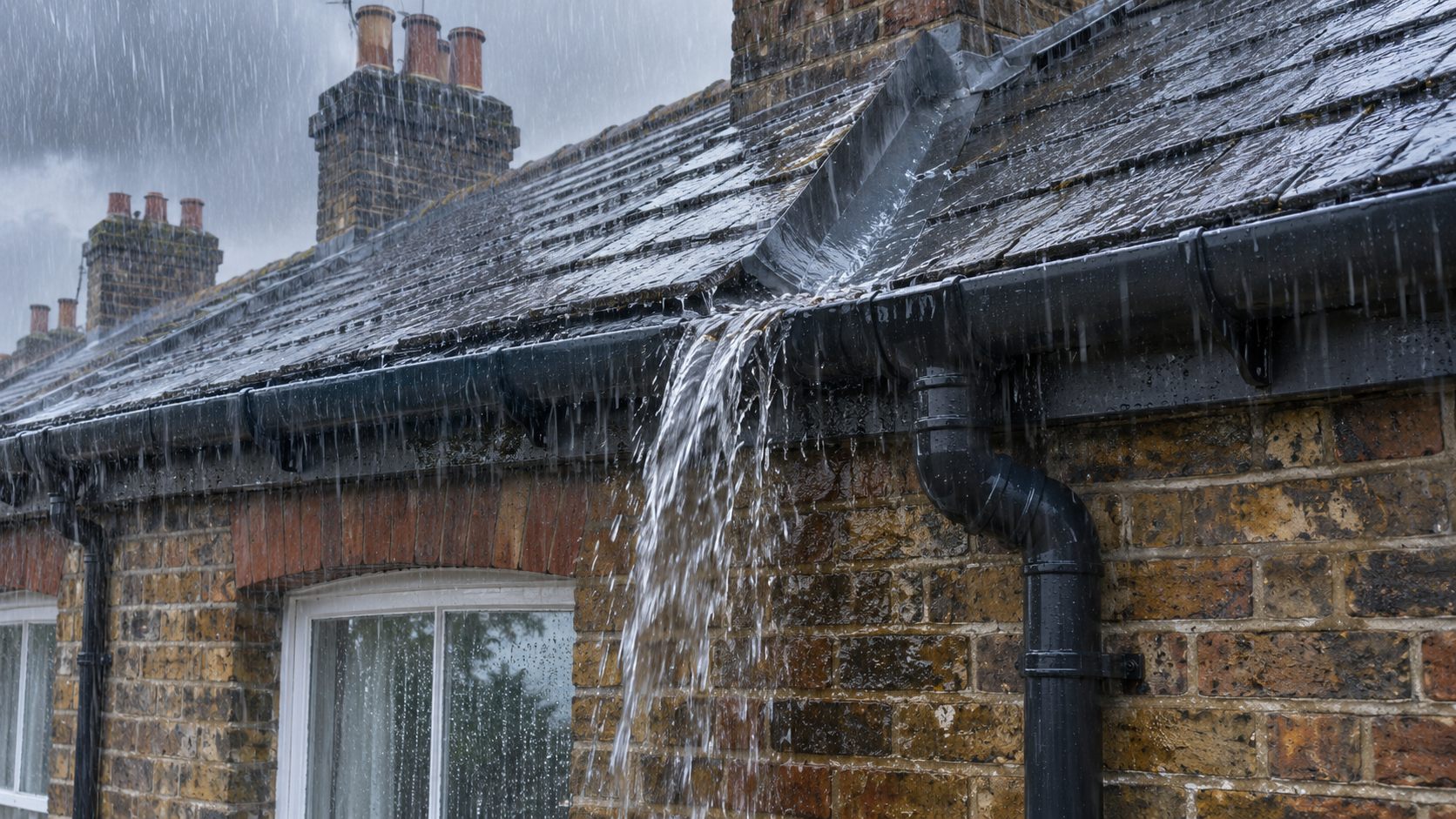
A gutter that works during an ordinary shower but spills during a downpour is giving a useful clue. The system has some ability to move water, but under greater flow that ability is no longer enough. A partly obstructed outlet is one possible reason. A shallow or uneven fall, an undersized outlet, a roof valley delivering water to one short section, or a downpipe that cannot discharge freely can produce the same pattern. Even a correctly designed gutter can briefly overflow in rainfall beyond its intended capacity.
The distinction matters before anyone recommends a bigger gutter or a routine clean. The right remedy depends on where water builds up, how the roof feeds that point, and whether the problem repeats in storms that would ordinarily be expected. A safe observation from ground level during rain can reveal more than an inspection of a dry gutter alone.
What changes when rainfall becomes intense?
The roof sheds more water each minute. The gutter must collect it, carry it along the channel, pass it through an outlet and move it down a pipe to a drained destination. Each part has a practical limit. A small mat of leaves at the outlet may barely matter in light rain, yet restrict a much larger flow. A slight dip in the gutter may hold water until a wave from the roof overtops the rim. A short pipe from an upper roof may add a concentrated stream to a lower gutter already handling its own roof area.
Rain intensity is not the only variable. Wind can push runoff towards one edge or blow it past the gutter. A roof valley can concentrate flow at a single location, while a long straight eaves run spreads it more evenly. The condition of the gutter matters too: sediment reduces the available depth and a shifted bracket changes the way water approaches the outlet. A diagnosis should therefore look at the whole route, not judge by one photograph of a cascade.
Approved Document H for England discusses gutter capacity and the need for overflow to discharge clear of the building when rainfall exceeds the design capacity. That does not make every spill harmless. Repeated water against a wall, window or entrance deserves attention even if it happens only in strong rain.
A partial blockage can hide in plain sight
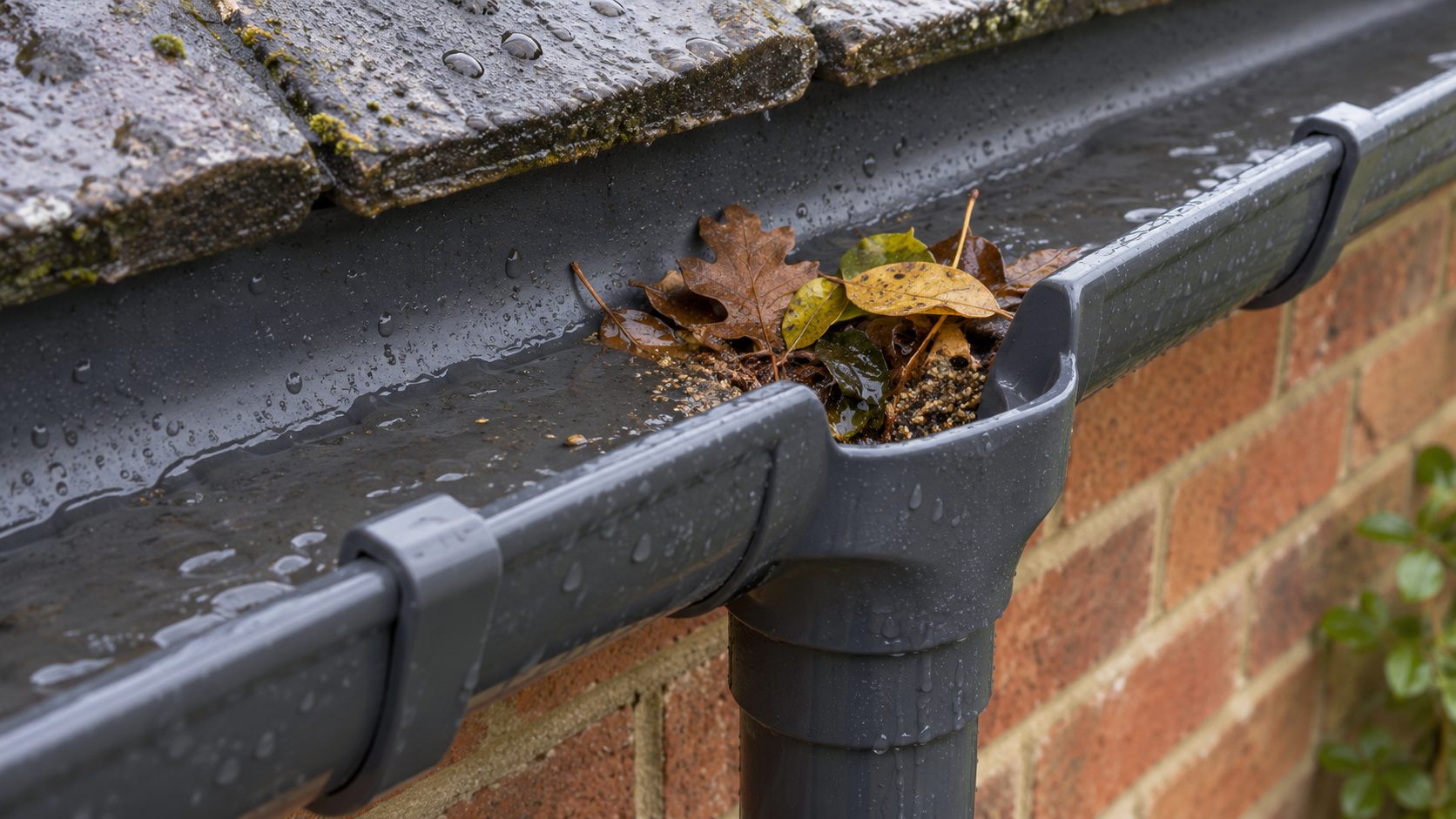
Leaves and moss do not need to seal an outlet completely to cause an overflow. A narrow opening may carry a light shower away, then become the bottleneck in a downpour. The gutter upstream fills, and water escapes at the lowest nearby edge. If the obstruction shifts, the problem may seem unpredictable: one storm produces a spill and the next does not.
The blockage may be in the gutter immediately before the outlet, in the outlet itself, at a bend in the downpipe or at the receiving gully. Clearing the open channel without checking these junctions can leave the same symptom. Conversely, a full-looking gutter during heavy rain does not prove a blockage; water may be arriving faster than the original arrangement was designed to handle.
Look for debris that remains visible after the rain, where a safe ground-level view is possible. Trees over the roof, roof moss or debris left after building work can raise the likelihood of a restriction, but none of these details establishes its exact location. A gutter cleaning assessment should follow the route through the outlet and connected downpipe where the system and safe access allow.
Poor fall and local dips slow the route to the outlet
Gutters are installed to carry water towards an outlet. They need not look dramatically sloped from the street. A run that has sagged between brackets, however, can create a shallow basin where water collects. During light rain the basin may drain slowly enough to avoid an obvious spill. In a heavy shower it fills before water can move on. Fine sediment and leaves then settle in the low area and further reduce its useful depth.
Notice whether water is still sitting in the same section after the rain stops. Persistent standing water suggests a fall or support issue, though the amount and timing need professional interpretation. A gutter can also be twisted towards the wall so the inner edge is the first place to overflow. If staining appears behind rather than below the front rim, that detail is worth mentioning.
Cleaning can remove debris from a low point, but it cannot restore a bracket or straighten a deformed channel. A contractor should inspect the support and the surface to which it is fixed before advising on resetting the run. Simply applying sealant to a joint at the low spot may stop one drip while leaving the water retention unchanged.
A roof valley or upper downpipe may concentrate runoff
The location of the spill can identify how the roof feeds the gutter. A valley brings water from two roof slopes into a narrower stream. An upper downpipe may release water onto a lower roof, whose gutter then has to receive both roof areas. Extensions and dormers can change this pattern from the original design. On a London terrace with several additions, a rear corner may receive much more water than its short gutter length suggests.
Watch where the strongest stream enters the channel. Does it land directly opposite the overflowing point? Is there an upper pipe or a narrow roof valley above it? These questions are useful even if you cannot see the outlet from below. Do not reach over a roof edge to trace the route; a contractor can inspect the geometry with suitable access.
If the inlet flow is concentrated, the remedy may involve the gutter profile, outlet position, downpipe arrangement or the way an upper roof discharges. Increasing one component without checking the next can simply move the problem downstream. The assessment should include the final discharge point so an apparent capacity fix does not overwhelm a gully that was already struggling.
Could the downpipe or drain be the limiting point?
A downpipe that is partly blocked may accept enough water for a light shower but back up when the gutter receives more. If it ends in an open shoe, you may be able to see whether a reasonable flow emerges during rain from a safe position. A weak discharge while the gutter above is full is a clue, not proof: water may be leaking from a joint or the roof may drain by another route.
At ground level, a gully that pools or overflows while the downpipe continues to discharge can indicate a receiving-drain issue. Cleaning the gutter would not solve that bottleneck. If the downpipe goes directly underground, the restriction cannot be located from a pavement view alone. Tell the contractor whether the pipe end is open, enters a gully, or disappears into a sealed connection.
Historic England’s guidance on rainwater systems treats below-ground drainage and outlets as part of the same route. This is particularly helpful when a building has several hoppers, concealed sections or older connections. The visible overflow at eaves level may be the final symptom of a problem farther down.
What to observe safely during the next storm
From a sheltered ground-level position, make a brief record of:
- The rainfall conditions and approximately how long it took for the spill to begin.
- Whether water crosses the front rim, runs behind the gutter or drips from a joint beneath it.
- Whether the spill is confined to one point or appears along a long run.
- Where roof valleys and upper downpipes feed the affected section.
- Whether water remains in the gutter after the shower, if visible without climbing.
- Whether the downpipe’s open discharge or receiving gully appears to be working.
A video should show enough of the roofline to place the spill in context. Avoid standing beneath an overflowing section or filming from an open upstairs window. Note any recent clearance, replacement or roof alteration, since the timing may help distinguish a new fitting issue from debris that has accumulated gradually.
Decide what needs to be checked first
If the run is visibly full of debris, clearance and an outlet check are a sensible first stage. If it is clean but holds water, alignment and brackets deserve attention. If overflow coincides with a concentrated roof stream, the roof area and outlet capacity need assessment. If the pipe discharges into a flooded gully, the downstream drain may be involved. More than one cause can coexist; a slight dip can collect leaves and turn a marginal outlet into a recurring overflow.
Ask the person inspecting to explain where the restriction or capacity limit was found and what was tested after the work. If the weather is dry on the day, keep your video and compare the next rainfall from a safe position. A diagnosis tied to the actual flow path is more useful than assuming every heavy-rain spill calls for the same treatment.