
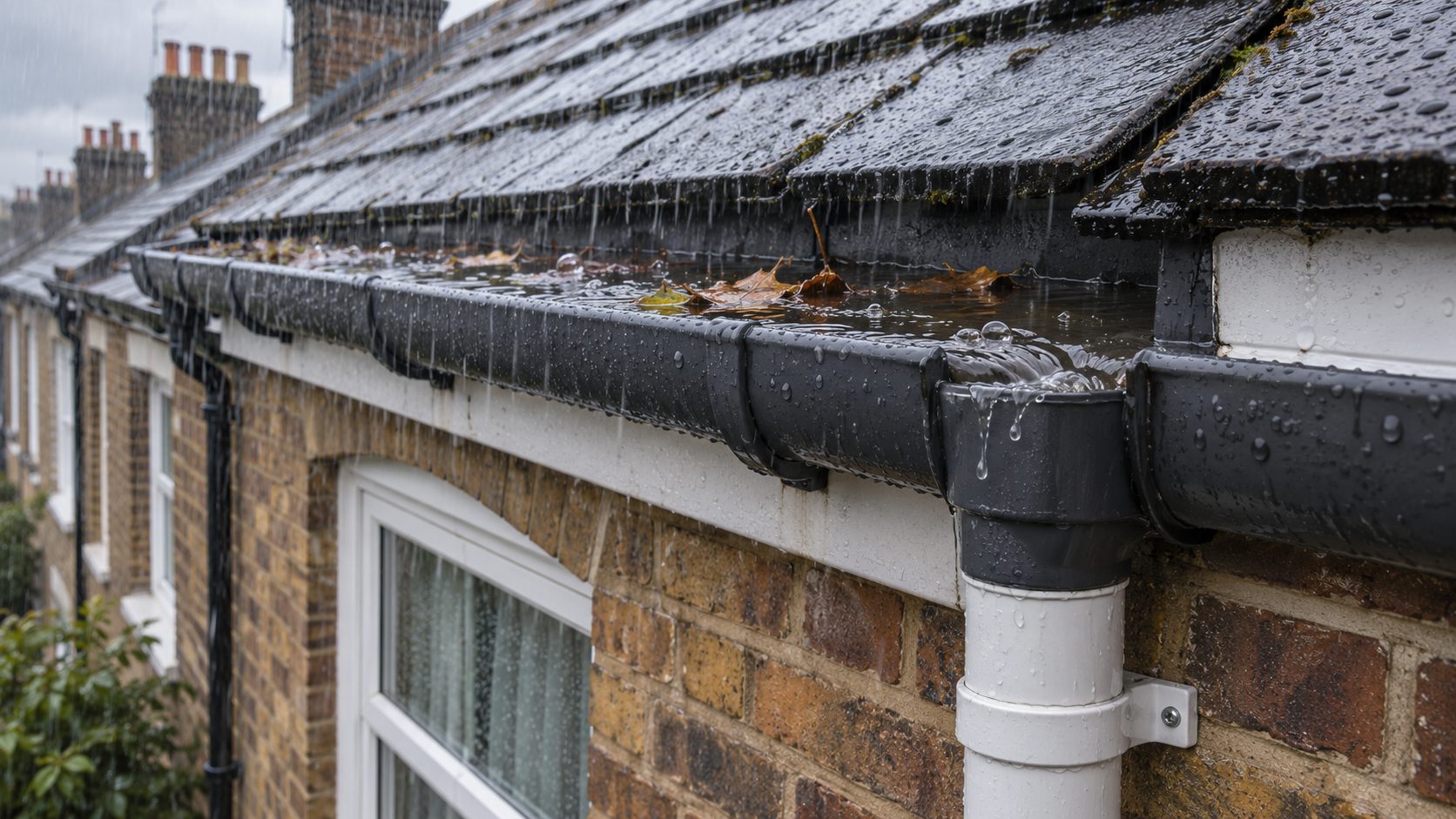
A gutter that spills in rain is easy to notice. A blocked downpipe is harder to identify because most of the obstruction is hidden inside a vertical tube. The first visible sign may be water backing up around the gutter outlet, a hopper overflowing, or a damp patch appearing beside the pipe. None of these signs proves that the pipe itself is blocked. Debris at the outlet, a leaking joint or a blocked ground-level gully can create a similar picture.
The useful question is where the rainwater stops moving. You can often collect clues without touching the pipe: watch the roofline during rain, see where the pipe discharges if its outlet is visible, and note where water first escapes. A contractor can then inspect the complete route rather than clearing one part and leaving the restriction elsewhere.
Follow the route from gutter to ground
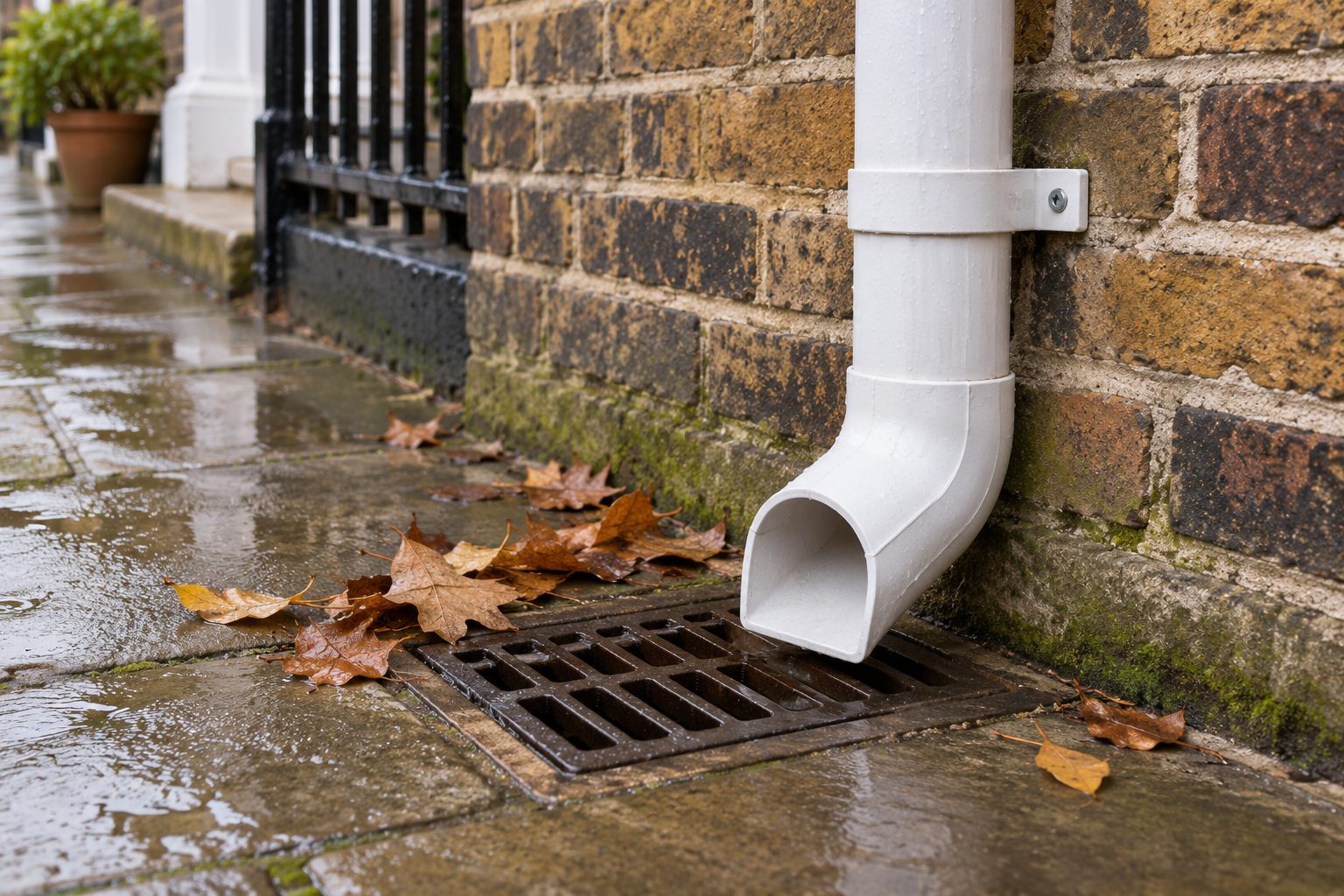
Rainwater normally moves from the roof into the gutter, through an outlet, down the pipe and onwards to a gully, drain, lower roof or other designed discharge point. The route differs between buildings. On one terrace the pipe may end in a visible shoe above a surface gully; on another it may enter a below-ground connection with no open outlet to observe. Some older or altered properties have hoppers that collect water from several roof surfaces before it enters the downpipe.
This layout matters because a symptom at the top can have a cause at the bottom. If the gully is full and cannot receive water, the downpipe may appear to be failing even when its bore is clear. Conversely, an open gully cannot rule out a blockage higher up the pipe. Before asking for a particular treatment, identify which sections can be seen and which remain concealed.
Look at the pipe from a safe position on the ground. Check for obvious disconnection, a missing section, a broken bend or water escaping through a joint. Those are defects, but not necessarily blockages. If the pipe is on a shared boundary or passes over an extension, tell the contractor where it runs and how it can be reached; do not climb or lean out to inspect it.
Water backs up at the gutter outlet
When the pipe cannot accept water quickly enough, the gutter near its outlet can fill and overflow. The water may spill at the closest corner or a lower point along the run. If other parts of the gutter look clear but water repeatedly gathers beside the outlet, that pattern is worth recording. A partial obstruction can allow light rain through and still cause trouble in a longer or heavier shower.
Debris can collect just above the pipe opening. Leaves, moss and sediment may form a mat across the outlet while the vertical pipe remains open. A visual check of the gutter and outlet is therefore the first distinction. Clearing the visible channel alone is not a complete test of the pipe, and assuming the pipe is blocked from a pavement view is equally premature.
If you can safely watch the same place in successive showers, note whether the water level rises gradually or the gutter spills as soon as rain reaches it. Gradual backing-up may suggest a restriction, but the rate also depends on rainfall and the roof area feeding the outlet. A video showing the gutter, outlet and downpipe together gives better evidence than a close-up of the overflowing rim.
A hopper overflows or holds debris
Hopper heads are open collectors at the top of some downpipes. They can receive runoff from gutters, a flat roof or a short pipe above. An overflowing hopper can indicate that the opening into the downpipe is obstructed, but it can also mean the hopper itself is full of leaves or that more water is entering than the system can carry during a particular storm.
Where a hopper is visible from the ground, look for vegetation or an obvious pool of water after the rain has stopped. Do not try to reach into a high hopper with a pole or stand beneath loose debris. Historic England includes gutters, hoppers and pipes in rainwater-system inspection because each junction can change how water flows. Ask that the hopper and the downpipe beneath it both be considered during an assessment.
Some hoppers sit in a recess or behind a parapet and are not visible from the pavement. A wet mark on the wall below them may be the only external clue. In such cases, access for a closer professional inspection matters more than a guessed diagnosis from a photograph.
Little water emerges at a visible pipe shoe
If a downpipe ends in a shoe above a gully, its discharge can sometimes be observed safely during rain. A roof is taking substantial rain but only a trickle leaves the pipe: that mismatch may indicate a blockage somewhere upstream. Yet it may also mean that the roof drains to a different outlet, or that water is escaping at a disconnected joint before it reaches the shoe. The observation is most useful when you can see both the contributing gutter and the pipe end.
Do not stand in the falling water or remove a gully cover during a storm. If water is flowing freely from the shoe but pooling at the gully, the downstream drain may need attention rather than the downpipe. If nothing emerges and the gutter above is overflowing, the contractor should trace the restriction from the outlet downwards. An underground connection has no equivalent open discharge to watch, so the diagnosis requires a different inspection method.
Stains beside the pipe need careful interpretation
Dark staining, algae or washed-out mortar beside a downpipe can indicate repeated wetting. Historic England’s maintenance checklist specifically looks for these marks around rainwater goods. However, a stain does not tell you whether the cause is a blockage. A split joint can discharge water onto the wall while the pipe remains clear, and water from a roof defect may travel behind the pipe before it becomes visible.
Check where the stain begins. Does it start at a pipe socket, below a hopper, around the gutter outlet or near ground level? Does the pipe visibly move away from the wall? Is the damp patch present only after rain? Record these details, especially if the wall is shared or the wet area is behind an extension. Avoid sealing an apparent leak before the path of water is understood; a patch can conceal a continuing obstruction or another fault.
What can be mistaken for a blocked downpipe?
Several faults produce similar symptoms:
- **Gutter debris at the outlet.** Water cannot enter the pipe, although the pipe below may be clear.
- **A low or sagging gutter.** Water collects and spills before it reaches an otherwise working outlet.
- **A leaking pipe joint or cracked bend.** Water leaves the system on its way down, so discharge at the base may seem weak.
- **A blocked surface gully.** The pipe may deliver water normally, but the receiving drain cannot take it away.
- **A roof or flashing leak.** Water appears beside the pipe after travelling through the building fabric rather than down the pipe.
- **An unusual roof connection.** An upper roof may feed a hopper or lower gutter in a way that is not visible from one viewpoint.
This is why a contractor should check the whole rainwater path. Approved Document H describes rainwater pipes discharging to a drain, gully or another drained surface, so the receiving point is part of the arrangement, not an afterthought. On a building with a complicated layout, a simple sketch of the roof levels and visible pipes can be helpful.
Information that helps a cleaning visit
Tell the contractor whether the pipe is plastic or metal, approximately how high it runs, whether it serves the front or rear roof, and where it appears to discharge. Mention conservatories, narrow side passages, parked vehicles or shared access that may affect safe working space. If a hopper or upper-level connection is present, include it in a ground-level photograph.
Describe the rainfall pattern: a problem in every shower, only after several minutes, or only during intense rain. Note whether the gutter was recently cleared, and whether the overflow returned immediately or after a period of leaf fall. A professional gutter cleaning assessment can then include the outlet and connected downpipe where access and the system allow, rather than treating the open gutter in isolation. Ask which sections were cleared and how flow was checked afterwards.
The most useful outcome is a specific finding. Was material removed from the outlet, a bend or the pipe? Was the pipe clear but the gully blocked? Did a loose joint or poor gutter fall cause the visible water? If the route disappears into a concealed drain, the contractor may need to explain what could and could not be confirmed during the visit. Keep that distinction in the record so a recurring overflow is investigated at the right point.