
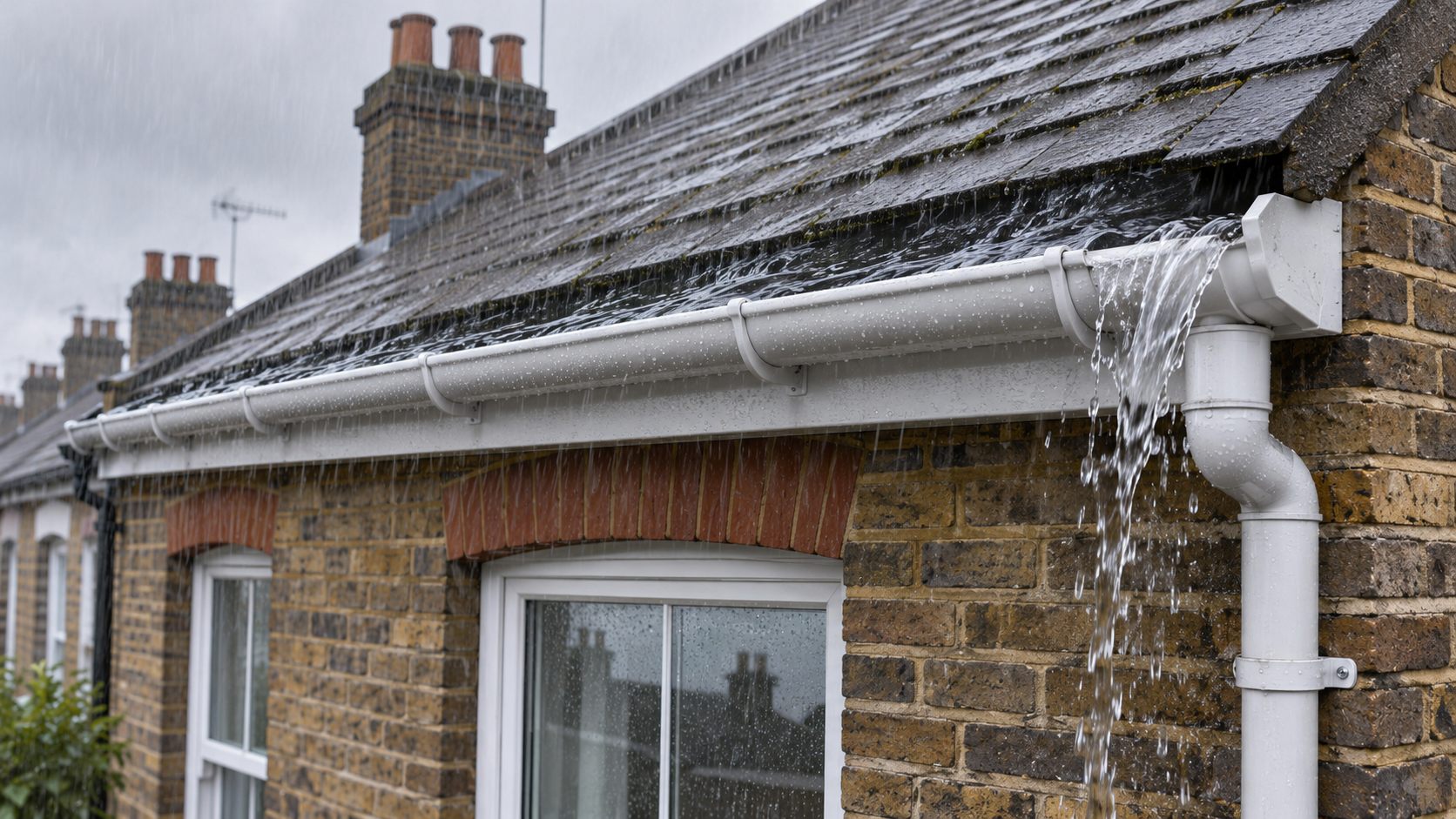
When rain pours over one corner of a gutter while the rest of the roofline seems to drain normally, it is tempting to blame the corner fitting. The fitting may indeed be at fault, but the location of the spill is only a clue. Water can build up at that point because an outlet is obstructed, a section has dropped, or a nearby roof surface sends more runoff into the gutter than it can move away. A leaking joint can look like an overflow from the pavement, although the repair is different.
The most useful starting point is to watch how the water behaves, without trying to reach the gutter yourself. Does it climb over the front rim, drip through a seam, or appear behind the channel against the wall? Does the problem begin with the first rain or only after the gutter has filled for several minutes? Those observations help narrow the cause and make a cleaning or repair visit more productive.
First, identify where the water leaves the gutter
An overflow crosses the top edge of the channel. It may form a broad curtain or a steady stream at the corner. A joint leak escapes through a connection beneath the rim and may continue even when the water level is low. Water behind the gutter runs against the fascia or wall rather than dropping from its front edge. From ground level, these routes can overlap visually, particularly in wind or poor light.
Watch during daylight if a safe viewing position is available. Stand clear of falling water and do not lean from a window, use a ladder or climb onto an extension roof. A short video that includes the gutter run, the corner and the nearest downpipe can be more useful than a close photograph of the wet wall. If the affected corner is above a public entrance or an electrical fitting, keep people clear of the falling water and arrange an assessment promptly.
Try to note whether the neighbouring length of gutter is also full. If water sits high for several metres before spilling at the corner, the restriction may be at or beyond the outlet. If the rest of the run carries water freely, a local dip, displaced fitting or concentrated roof discharge may be more likely. Neither observation proves the cause on its own; it simply tells the person inspecting where to begin.
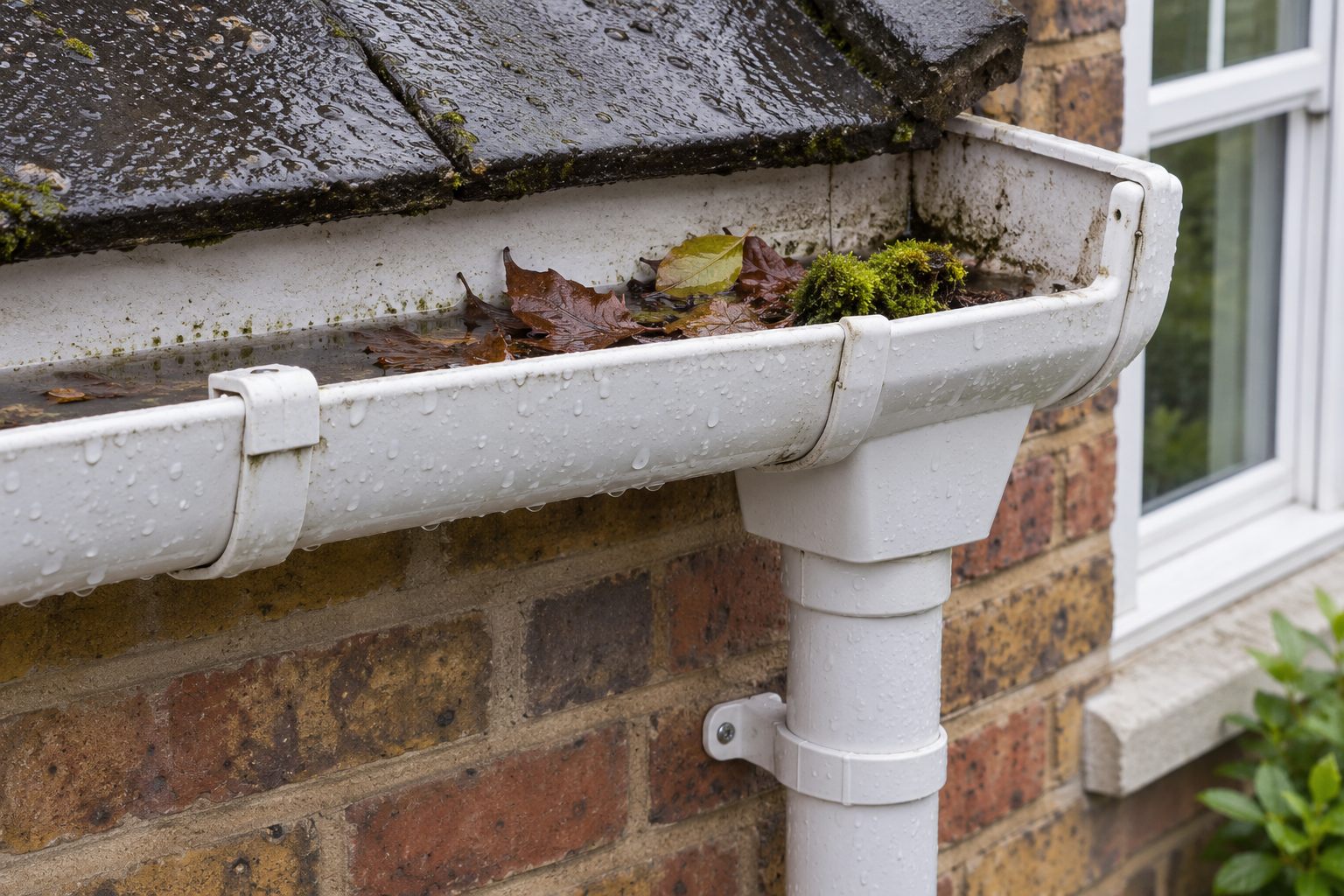
A blocked outlet can make one corner behave like a dam
Many gutter corners sit close to an outlet and downpipe. Leaves, moss, twigs and roofing debris can collect where the channel narrows into the outlet. Water then backs up behind the obstruction and finds the lowest accessible rim. That rim may be at the corner, even if the blockage itself is a short distance away.
An outlet problem can be intermittent. In light rain, water may pass through the remaining opening. In a longer downpour, debris holds back a growing volume until the channel spills. A clump of leaves can also shift during rain, making the overflow appear and disappear. If there are trees above the roof, or moss has been washing down from the tiles, that history is worth mentioning when you book a visit.
The downpipe is part of the same route. Clearing the visible gutter but leaving an obstructed pipe can allow the corner to overflow again. A professional gutter cleaning visit should therefore consider the outlet and connected downpipe as well as the open channel. The exact scope depends on access and the system fitted, so describe the corner and ask what will be checked when obtaining a quote.
A dropped corner or poor fall can hold water locally
Gutters are intended to guide water towards an outlet. If a bracket loosens or the corner drops, a low pocket can form before the outlet. Water remains there after a shower, collects fine sediment and leaves, and may spill from that point during the next heavy rain. Sometimes the visible corner is sound but the adjacent run has shifted enough to interrupt the route.
From the ground, look along the gutter line rather than concentrating only on the wet corner. A visible sag, a change in height at a union, or a bracket that appears separated from the fascia may be relevant. Do not assume that a channel must look steeply sloped to work; small changes in alignment can matter, and the correct fall is assessed against the outlet and the gutter profile. Equally, a straight-looking run can still contain a local dip that is hard to see from below.
If the gutter has moved, removing debris may expose the issue but will not restore its position. The contractor may need to inspect fixings, the fascia and the adjoining lengths before advising on refixing or a replacement part. Sealing the corner without addressing a low point merely leaves water sitting against the fitting.
The roof may send extra water into that corner
Not every one-corner overflow starts inside the gutter. A roof valley, a small upper roof draining onto a lower roof, or the roof of a rear extension can concentrate runoff into a short length. During intense rain, the water can arrive faster than the local outlet removes it. If a previous alteration changed where the roof discharges, the original gutter arrangement may no longer suit the flow.
Look for the path water takes down the roof. Does a distinct stream land at the problem corner? Is there a downpipe from a higher level discharging onto nearby tiles or directly into the same gutter? These details are especially relevant on altered London terraces, where additions can create several connected roof levels. A contractor needs to consider the contributing roof area, outlet and downpipe together before suggesting a larger gutter or a different discharge arrangement.
An occasional brief spill in exceptional rain does not automatically mean the corner is broken. Repeated overflow in ordinary rain, staining on the wall, or water entering the building calls for investigation. The aim is to find why the system cannot carry water away under the conditions in which the problem recurs.
When the corner fitting is actually leaking
A gutter angle or union can develop a leak at its seal or connection. In that case water may drip from the underside of the corner while the top rim remains dry. The drip can be surprisingly far from the actual opening because water runs along the underside before falling. A cracked fitting, movement between sections or a poor connection can all produce a similar visible mark.
One clue is timing: a seam may begin dripping soon after water reaches it, whereas a restricted outlet often needs time to fill the gutter. Another is the shape of the flow. A narrow drip below a joint differs from a sheet crossing the front edge. These are observations rather than a diagnosis, because wind, rain intensity and the angle of view can confuse the picture. If the connection is leaking, the next step is a fitting assessment rather than simply clearing leaves.
What to record before asking for help
A useful report gives the contractor enough context to plan access and decide whether the job begins with clearance, inspection or repair. Include:
- The exact corner and its height: front or rear, main roof or extension, and whether a conservatory or shared passage sits below it.
- Whether water crosses the top rim, appears under a joint or runs down the wall behind the gutter.
- How long it rains before the spill starts, and whether it happens in every shower or only in heavy rain.
- Whether the nearest downpipe appears to carry water away, and whether there is visible discharge at its base where this can be seen safely.
- Any recent roof work, gutter replacement, tree shedding or recurring moss fall.
- A ground-level video or photograph that shows the whole affected section, not just the wet patch.
Avoid trying to flush an inaccessible gutter from an upstairs window or dislodging debris with a pole near overhead cables. A person with suitable access can check whether material is lodged at the outlet, whether the pipe is clear and whether the corner retains water because the gutter has moved.
Choose the remedy that matches the fault
If debris blocks the outlet, the practical remedy is to clear the affected run and check the path into the downpipe. If the corner has sagged, its support and alignment need attention. If a fitting leaks, the connection may need repair or replacement. If a roof alteration sends concentrated water into the corner, the drainage arrangement may need reassessment. Some properties have more than one fault: a low corner can catch leaves and then overflow as the outlet narrows.
After the work, ask what was found and which parts of the route were checked. A dry-weather inspection cannot always reproduce the spill, so keep the original video and observe the next rainfall from a safe position. The goal is not merely to stop a visible cascade for one shower; it is to understand the route from roof to outlet to downpipe, and to correct the point where that route fails.