
Gutter Cleaning in London
We clear leaves, moss and compacted silt from gutters on homes, managed blocks and commercial premises. We use a gutter vacuum on suitable runs and check the openings into the downpipes. If rainwater still escapes after the debris is removed, we look for a visible fault and explain what further work may be needed. Send us the postcode, the number of storeys and the parts of the building you want us to reach.
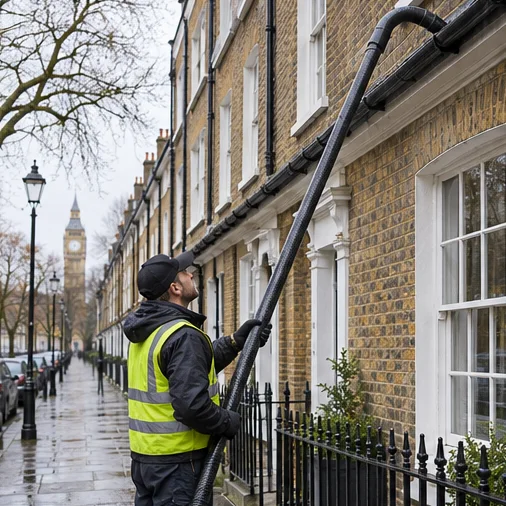
Photographic illustration of gutter cleaning in london.
Can you clear the rear gutter on a London terrace?
Tell us how the rear is reached, especially if the only route is through the house or a shared passage. A conservatory or side return can change where the equipment can stand. Give us a rough idea of the height and any narrow turns before we arrange the visit.
Do you clear downpipes as part of gutter cleaning?
We check the outlet at the top of the downpipe and clear material we can reach. If water still backs up when the outlet is clear, we discuss where the restriction may be. A fault in an enclosed pipe or a drain below ground needs to be assessed separately.
Clearance from the channel to the outlet
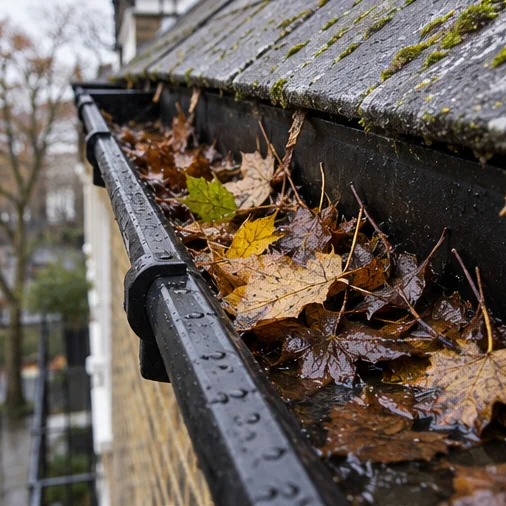
Leaves often collect at corners, joints and changes in direction. The top layer can look loose while a dense bed of moss and fine grit sits beneath it. We work along the accessible channel and pay particular attention to the point where the gutter feeds the downpipe. Tell us if the water always spills at the same place or if it moves along the run in heavier rain.
Clearance is useful when the gutter is obstructed. It cannot close a split or put a slipped joint back into position. Where we see a defect after clearing the channel, we can discuss guttering repairs and explain which section needs attention. If you have photos of the leak in rain, show us where they were taken so we can relate them to the affected run.
What we include in a clearance visit
We agree which runs you want us to clear. The gutter on a front bay, a lean-to or a garage may be separate from the main roof. If you want those lower gutters included, mention them when you ask for the quote. For linked houses, identify the parts that belong to the property and any length that continues across the boundary.
During clearance we remove reachable debris along the agreed runs, including the material that gathers near outlets. If a bracket appears loose or a connection has opened, we identify it as a separate issue. We can discuss camera inspection for the areas that are difficult to see, subject to access and the condition of the run.
How we work along the roofline
We start by checking the layout and finding a position below the gutter where the equipment can be used. A side passage, ground-level planting or a canopy can restrict access even when the gutter itself looks straightforward from the street. If an elevation cannot be reached using the planned setup, we explain what needs to be arranged before attempting it.
We then work along the gutter, breaking up reachable compacted material as needed so the vacuum can collect it. Once the channel is clear, we pay particular attention to the outlets and look for anything visible that could still stop the water moving through the run. At the end we explain which sections were cleared, flag any access restrictions and discuss the next step if a fault remains.
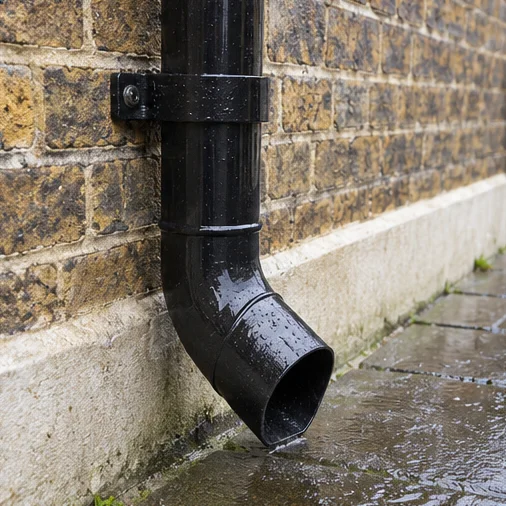
Vacuum equipment and camera checks
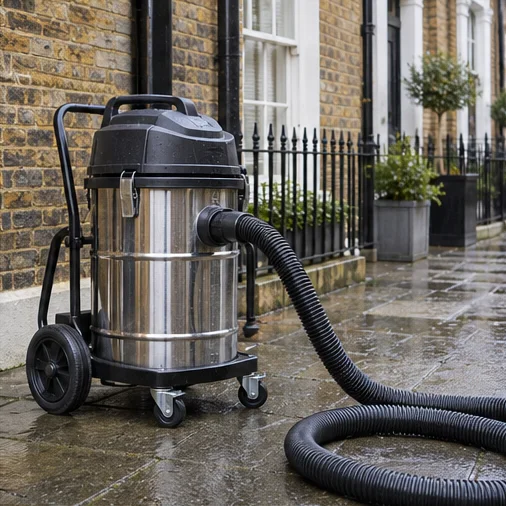
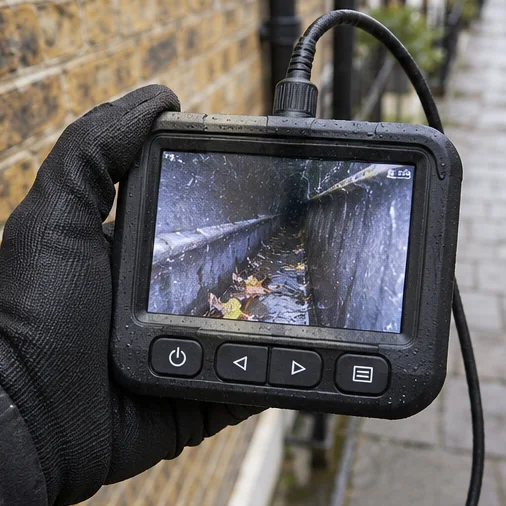
A gutter vacuum uses a collection drum and reach poles to draw leaves, moss and silt out of the channel. Where the building and surrounding space allow, the equipment can be operated from the ground. A camera is useful for looking into a channel that is hidden behind the roof edge and for locating an obstruction around a bend or outlet.
The equipment still needs room to work. If a parked vehicle, roof projection or narrow passage affects where we can stand, let us know before we visit. Ask about camera inspection when booking if you need to see a section for yourself or share what we find with a building manager.
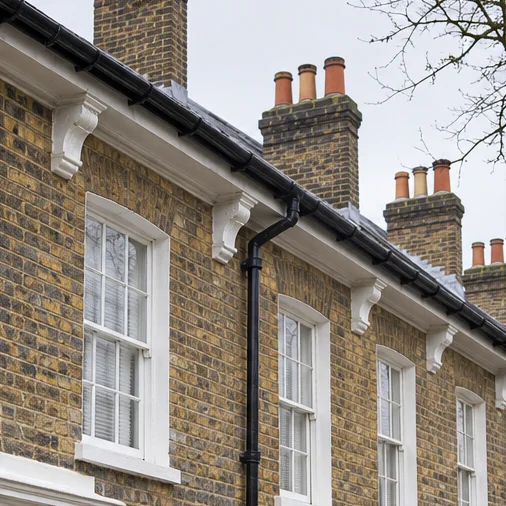
Access at homes and commercial premises
At terraced and semi-detached homes, the rear gutter may have a separate route through a garden, shared passage or neighbouring gate. Lower extensions can sit beneath the higher gutter, so tell us if the problem is at the extension itself or on the main roof above it. For detached houses, identify any garage or porch with a separate outlet.
At flats and managed buildings, tell us which block and elevation are affected and who can open communal gates. For shops, offices and other commercial premises, let us know about customer entrances, delivery routes or shared yards. That helps us discuss when the equipment can be positioned without interfering with normal access.
What the overflow is telling us
| What you see | What we check | What may follow |
|---|---|---|
| Water over a long section | Material along the channel and around its outlet | Clear accessible debris and look for a visible sag |
| Drip from a single seam | Whether water backs up near the seam or escapes at the joint | Discuss repair if the joint still leaks |
| Water behind the gutter | Position of the gutter and condition of its supports | Assess the affected section after clearance |
| Pooling by the downpipe | Outlet, accessible pipe opening and visible discharge point | Discuss a separate assessment if the restriction is lower down |
Which work to request
| Visit | Useful when | What to mention |
|---|---|---|
| Gutter clearance | Moss, leaves or silt are visible in the run | Which rooflines and lower gutters are affected |
| Outlet check | Overflow starts at the top of a downpipe | Where the pipe discharges and whether that point is accessible |
| Camera inspection | You cannot see a concealed or high section | Which elevation you want to inspect |
| Repair assessment | A leak remains after the run has been cleared | The location of the drip and any movement in the gutter |
When clearing the gutter is only the first step
A leak can be caused by several faults at once. A blocked outlet can raise the water level enough to expose a joint that otherwise appears dry. Once the channel and opening are clear, a leak from the same seam may point to a failed joint or damaged section. If several parts of the run have deteriorated, we can talk through replacing the guttering. If growth is interfering with the roofline, ask about ivy removal and tell us where the stems reach the gutter.
Where we work in London
We cover Greater London and areas around the M25. Give us the property postcode even if you have already told us the neighbourhood. For a site with several buildings, tell us the building name or unit number and the elevation where the problem occurs. That helps us distinguish a single blocked outlet from work on several rooflines.
Questions about booking a clearance
Can I book just the front gutter?
Yes. Tell us which elevation you want included and if a front bay or porch has a separate gutter. We can discuss the other sections separately if you later decide they also need clearing.
Is a photograph useful before I call?
A photo taken from the ground can show the roofline, the downpipe and anything below the gutter that could affect access. Tell us which corner or entrance is shown.
Can you clear a gutter above a conservatory?
It depends on where the equipment can stand and how far the gutter sits beyond the conservatory. Give us a description or a photo of the rear elevation so we can discuss access.
What if there is no rain on the day?
Tell us where the water spills and whether it starts as soon as rain falls or only during a downpour. We can check for debris and visible faults even if the symptom cannot be seen on the visit.
Can you arrange repeat clearance for several properties?
We can discuss scheduled maintenance. Share the addresses, the type of guttering and access arrangements for each building so we can understand what is involved.
What if water is already getting inside?
Tell us which room or surface is affected and whether it corresponds to the gutter above. Clearance and repair of existing water damage are separate enquiries, and we can discuss what needs looking at.
Request a gutter cleaning visit
Send us your postcode, the building type and the location of the gutter or downpipe causing trouble. If you manage the building on someone else’s behalf, include the name of the person who can arrange access.