
Gutter Cleaning Knightsbridge
We clear accessible guttering in Knightsbridge and check reachable openings into downpipes. If the affected gutter is above a mansard or behind a roof feature, tell us which part of the frontage becomes wet and where the nearest pipe is visible. On a block with several entrances, give us the roofline reference as well as the building address so we can discuss the appropriate visit.
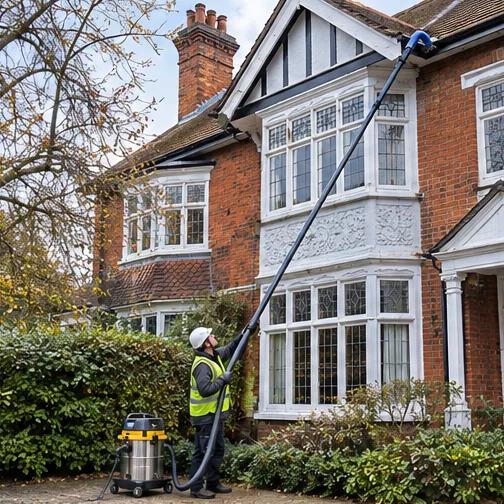
Illustrative photograph.
Relate the symptom to a roof level
| First visible water | Reachable check | Information to provide |
|---|---|---|
| Below a mansard or gable | Accessible gutter edge and outlet | Which roof feature is nearest |
| On a lower roof beneath the main frontage | Lower run and any visible discharge from above | Which level wets first |
| At a seam beside an entrance | Visible connection and opening it serves | Entrance and height of the seam |
Identify the roof level rather than the nearest entrance alone
Westminster’s conservation area audit describes mansion blocks in Knightsbridge Green with roof forms that include mansards, gables and turrets. It also identifies terraces and squares elsewhere in Knightsbridge. The building type can help describe the property, but we need the location of the specific run. Tell us whether the water appears near the top of a visible gable, below a roof projection or at a pipe farther down. Include the nearest window or corner and whether you can see the channel. That helps us relate the report to the gutter that serves that part of the roof.
Where the roofline steps in and out, a photograph from the street can show the relationship between levels. A lower roof may collect water from above, or it may drain independently through its own outlet. If someone saw the spill from an upper room, ask which elevation the window faces and which edge appeared to overflow. If the report concerns a commercial entrance beneath the roof, tell us the entrance name and the side where the water first appears. A picture of the wet paving alone may not show which gutter feeds it.
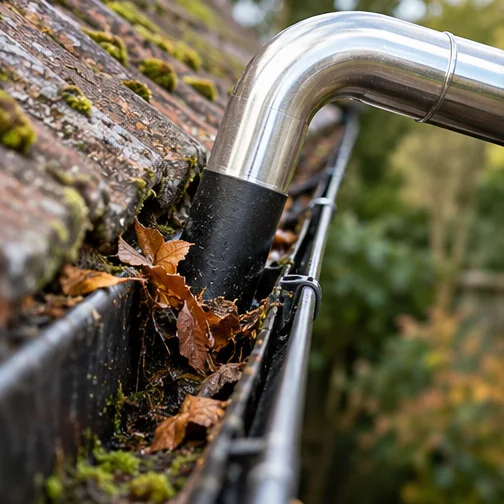
Clear the accessible gutter and check where water enters the pipe
We confirm the included lengths and identify the accessible outlet where each run empties. On suitable gutters we use a vacuum and reach poles to remove loose and compacted debris. We work along the reachable length and look at corners and changes in direction, where material can be held close to the outlet. If there is a separate lower channel, we distinguish its opening from the one that serves the higher run. Where the outlet can be reached, we clear the obstruction we find at its opening. If the pipe goes out of sight, we explain the point beyond which the check could not be made.
A camera view can help where the gutter sits behind a roof feature. Ask about it before booking and identify the location you want to see. The view depends on the available position and reach. It may show an obstruction or standing water in an accessible part of the channel, but it will not show the route inside the building. If the water still appears to back up after the reachable opening has been cleared, we discuss which part may need a separate assessment. See our gutter cleaning service for more on how the equipment is used and what affects the accessible checks.
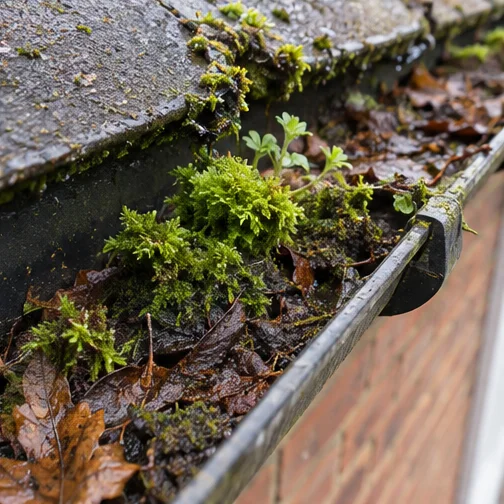
Explain the approach beneath the feature that hides the run
The roof may be set back while a canopy or bay projects over the ground below it. Tell us where there is space to set up and what lies between that position and the channel. We consider the angle to the gutter as well as its height. A route through a courtyard may give access to the rear but leave the upper frontage out of reach. For a home or block of flats, give us the gate or door used to get there. For a managed premises, give us the name of the person who can show us the relevant working area.
If the front and rear have different access contacts, let us know who can arrange each. Tell us whether a service area is shared, or whether a door below the gutter needs to stay open during the visit. We can discuss which lengths can be reached from the agreed positions. If an independent roof below the main run is also affected, describe the approach to it separately. A working position below the lower gutter does not establish that the higher channel can be reached. We explain what can be included before agreeing the work.
- Show where the roof changes level or projects.
- Distinguish the upper outlet from the lower roof’s own pipe.
- Give the entrance below the gutter and the equipment route.
- Identify the person responsible for follow-up.
Assess a visible leak before discussing another type of work
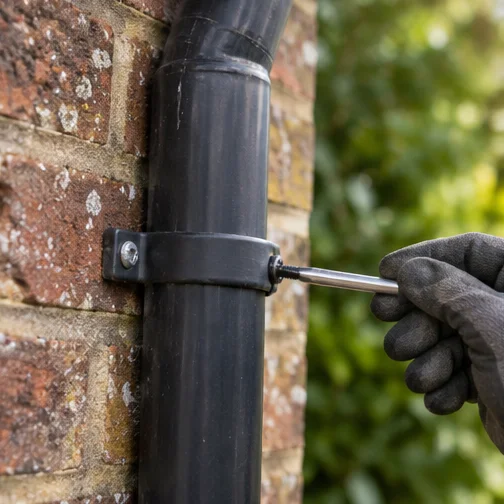
If a seam still drips or a support appears to have moved, we can discuss guttering repairs where the condition is visible. A failed length may need replacement if repair is not suitable. We consider how it joins the neighbouring gutter and outlet, which can matter where the roof form changes. A supported channel whose surface has failed can be assessed for lining after its condition and outlet are understood. We identify the relevant part so any work beyond the clearance can be agreed separately.
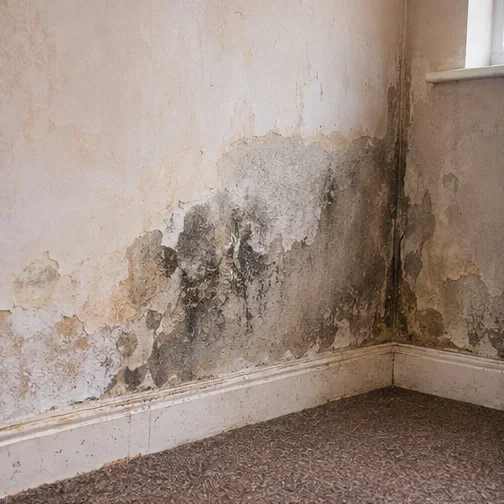
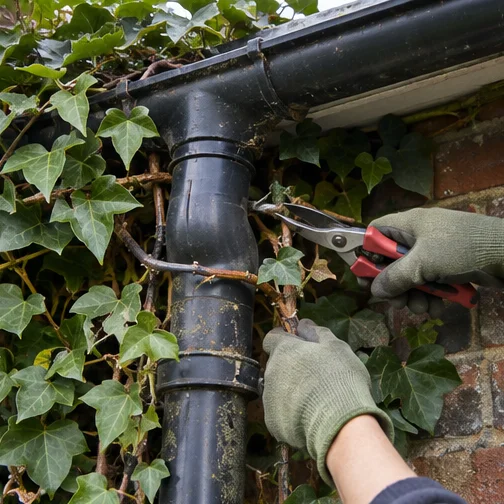
Tell us if ivy hides the pipe or prevents a view of a fitting at the rear. We can discuss cutting back the relevant growth where there is access. If rainwater has already reached an interior wall or finish, give us the room, surface and timing of the first sign. We can discuss water damage repair separately from clearing the external gutter. A mark inside a room can be useful information even where it is not yet clear which outlet serves the roof above it.
Services for the building manager
Guttering repairs
We look at the accessible seam or support that remains a concern after clearance.
Gutter cleaning
We agree which reachable levels are included and check each accessible outlet.
Water damage repair
For moisture inside the property, give us the affected room, surface and timing of the report.
Gutter replacement
We consider how a replacement length meets the existing gutter where the roof form changes.
Gutter lining
We assess a supported concealed channel and its outlet before discussing lining.
Ivy removal
We can discuss cutting back growth obscuring a pipe or fixing at the rear.
Information to keep with the maintenance record
Provide the working approach
| Position | Detail to confirm | What it helps assess |
|---|---|---|
| Front below a projecting roof | Ground and distance to the upper channel | Angle and available reach |
| Rear courtyard | Entrance and who can agree access | Approach to the rear run |
| Separate lower roof | Route below that length and nearest pipe | Whether it can be included independently |
Give an account of each roof level reached
We explain which lengths were cleared, which accessible openings were checked and whether a visible defect remains. If the building team uses a roof reference or a name for the courtyard, tell us in advance so we can use it when describing the findings. We say which section was outside reach and what access may need to be discussed. If the upper and lower runs were both in the enquiry, we distinguish them so the person organising follow-up knows which one is involved.
For a further appointment, tell us if the roof, courtyard or entrance arrangement has changed. If the problem now appears beneath a different part of the mansard or gable, give us the new position. An earlier account is useful when it identifies the run, not just the address. If someone has since worked on a joint or pipe, tell us which one. We can then discuss whether the visible symptom needs another clearance or a separate assessment of that fitting.
Questions about Knightsbridge gutter visits
Can you see a gutter behind a mansard from the ground?
Sometimes a camera can give a view from a suitable position. Tell us which roof feature hides the channel and where there is ground below it.
Can you include both an upper and lower roof?
Identify the two lengths and the approach to each. We assess what is reachable and agree the parts that can be included.
What if our building has several entrances?
Give the address and the name or number of the entrance below the gutter. Tell us which route the equipment should use if that is different.
Does a wet lower roof mean its own gutter is blocked?
It may have a restriction, but water can also reach it from above. Say which level becomes wet first.
Who should get the account if the concierge arranges access?
Give us the contact responsible for follow-up as well as the person who opens the route. We can use the building’s own roof reference in the findings.
What if the accessible gutter is clear but the pipe still backs up?
We describe the point we reached and whether the remaining route needs further assessment. A restriction beyond the reachable opening is separate from debris in the gutter.
Coverage and bookings
See the areas we cover. For nearby enquiries, see South Kensington and Belgravia.