
Gutter Cleaning Mile End
We clear reachable gutters and check outlets in Mile End. If you are reporting a spill from a tall terrace, show the roofline above the affected entrance and the ground below it. Tell us if there are basement steps, railings or a lower roof in the way. We can discuss which lengths can be included and where the equipment can be positioned.
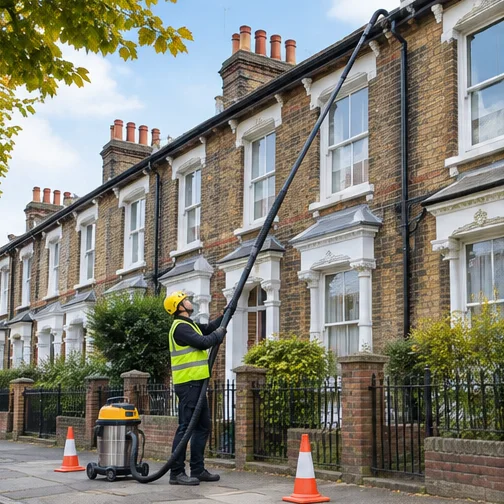
Illustrative photograph.
Describe the individual frontage
The council appraisal of Tredegar Square describes terraces with basements and buildings of different periods in the surrounding conservation area. That gives context for the street, but we plan from the individual address. Tell us if the front has a separate lower entrance and where the nearest level ground sits. A photo including both the roof edge and the path helps show the working distance.
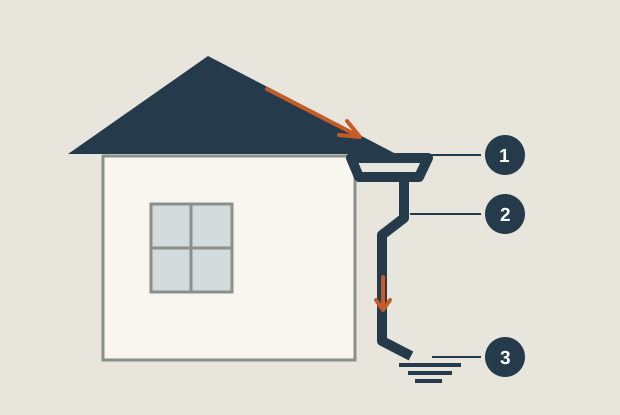
If the gutter is behind a roof edge, identify the closest visible downpipe and where the first water appears. A stain above the lower door may not be directly below the outlet that serves the gutter. Tell us if the water runs along the wall before it reaches the steps or falls directly from the channel. We can use those details to decide where to look and which run to include.
Agree an approach to the taller run
When the upper gutter sits well above an area with steps or railings, we check whether the working position can be set farther away without losing reach. Tell us where there is firm ground and how far it is from the wall. If an upper channel sits over a projection, show that from the side. The distance past a bay or canopy matters as well as the height.
Where the lower entrance belongs to another occupier, tell us who controls the gate and which routes must remain available. A key for the front door may not open the paved area beside the steps. For a rear run, explain whether there is a side passage or whether access is through the house. We agree each included length according to the area from which it can actually be approached.
- Show the gutter and available level ground in one view.
- Identify any separate bay or rear return.
- Tell us who controls the entrance below the run.
- Mention a previous visit that reached only one end.
Clear the accessible length and check the opening
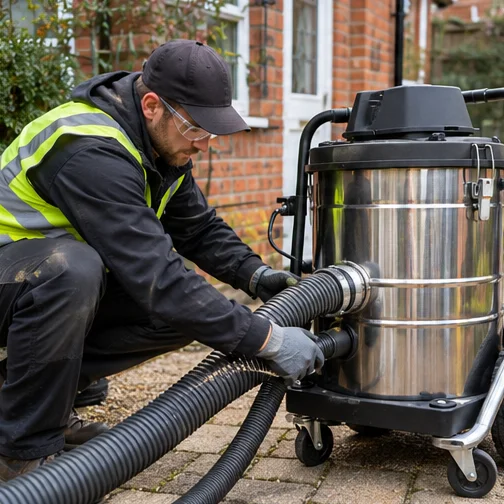
We use reach poles and a gutter vacuum where they are suitable for the roofline and working position. We remove leaves, moss and compacted material along the agreed channel and pay attention to changes in direction and openings into downpipes. Where a stretch can only be reached from one position, we describe what is included and whether another area would be needed to inspect the far end.
At a reachable opening we remove material we can access. If water seems to back up below that point, we explain which visible part was checked and whether the pipe needs separate investigation. Ask about a camera check if a particular joint or length is difficult to see. We consider what angle is available and whether it would give a useful view of the gutter.
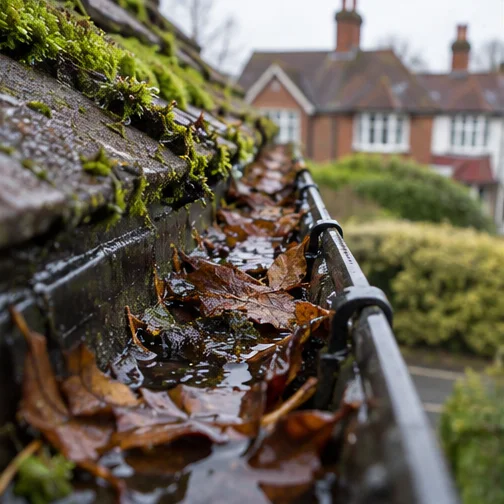
Relate the overflow to the frontage
| What you see | Detail to show | What we check |
|---|---|---|
| Water falls beyond the bay | Main gutter and nearest visible pipe | Accessible run and outlet |
| Wet wall beside a lower entrance | Where the water first appears higher up | Visible joint or edge |
| Overflow above a return | Which way the gutter turns | Reachable opening on the agreed length |
Discuss visible defects around an upper seam
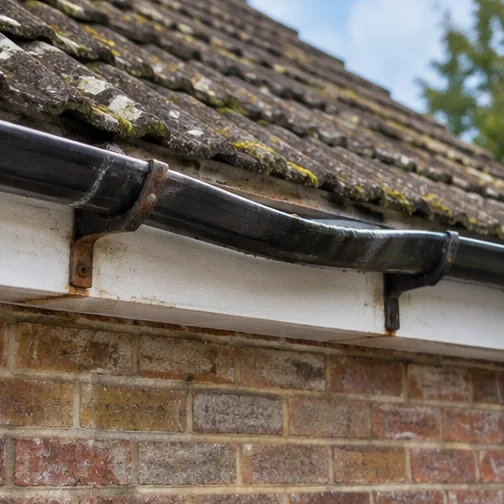
If an accessible seam appears to leak once debris is cleared, we can look at repairing the affected fitting. If several sections have deteriorated, replacement of the damaged length may be more appropriate. We discuss how that length meets the outlet or adjoining gutter before agreeing work. A sound concealed channel with a failing inner surface may be considered for lining after inspecting the support and opening.
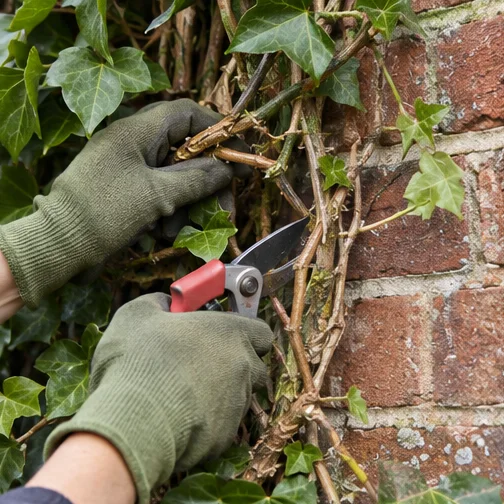
If ivy covers a visible fitting, tell us where the growth starts and what needs cutting back. We can discuss removal separately when it affects access. If water has reached an inside wall or the area near a lower entrance, ask about assessment of the affected surface separately from clearing the gutter. Our gutter cleaning service sets out what we normally include and how we report visible issues.
Work we can discuss after clearance
Gutter cleaning
Check the accessible terrace run and identify where the opening into the pipe can be reached.
Guttering repairs
Look at an accessible seam or bracket above the reported entrance.
Gutter lining
Assess the support and outlet of a suitable concealed channel before discussing lining.
Gutter replacement
Discuss which failed lengths would need renewing and how they meet the adjoining gutter.
Ivy removal
Consider cutting back growth where it prevents access to an external fitting.
Water damage repair
Assess an affected interior surface separately from clearance of the upper run.
Give the report a position that can be found from the ground
After clearance we explain which gutters and openings were reached, what debris was removed and where we found any visible issue. If a length remained out of reach, we identify it using the entrance or elevation and explain what would need discussing before a further visit. Tell us if an owner or manager needs the findings even though another person opened the area.
For a Mile End quote, give us the postcode, approximate roof height and a view of the path, railings or lower roof beneath the run. Say if the water first appears above the main entrance or beside a lower door. If the same gutter was cleaned recently, explain which sections were reached. We can use that to discuss whether the problem is on a length that was missed or whether an accessible fitting now needs a separate look.
If the rear elevation has a different ground level, show it separately rather than giving one height for the whole building. Mention whether a previous visit used the front path or the garden. If a new addition changes the approach, an older photo may no longer show the position that is available for the equipment.
Describe how each side can be reached
| Working area | Information to send | What we consider |
|---|---|---|
| Level path beside railings | Distance from path to wall | Reach to the taller gutter |
| Rear ground beyond an extension | Projection and clear space | Working position for the return |
| Shared entrance at a lower level | Gate contact and times it stays available | Whether another approach is needed |
Before we assess the roof edge
If there is a change in the roofline near the affected position, include the front and side in a single photograph if possible. That can show whether the pipe serves the same run or a neighbouring one. Tell us where water first leaves the visible system and what the area below is used for. Those details help us discuss where to work and which accessible opening to check.
When a frontage has a lower entrance as well as a raised front door, the visible downpipe may pass close to both. Tell us where it crosses the railing line and whether it ends beside the steps or disappears into the paving. If someone reported the leak from inside, ask which entrance they use and whether they can identify the window above it. We can then relate that report to the correct section and discuss where the equipment would need to stand.
Mile End questions about taller runs
Can you work above a basement entrance?
Tell us where the steps and railings sit. We check whether a suitable position is available and discuss which lengths can be reached.
Do you need the height measured exactly?
An approximate number of storeys and a picture of the whole elevation are useful. Tell us if the ground changes level beside the gutter.
Can a camera show the corner above the railings?
Ask about the view you need. We can discuss what the roof edge and working position allow us to inspect.
What if the rear needs a different route?
Tell us who can open it and what is on the ground below the gutter. We agree front and rear access separately.
Is water at the lower door always from the main gutter?
No. Show the nearest pipe and where water appears first. We can check the accessible system and describe which visible part might need further work.
Can you tell us which end was beyond reach?
Yes. We identify the relevant entrance or elevation in the findings and explain where another working position would need considering.
Coverage and bookings
See the areas we cover. For nearby enquiries, see Bethnal Green and Bow.