
Gutter Cleaning Whitton
We clear accessible gutters in Whitton. If the roof edge continues past the boundary between two homes, tell us which length you are arranging and where the nearest downpipe sits. We check the reachable opening on the agreed run and explain if another section needs separate access. A picture of the whole roof edge is useful when the shared line is difficult to follow from below.
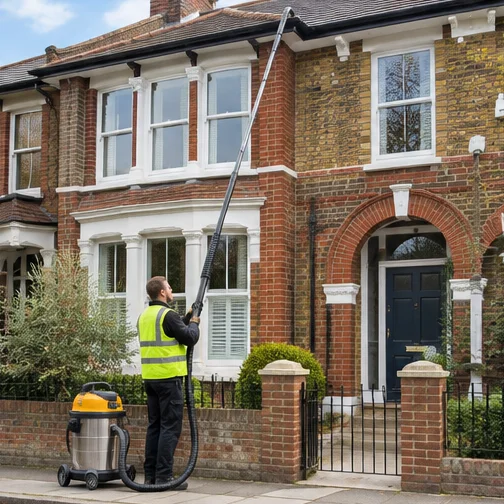
Illustrative photograph.
Find out whether the run serves both homes
A pair of houses can have two outlets and a break between the gutters, or it can have a continuous length draining towards one side. The appearance of the roof alone does not establish which arrangement is present. Look from the ground and tell us what you can see at the boundary. If there is a fitting or a change in profile at that point, include it in the picture. We use the available view to agree the relevant length.
The location where water falls may be some distance from the outlet. If the channel slopes towards the adjoining home, water may be held behind debris farther along the run. If it leaks at a single seam close to the boundary, the fitting could need attention even if the outlet is clear. Tell us whether the water spills over the edge or drips from underneath. We can then discuss what can be inspected without assuming that the adjoining roof needs work.
Ask whoever arranged previous clearance what was included. If only one half of the frontage was cleared, the visit may not have covered the outlet you are concerned about. Tell us what happened afterwards and whether the overflow returned at the same place. If the run is shared, identify the contact who can discuss access to the other part if that becomes necessary.
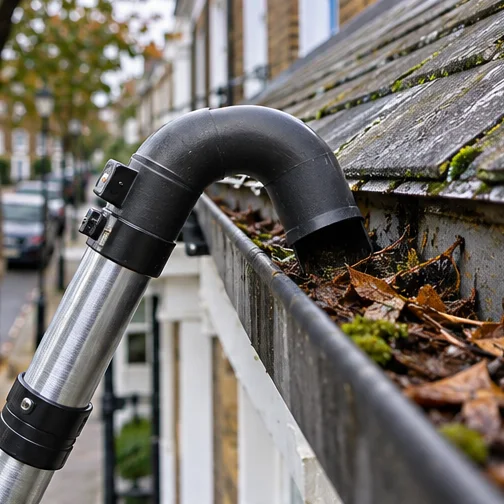
Identify the job without making assumptions about the neighbour
When contacting us, say whether the gutters have independent pipes and where those pipes are visible. If you cannot tell, send a picture that shows the area either side of the boundary and the gutter above it. If a previous repair changed one part of the run, point out where. That helps us distinguish a change of profile from a defect that appeared later.
If more than one occupier will be affected by the access, tell us who can confirm the arrangements before we arrive. A shared gate may be open at certain times and locked at others. Give us the details of the person who controls it and the name of whoever should receive any findings. We explain whether the booking covers just your length, a reachable outlet or a further part that needs a separate discussion.
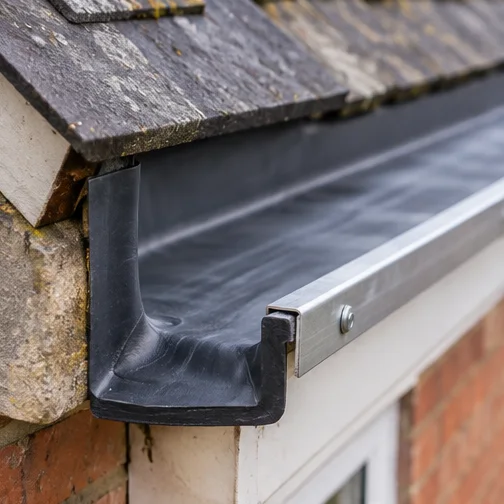
Agree the position from which we can work
Show us which ground belongs to the property and where a dividing wall, hedge or fence interrupts the approach. A gutter might be visible from the other side of the boundary without being reachable from yours. We look for a suitable place for the pole and vacuum within the area available. Tell us if the ground is stepped, if there is a porch below the gutter or if equipment has to pass through a narrow gate.
A driveway may give a useful position for the front run, while a back or side gutter may need separate access. Describe the route to each side and tell us who can open the relevant gate. If a neighbour controls a shared passage, explain what has been arranged rather than assuming it is available. We can discuss a visit for one reachable side if access to another remains uncertain.
For an enquiry on behalf of a tenant, let us know who will be at the address and who can discuss any further work. The person who reports water by a window may be different from the owner who approves a repair. Give us a reliable reference for the affected part of the roof so that we can describe it to both people.
- Show the boundary and nearest outlet in one view.
- Say whether the two homes have separate downpipes.
- Identify which gate or driveway we may use.
- Describe the lengths included on the previous visit.
Discuss access to the relevant side
| Approach | What to confirm | Why we need it |
|---|---|---|
| Driveway beside one home | Position of the boundary and clear ground | Establishes the working area available |
| Shared passage | Keyholder and whether the route stays open | Determines access to a side or rear run |
| Dividing hedge under the gutter | Space available away from the hedge | Helps identify an angle to reach the channel |
Clear the included run up to its reachable outlet
Where the working position and reach suit the equipment, we use a gutter vacuum with reach poles to collect leaves, moss and compacted debris. We work along the agreed length, including accessible ends and corners. If the channel continues over the boundary, we identify what is in the booking and which parts are outside it. Where we can reach the opening into the downpipe, we check and clear what is accessible there.
A camera can help us look into a section screened by the roof edge, depending on access and angle. Ask beforehand if you want a view at the boundary or near a particular outlet. The view may show the accessible channel without showing the full pipe beyond the opening. If the source of a restriction is not visible, we explain which point we reached and what may need a separate assessment.
After clearance, we tell you which lengths and openings were checked. If the outlet is outside the accessible ground, we describe that limitation rather than reporting the entire connection as clear. Our gutter cleaning service explains how we agree the reachable work. If a visible fault remains, we discuss it independently of the debris we removed.
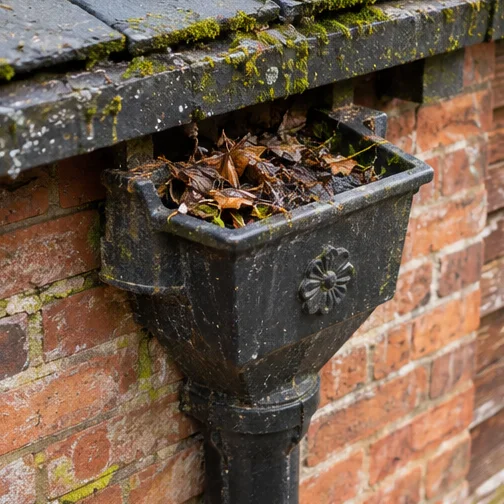
Separate work at the premises
Gutter cleaning
We agree what can be reached on your side of the roofline.
Ivy removal
We consider trimming growth that blocks the view of an outlet or shared passage.
Guttering repairs
We can discuss a persistent leak at the boundary fitting.
Water damage repair
Tell us which finish indoors has been affected and who can show it to us.
Gutter replacement
We assess how a renewed length would meet the retained gutter.
Gutter lining
We inspect supported concealed channels before discussing lining at a shared point.
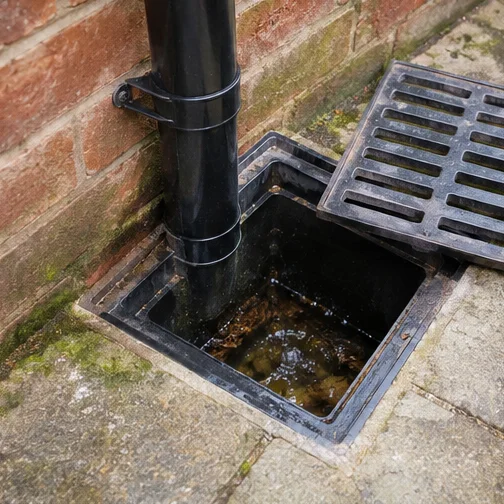
Report overflow on a connected frontage
| What you saw | Reachable check | Useful detail |
|---|---|---|
| Water spills close to the dividing point | Accessible channel and visible connection at the boundary | Direction towards the nearest outlet |
| Drip comes from a seam above one window | Visible fitting and nearby debris | Whether it begins in a light shower |
| Overflow returns after one side was cleared | Length included and reachable opening | What the earlier visit covered |
Deal with damage at the joining point
When a seam still drips after the channel has been cleared, we can discuss repairing the visible fitting. If there is a loose support, we describe its position and which length it affects. We can assess renewing the affected guttering when a longer section has failed, including how it would connect to any part that stays in place. We need to know who is responsible for each part before agreeing work at a shared point.
A supported concealed gutter may be suitable for lining if the surface and outlet can be inspected. If growth has covered a pipe clip or obstructed the route beside the boundary, we can consider cutting the ivy back as separate work. If water has entered the property, tell us which finish has been affected and whether the source is still active. Assessing the damage inside is a different enquiry from clearing the outside channel.
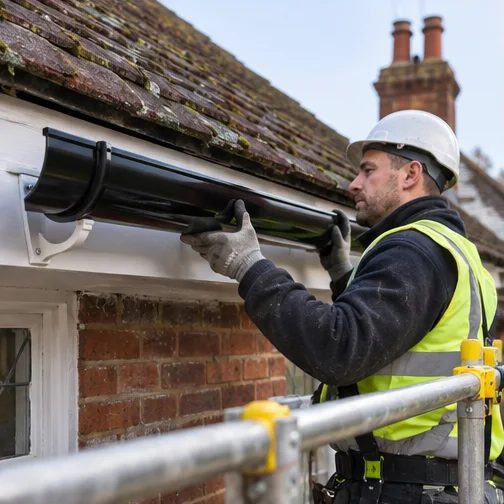
What helps when several people report the leak
Coverage and bookings
See the areas we cover. For nearby enquiries, see Feltham and Twickenham.
Whitton booking questions
Can you clear only my side of a continuous run?
Tell us where your section ends and where the outlet sits. We can discuss what can be reached from your side.
What if the only visible pipe is beside the neighbour’s door?
Send a wide view and explain where water spills. We can discuss which sections connect and whether another contact is needed.
Can I report a drip without knowing who owns the fitting?
Yes. Identify the position and tell us who can confirm the work. We explain what we can see before discussing additional work.
Should I include a separate rear run?
Tell us if you want it included and how it can be reached. It may have its own outlet and access.
Can a camera show the join at the boundary?
That depends on the position and shape of the channel. Ask about the view when agreeing the visit.
Do I need to make the neighbour available for every visit?
Tell us what access you have. We can agree work within the area available and explain if more access is needed.