
Gutter Cleaning Southall
If a gutter over a Southall shop or home discharges into a pipe partly hidden by a sign or wall covering, tell us where the pipe comes into view. The place where you see water may be some distance from the roof outlet. Glen’s clears accessible gutters and checks reachable downpipe openings. Show the entire wall and the nearest entrance so we can locate the visible fittings and discuss access.
Send the full postcode and any name or number used to identify the entrance. If several units share an address, give the one affected and the one we should use. A picture of the pipe alone may make it hard to recognise the relevant part of the building. Add a wider view and mark the highest point where you see fresh water.
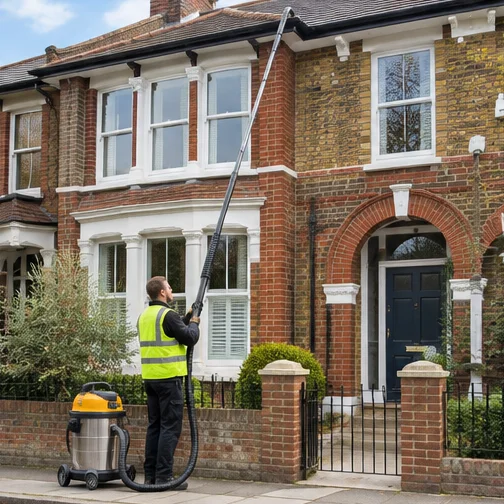
Illustrative photograph.
Use two angles to locate the outlet
Take a photograph from directly in front and another from the side if you can do so safely. A sign, fascia or projecting canopy may block the view from one direction. Include the gutter ends and any visible branch above the obstruction. If the pipe becomes visible again further down, show how the two exposed portions line up. Tell us which part of the route you can see and which you are unsure about.
During rain, note whether water comes over the gutter or appears along the side of the obstruction. It can follow the top of a sign before falling from one corner. If you record it from inside or under shelter, include the window or doorway nearest the drip. We can match the recording to a wide photograph and discuss the relevant lengths for gutter cleaning.
Relate a new wet mark to the visible water route
For an indoor stain, record whether it appears at the top of a frame, beside an opening or at floor level. Take a wide exterior photograph showing the matching position. If water crosses the threshold, include any step or gully close to the door. If the mark appears above a sign, show the gutter and the pipe or roof edge above it. Give the dates of fresh wetting and note what the rain was doing.
For a water damage repair enquiry, include records of earlier gutter clearance or work to the frontage. Tell us if a sign, door or canopy was changed before the symptom appeared. Keep an account of which openings were reachable. If another occupier reports a leak later, use the same building references to determine whether they are describing the same fitting or a different part of the wall.

Find a working position that leaves the entrance usable
Tell us who uses the doorway and when. A sign or shutter may occupy part of the entrance recess, and a delivery may need the same space below the gutter. Include any steps, rails and fixed equipment in a photograph of the approach. If there is a lower roof over the entrance, show its depth from the side. The clear pavement or yard further out may have a different view of the fittings.
For a rear approach, give the entrance name, keyholder and route to the wall. If another occupier uses the area for deliveries or storing bins, confirm what space can be made available. At a house, tell us whether a side gate or drive can be used. If the gutter is above a bay or porch, send the working space at both ends. We can assess the approach to each roof edge once these positions are clear.
- Photograph the roof outlet from two directions
- Show the usable space beside the entrance
- Trace the pipe above and below the obstruction
- Match fresh indoor wetting to the outside wall
Observations around a covered pipe
| What you see | What to record |
|---|---|
| Water comes off one corner of a sign | Where it first reaches the sign and what lies above |
| A pipe drips below the covering | The lowest visible joint and any wet surface above it |
| A gully rises beside the entrance | Which pipes feed it and when the water first appears |
| Damp develops beside an indoor frame | Its height, timing and corresponding exterior point |
Follow the pipe past the visible obstruction
Start at the roof outlet and photograph the pipe down to the point where it disappears. Then show the lowest visible connection and where it discharges. If you can see a second pipe beside it, include the roof edge that appears to feed each one. A lower canopy can have its own pipe even when the upper downpipe follows the same wall. A wide view can help establish the distinction.
If water rises around a gully, record whether it starts there before a spill higher up. Show any nearby paving that drains towards it. We check reachable openings within the agreed clearance. An enclosed connection behind a sign or wall covering, or an underground drain, may need separate assessment. Tell us whether the sign or covering is fixed and who can arrange access if the concealed route needs investigation.
Separate work at the premises
Gutter cleaning
Clear agreed reachable roof and canopy gutters on the marked side of the property.
Ivy removal
Check where plant growth behind a covering obscures a rainwater fitting.
Guttering repairs
Assess a reachable shifted socket, loose support or open seam.
Water damage repair
Compare fresh wetting near the entrance with the visible pipe and gutter routes.
Gutter replacement
Specify replacement sections around connections that pass behind a sign or canopy.
Gutter lining
Assess the channel and visible discharge before discussing lining near the frontage.
Information for a Southall enquiry
| Detail | What to include |
|---|---|
| Frontage | Street number, unit or entrance and a wide view of the roof edge |
| Obscured pipe | Exposed sections above and below the sign, canopy or cladding |
| Working area | Doors, steps, fixed equipment and when the approach can be available |
| Discharge | Visible outlet, gully and any surface water reaching the same point |
Describe a visible fault with its adjoining fittings
If a socket has moved or a gutter union appears open, show the nearest support and the length on each side. After clearing accessible debris, we can describe visible defects and discuss guttering repairs separately. Give the location by a recognisable door, shop sign or window. If the fault sits above a shared entrance, tell us who can approve further access and when the area can be available.
For gutter replacement, show the existing outlet and any adjoining lengths that would stay in service. If the pipe passes behind a sign or new cladding is planned, say where the new fittings must connect. The position of a sign can affect both the installation and later access to the pipe. Keep the earlier scope available so a quote can distinguish the lengths cleared from any connection that was out of view.

What helps when several people report the leak
Where a sign is fitted away from the wall, an end view may show a short pipe between the back of the sign and the brickwork. Take the picture from ground level without moving the fitting. If the pipe continues beneath the sign, show the next visible joint and give the doorway or window nearest to it.
Coverage and bookings
See the areas we cover. For nearby enquiries, see Greenford.
Southall gutter cleaning FAQs
Can you check a pipe behind a sign?
We can assess the reachable openings and visible sections. Show where it goes out of view. A concealed fitting may need separate access or investigation.
Can you work around a shared entrance?
Tell us who uses the entrance and when it has to remain open. Send a picture of the area below the gutter. We can discuss what space is needed.
Can a shop and upper flat share a gutter booking?
Yes, where the relevant roof edges and approaches can be agreed. Identify who manages the gutter and who can open the working areas. Mark the affected entrance in the photographs.
Can you include a house gutter with no sign or canopy?
Yes. Send the postcode, roof edge and available approach. If the rear is included, tell us whether access is through a gate, passage or the house.
What if a gully near the front rises during rain?
Show its position, the incoming pipes and where water starts to appear. We can discuss reachable roof-level openings. A restriction below ground may need separate assessment.
Should I wait until the stain gets wet again to contact you?
You can send a photograph while it is dry. Include its position and the last date you noticed fresh wetting. If you can later record the first drops safely, send that too.