
Gutter Cleaning White City
We clear reachable gutter channels in White City. When enquiring for a property on a site with several buildings, give us the block, entrance or unit and the exact roof edge you want checked. Tell us who can show us the approach. We use those details to agree the accessible lengths and downpipe openings before the visit.
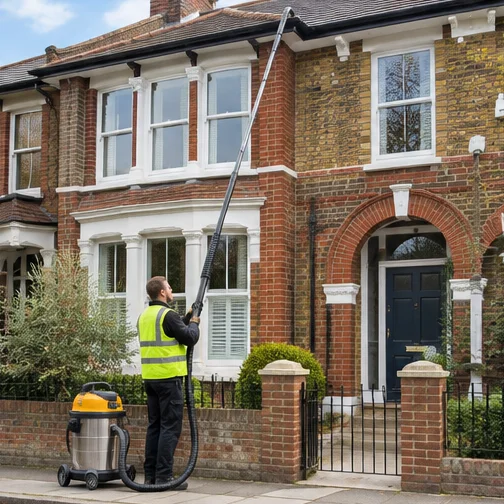
Illustrative photograph.
Identify the block and its rainwater fittings
Hammersmith & Fulham’s White City Public Realm Strategy material describes local places and routes around Wood Lane and White City. A site can have more than one entrance or an address used by several units. Give us the name or number that appears on the building, and say which side faces the reported problem. A postcode alone may leave more than one possible roof edge.
If water falls near a shared path, describe the position relative to the nearest door and show the gutter as well as the ground. A route that is obvious to someone who uses it every day may be hard to identify from a close-up of the wet wall. If a lower roof sits in front of the main wall, show whether the water comes from its gutter or falls onto it from above.
For a home with its own entrance, we still need to know what drains separately. Identify any porch, garage or rear addition you want included in addition to the main gutter. A shorter length may empty into a different pipe. Mention when the issue first appears in rain and whether it is visible as an overflow over the edge or a drip from one fitting. We can discuss the relevant runs without assuming every gutter at the address needs clearing.
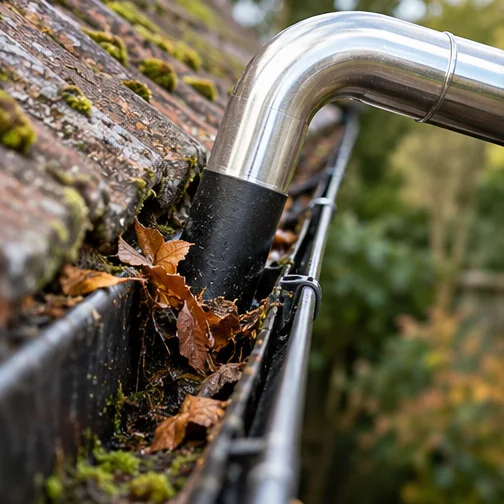
Report back in terms the site can act on
Give us the address and the name or number used for the entrance. If the instruction came from a resident or employee, send what they saw and indicate where that position is on a wide photo. We can then describe the accessible gutter, the opening we checked and anything that remains without relying on a reference such as “side wall” alone.
For a managed property, tell us who should receive the findings and who can agree a further visit. One person may be able to open the gate while another approves repairs. If a different access position is needed later, we can identify the part still to be reached and discuss what has changed before booking it.
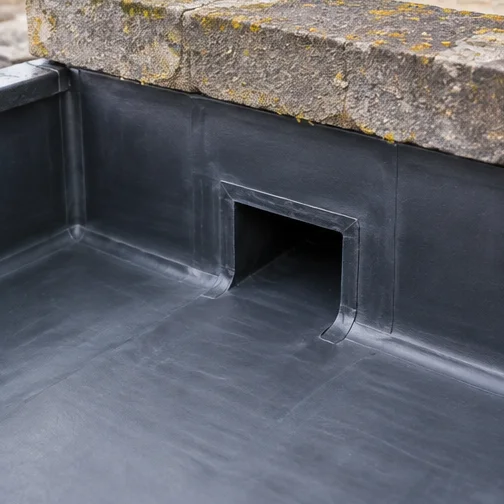
Confirm the approach with someone who uses the site
At a managed block, tell us whether we should arrive at a reception, gate or particular entrance. Give us the details of the person who can show us from there to the working ground. A maintenance contact may know the roofline but not control a door or gate that is normally locked. Let us know who can open each route if the two elevations are approached separately.
If the gutter faces shared paving, identify where people need to pass during the visit. A clear view up to the eaves does not necessarily mean the space is available to work in. Tell us about steps, low projections, bicycle storage or other features that affect moving the vacuum or raising the pole. A wider view can show where there is usable ground rather than just what stands directly beneath the leak.
For a shop or office, ask the person on site how contractors normally reach the rear. If deliveries use the same approach, tell us when the ground can be made available. For a home reached through a front path, describe where a side gate or separate garden entrance leads. We can discuss the accessible work without including an elevation that still requires permission or a different approach.
- Give the block, entrance or unit as well as the postcode.
- Show which elevation faces the reported spill.
- Name the person who can confirm the access route.
- Tell us who should receive the findings for the site.
Confirm which route gives working access
| Access route | What we need | What it helps establish |
|---|---|---|
| Gate used by site staff | Person who can open it and meeting point | How equipment reaches the wall |
| Path used by several occupiers | Area that needs to stay clear | Whether a working position is available |
| Separate entrance for the rear | Route from the entrance and any steps | Which lengths can be approached from there |
Clear accessible material and identify the checks completed
Where the reach and working position suit the equipment, we use a gutter vacuum and reach poles to lift accessible leaves, moss and compacted material. We work along the agreed lengths and check the openings into the downpipes where they can be reached. A short gutter above an entrance can be considered separately from an upper run and may have different access. We do not assume the two feed the same opening.
Ask about a camera check if you need a view of a particular section. Where the angle allows, it can show part of the channel or the reachable inlet. A downpipe may run behind an enclosure or through part of the building. If the blockage appears to be beyond our view, we explain the limit of the check and discuss what requires separate attention. See our gutter cleaning service for how we agree the accessible work.
After clearance, we identify the lengths reached and the openings checked. If the working position did not give access to a particular corner, we describe which part remains. If the enquiry covered one block, we do not treat a neighbouring building as included. Tell us how the person who receives the findings refers to the relevant elevation so we can use a reference they recognise.
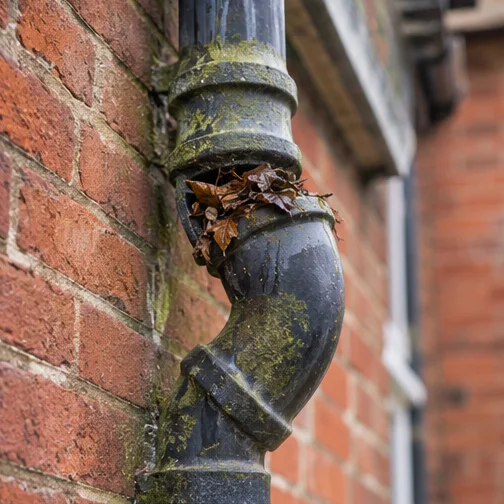
Separate work at the premises
Gutter cleaning
We agree which gutters are reachable for the specified block, unit or home.
Ivy removal
We consider cutting back growth where it obstructs the view of a fitting or path.
Guttering repairs
A visible seam or support may need repair after the clearance.
Water damage repair
Tell us which unit or room is affected and whether water is still entering.
Gutter replacement
We check how a replacement would meet the retained runs at the property.
Gutter lining
We assess a supported concealed channel and outlet before discussing a liner.
Identify the gutter within a multi-building address
| Reported position | What we can check | Detail to give us |
|---|---|---|
| Water above a communal doorway | Reachable channel and nearby opening | Block and entrance number |
| Overflow on a side facing shared paving | Accessible run and visible outlet | Marked photo of the wall and path |
| Water falls on a lower canopy | Canopy gutter or upper run as agreed | View including both roof edges |
Assess a remaining fault without extending the booking by default
A visible seam, bracket or joint can still need work after debris is removed. We can discuss repairing the affected gutter fitting separately. Where several lengths have failed, we can assess renewing the relevant part of the guttering and how it connects to the sections that remain. Before discussing extra work, we need to know which building and length the manager is responsible for.
If a supported concealed channel has a failing surface, we can consider lining once its outlet and condition can be inspected. If ivy hides a pipe or restricts the path beside the wall, tell us where it is affecting access. We can discuss cutting it back separately. If rainwater has already entered a unit, tell us who can show the affected surfaces and whether the source has been identified. Water damage assessment concerns that damage independently of clearance outside.
What helps when several people report the leak
Coverage and bookings
See the areas we cover. For nearby enquiries, see Shepherd’s Bush and North Kensington.
White City booking questions
Is the postcode enough for a site with several blocks?
Please include the block and entrance. A photograph or marked site plan can help identify the affected elevation.
Can you check a separate entrance canopy?
Tell us which canopy and how it drains. We discuss whether it can be reached and agree it separately if appropriate.
What if the manager is off site?
Give us an on-site access contact and tell us who should receive the findings and discuss any extra work.
Does a camera show an enclosed downpipe?
A view can help with an accessible channel or inlet. An enclosed part may need separate assessment beyond that point.
Can you arrange the rear independently of the front?
Yes, where the rear run and its outlet can be approached. Tell us who can confirm access and where the working ground is.
Will you identify an outlet that could not be reached?
Yes. We describe which openings were checked and which remain inaccessible so the site can arrange the next step.